AZEK Building Material Selection Guide: Decking, Trim & Siding Picks
Discover the ultimate AZEK building material selection guide. Compare capped polymer decking, cellular PVC trim, and shingles with 2026 pricing and specs.

The Material Science: Cellular PVC vs. Capped Polymer
When contractors and architects specify AZEK building material, they are generally referring to two distinct product categories manufactured by The AZEK Company: cellular PVC (used for trim, moulding, and shingles) and capped polymer PVC (used for premium decking, now branded under the TimberTech AZEK line). Unlike wood-plastic composites (WPC) that blend wood flour with plastic, AZEK’s core technologies rely on 100% synthetic, closed-cell structures. This eliminates organic material from the equation, rendering the products entirely impervious to moisture absorption, rot, and termite degradation.
Understanding the distinction between these two material profiles is critical for proper specification. Cellular PVC trim features a micro-cellular core that machines, routes, and fastens exactly like clear pine, while capped polymer decking utilizes a dense PVC core wrapped in a high-density Alloy Armour Technology (AAT) cap for extreme UV and scratch resistance.
The AZEK Decking Matrix: Vintage vs. Landmark Collections
For exterior decking, the AZEK portfolio is split into two primary tiers. Both utilize a 100% PVC core (no wood fillers), but they differ in board profiling, cap texture, and dimensional options. Below is a specification matrix to guide your selection based on project scope and budget.
| Collection | Board Widths | Cap Technology | Est. Material Cost (2026) | Best Application |
|---|---|---|---|---|
| Vintage | 3.5", 5.5", 7.25" (Multi-width) | Alloy Armour (Cathedral wood grain) | $9.50 - $12.00 / sq. ft. | High-end custom builds, historic restorations requiring varied plank widths. |
| Landmark | 5.5" (Standard) | Alloy Armour (Reclaimed wood grain) | $8.00 - $10.50 / sq. ft. | Modern residential decks, commercial boardwalks, uniform aesthetic requirements. |
A common critique of early-generation PVC decking was heat retention. Modern TimberTech AZEK boards with Alloy Armour Technology reflect more UV radiation than traditional composite boards. However, if specifying dark colorways (like Dark Hickory or Mahogany) for a south-facing, unshaded deck, expect surface temperatures to reach 120°F–135°F on a 90°F summer day. For barefoot traffic around pools, always specify lighter tones like Sea Salt Gray or Weathered Teak, which can run up to 20°F cooler under direct solar load.
AZEK Trim & Moulding: Sizing, Profiling, and Fastening
AZEK Trim is the industry benchmark for cellular PVC millwork. It is available in standard dimensional lumber sizes (1x4, 1x6, 1x8, etc.) as well as specialized profiles like brickmould, drip cap, and beadboard. Because it contains no wood fibers, it will not wick water from masonry or soil contact, making it the mandatory choice for water tables, fascia boards, and garage door jambs.
The Expansion and Contraction Protocol
The most frequent failure mode in PVC trim installation is buckling or pulled fasteners caused by thermal expansion. PVC expands and contracts at a rate of approximately 1/8 inch per 18 linear feet for every 50°F temperature change. According to best practices outlined by ProTradeCraft, installers must adjust their gapping strategy based on the ambient temperature on the day of installation:
- Install at 80°F or higher: Butt joints tight. Leave minimal gap at end joints.
- Install at 50°F: Leave a 1/8-inch gap at end joints.
- Install at 20°F or below: Leave a 1/4-inch gap at end joints.
Always use shiplap or scarf joints for runs exceeding 18 feet, and secure the board within 2 inches of the joint to restrict movement to a single direction.
The Paint & Primer Protocol: Navigating LRV Limits
While AZEK trim comes in a crisp white finish, it is frequently painted to match modern exterior palettes. You do not need a primer if you are painting it white or a very light color. However, if you are specifying a dark color, you must understand Light Reflectance Value (LRV).
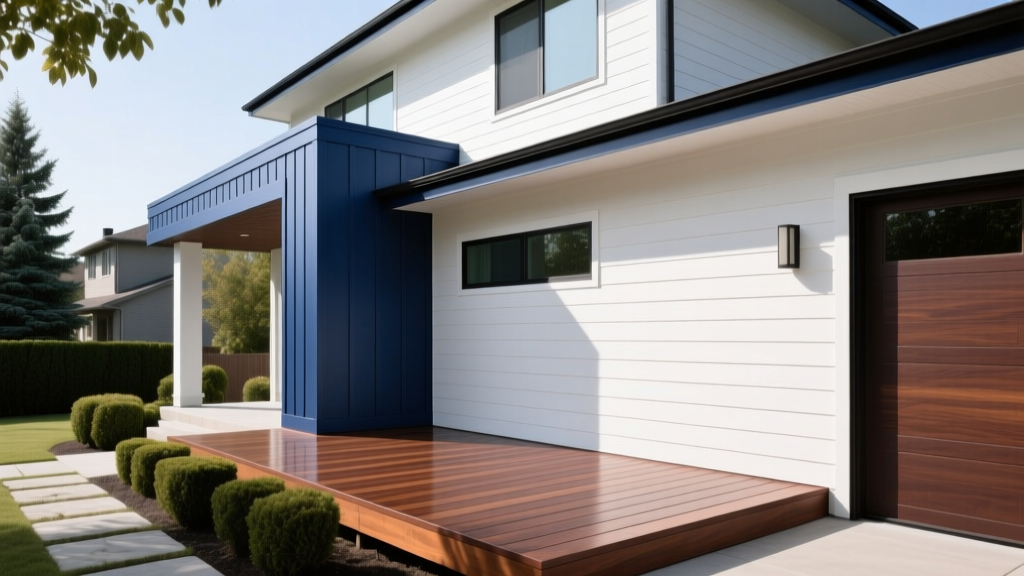
Standard acrylic latex paints absorb solar heat. If you paint cellular PVC a color with an LRV below 56 (e.g., navy blue, charcoal, or black), the board surface can exceed 150°F. Because PVC begins to soften and distort around 155°F, the boards will warp and pull away from the substrate. To safely paint AZEK trim in dark colors, you must use specialized vinyl-safe paint formulations, such as Sherwin-Williams VinylSafe technology or Benjamin Moore Aura Exterior with specific dark-color bases, which reflect infrared heat even in dark pigments.
AZEK Shingles & Siding Accents
For architectural accents, gables, and dormers, AZEK manufactures extruded PVC shingles that replicate the shadow lines of cedar shakes without the maintenance. Available in half-round, Perfection, and Cape Cod profiles, these panels install in 4-foot to 8-foot sections. Unlike real cedar, which requires chemical treatments and periodic staining to prevent gray weathering and moss growth, AZEK shingles maintain their dimensional stability and can be painted or left in their factory-applied finishes. They are particularly advantageous in coastal environments where salt spray rapidly degrades organic wood fibers.
Cost Breakdown & ROI Analysis
Specifying AZEK building material requires a higher initial capital outlay compared to wood or standard composites, but the lifecycle cost often justifies the premium. Below is a comparative analysis of material and estimated professional installation costs per square foot for decking applications.
| Material Type | Material Cost / Sq. Ft. | Install Labor / Sq. Ft. | 25-Year Maintenance Cost | Total 25-Yr Lifecycle Cost |
|---|---|---|---|---|
| Pressure-Treated Pine | $3.50 - $5.00 | $8.00 - $12.00 | $18.00 (Staining/Sealing) | $29.50 - $35.00 |
| Wood-Plastic Composite | $6.00 - $8.50 | $9.00 - $13.00 | $4.00 (Cleaning) | $19.00 - $25.50 |
| AZEK (Capped PVC) | $8.50 - $12.00 | $10.00 - $14.00 | $2.00 (Basic Wash) | $20.50 - $28.00 |
As detailed in comprehensive exterior material reviews by Fine Homebuilding, capped PVC decking routinely outlasts its warranty period with zero structural degradation, effectively achieving cost parity with pressure-treated lumber by year 15 when factoring in labor for annual wood sealing and board replacement.
Common Installation Failures to Avoid
To ensure your AZEK materials perform to their engineered specifications, audit your contractor's installation plan for the following critical errors:
- Using Electroplated Fasteners: PVC traps moisture against the fastener head. Standard zinc-plated screws will rust within 3 years, leaving permanent black streaks down the trim or fascia. Always specify 304 or 316 stainless steel, or use hot-dipped galvanized fasteners.
- Over-driving Cortex Plugs: When using hidden fastening systems like Cortex, driving the screw too deep fractures the cellular PVC core, preventing the color-matched plug from seating flush and creating a visible divot.
- Gluing Without Mechanical Fasteners: While PVC cement (like Christy's Red Hot Clear) works for miter joints, adhesive alone is insufficient for field fastening. PVC must be mechanically pinned to the substrate to counteract thermal bowing.
For complete technical data sheets, fastening schedules, and warranty registration, always refer to the official AZEK Trim Product Specifications portal prior to finalizing your material takeoffs.
Written by
David NakamuraDavid Nakamura is a licensed architect (AIA) and construction technology writer focused on sustainable building methods, mass timber engineering, and high-performance building envelopes. He holds a Master of Architecture from the University of Washington and is a certified Passive House Consultant (CPHC). David spent eight years at the Seattle firm Mithun, where he led the design of three LEED Platinum projects, before founding his own practice specializing in net-zero residential design. He serves on the editorial advisory board of GreenBuilder Magazine and has authored peer-reviewed papers on cross-laminated timber (CLT) connections for the Journal of Structural Engineering. In his spare time, David teaches woodworking at Pratt Fine Arts Center and kayaks the Puget Sound.
More from David Nakamura
View all
Construction Cost
Labor Cost to Build a Deck Per Sq Ft: 2026 Installation Guide
Discover the exact labor cost to build a deck per sq ft in 2026. This installation guide breaks down contractor rates, complexity factors, and hidden fees.
Aug 4, 2026

Construction Cost
How Much Does It Cost to Build a 3 Bedroom House? Financing Guide
Learn exactly how much it costs to build a 3 bedroom house and explore 2026 financing options, construction loan types, and budget frameworks for your build.
Aug 4, 2026

Construction Cost
Cost to Build a Tennis Court: 2026 Guide
How much does it cost to build a tennis court in 2026? Breakdowns for asphalt, concrete, and synthetic surfaces plus fencing and lighting.
Jul 30, 2026