Colosseum Building Materials: Roman Concrete Trends Reshaping 2026
Discover how ancient Colosseum building materials inspire 2026 self-healing concrete and geopolymer trends to slash carbon emissions and boost durability.

The Carbon Crisis and the Colosseum Blueprint
When structural engineers analyze the survival of the Flavian Amphitheatre, they are not just studying ancient architecture; they are reverse-engineering the original colosseum building materials to solve a modern crisis. Ordinary Portland Cement (OPC), the backbone of contemporary construction, is responsible for approximately 8% of global CO2 emissions. Furthermore, modern reinforced concrete structures typically exhibit a functional lifespan of 50 to 100 years before rebar corrosion and micro-cracking compromise their integrity. In stark contrast, the unreinforced marine and monumental structures of the Roman Empire have withstood seismic activity, tidal battering, and chemical degradation for over two millennia.
As the construction industry faces aggressive 2026 decarbonization mandates, material scientists are looking backward to move forward. The chemical composition and mixing techniques used in historical colosseum building materials—specifically opus caementicium—are currently driving a multi-billion-dollar shift toward self-healing concretes, geopolymer binders, and calcined clay blends. This is not mere historical novelty; it is the foundation of next-generation sustainable infrastructure.
Decoding Ancient Colosseum Building Materials for Modern Use
For decades, modern engineers assumed the longevity of Roman structures was simply a result of over-engineering and massive structural mass. Recent metallurgical and chemical analyses have proven that the secret lies in the exact mineralogy and thermodynamics of the mixing process.
The "Hot-Mixing" and Lime Clast Phenomenon
Historically, the small white chunks of lime found in ancient Roman concrete cores were dismissed as evidence of poor quality control or inadequate mixing. However, groundbreaking research published by MIT researchers fundamentally altered this understanding. Through high-resolution mapping and spectroscopy, scientists discovered that these "lime clasts" were the result of intentional "hot-mixing."
Roman builders did not use slaked lime (calcium hydroxide) as previously thought. Instead, they mixed quicklime (calcium oxide) directly with water and volcanic ash. This exothermic reaction generated temperatures exceeding 200°C (392°F), creating a highly reactive, amorphous calcium-aluminum-silicate-hydrate (C-A-S-H) matrix. More importantly, the residual lime clasts act as a built-in healing mechanism. When modern micro-cracks form and water infiltrates the concrete, the water reacts with the lime clasts to precipitate calcium carbonate, effectively sealing the crack from the inside out. In 2026, several specialized admixture companies are commercializing synthetic "clast-equivalents" to replicate this self-healing property in modern high-performance concrete (HPC).
Pozzolanic Ash and Marine Resilience
The second critical component of colosseum building materials was pulvis puteolanus (volcanic ash from the Bay of Naples). When mixed with lime and seawater, this ash triggers a pozzolanic reaction that forms tobermorite and phillipsite—rare aluminum-rich minerals that interlock and grow stronger over time when exposed to saltwater. Modern OPC, conversely, degrades rapidly in marine environments due to the formation of expansive ettringite and thaumasite.
Today, the industry mimics this volcanic ash using Ground Granulated Blast-furnace Slag (GGBS), fly ash, and increasingly, Limestone Calcined Clay Cement (LC3). LC3 mimics the amorphous silica and alumina profile of volcanic ash, providing the exact chemical environment required for long-term marine durability while cutting clinker usage by up to 50%.
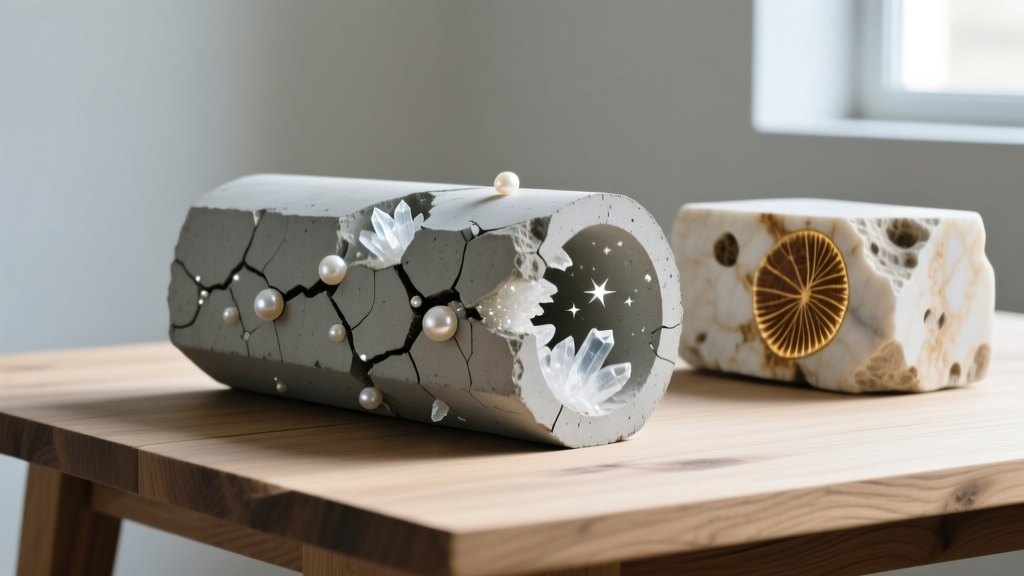
Material Matrix: Modern OPC vs. Roman-Inspired Alternatives
Specifying the right binder requires understanding the trade-offs between traditional OPC and the new wave of historically inspired geopolymers and blended cements. The table below outlines the performance metrics for 2026 commercial offerings.
| Material Type | Embodied Carbon (kg CO2e/ton) | Self-Healing Capability | Marine Sulfate Resistance | Approx. 2026 Cost (USD/ton) |
|---|---|---|---|---|
| OPC (Type I/II) | 850 - 950 | None (Requires external sealants) | Poor to Moderate | $110 - $130 |
| LC3 (Limestone Calcined Clay) | 400 - 500 | Low (Autogenous healing only) | Excellent | $125 - $145 |
| Fly Ash Geopolymer | 150 - 250 | Moderate (Dense matrix limits ingress) | Exceptional | $160 - $190 |
| Hot-Mixed Lime C-A-S-H (Neo-Roman) | 350 - 450 | High (Active lime clast precipitation) | Excellent | $180 - $220 (Specialty) |
2026 Industry Trends: Commercializing "Neo-Roman" Materials
The translation of ancient colosseum building materials into modern supply chains has accelerated rapidly. According to sustainability roadmaps outlined by the Global Cement and Concrete Association, the shift toward alternative binders is no longer a niche experimental phase; it is a core market strategy. Three major trends dominate the 2026 landscape:
- Bio-Mineralization Admixtures: Startups are now packaging bacillus bacteria alongside calcium lactate nutrients in microcapsules. While not strictly "Roman," this biological approach achieves the exact same self-healing calcium carbonate precipitation that Roman lime clasts provided, allowing for zero-maintenance subterranean and marine foundations.
- Alkali-Activated Materials (AAMs):strong> By utilizing alkaline activators (like sodium silicate) to dissolve the silica and alumina in industrial byproducts, manufacturers are creating geopolymer concretes that mimic the C-A-S-H and N-A-S-H gels found in ancient harbor structures. These materials are currently capturing a 14% market share in precast marine segments.
- Calcined Clay Scaling: The bottleneck for LC3 cements has historically been the energy required to calcine low-grade kaolinitic clays. In 2026, new flash-calcination kilns powered by renewable electric grids have dropped the cost of metakaolin, making LC3 a direct, cost-competitive drop-in replacement for OPC in standard commercial slabs.
Specification Guide: Sourcing and Bidding in 2026
For general contractors and structural engineers, specifying these advanced materials requires navigating updated building codes. You cannot simply order "Roman concrete" from a batch plant. Instead, you must specify the modern performance equivalents using established standards.
- Leverage ASTM C595 and C1157: When seeking the pozzolanic durability of volcanic ash, specify blended hydraulic cements under ASTM C595 (specifically Type IP or Type IS) or performance-based ASTM C1157. These standards ensure the supplementary cementitious materials (SCMs) meet rigorous strength and sulfate-resistance criteria.
- Demand Environmental Product Declarations (EPDs): To verify the carbon reduction claims of geopolymer or LC3 suppliers, require Type III EPDs. A genuine Roman-inspired blend should show an embodied carbon footprint below 500 kg CO2e per cubic meter of concrete.
- Adjust Curing Protocols: Pozzolan-heavy and geopolymer mixes react slower in the first 48 hours than pure OPC. Batch plants must be instructed to use internal curing agents (like pre-wetted lightweight aggregates) or specify extended wet-curing periods of 7 to 14 days to prevent plastic shrinkage cracking before the secondary pozzolanic reactions fully engage.
- Factor in Lifecycle ROI: While Neo-Roman self-healing concretes carry a 15% to 25% upfront material premium, they eliminate the need for epoxy crack injection and cathodic protection systems in marine environments. For infrastructure projects with a 75-year design life, the net present value (NPV) of maintenance savings heavily favors the historical mimicry approach.
Project Implementation FAQ
Can self-healing Roman-style concrete replace epoxy coatings on rebar?
In low-to-moderate chloride environments, the autogenous healing provided by lime-clast equivalents and dense C-A-S-H matrices can significantly delay the onset of rebar corrosion, potentially allowing for a reduction in concrete cover depth. However, in direct tidal splash zones, it should be used in conjunction with stainless steel or GFRP rebar, as the healing mechanism cannot repair macro-cracks wider than 0.4mm caused by structural overloading.
Are geopolymer concretes compatible with standard concrete pumps and finishing tools?
Yes, but with strict rheological controls. Geopolymers tend to exhibit higher yield stress and can become "sticky" in the pump lines. Batch plants must utilize specialized polycarboxylate ether (PCE) superplasticizers formulated specifically for high-SLM (slag/fly ash) mixes. Finishing crews must also be warned that geopolymer bleed water behavior differs from OPC; dry-shaking or early troweling can trap water and cause surface delamination.
Why did the Romans use travertine and tuff alongside concrete, and should we mimic this?
The Romans used travertine (a dense limestone) for high-load bearing piers and tuff (a porous volcanic rock) for lightweight vaulting. This is an early example of structural optimization based on material density. In 2026, this translates to using high-density, low-carbon concrete for ground-level columns, while utilizing structural lightweight concrete (SLWC) with expanded clay aggregates for elevated slabs, reducing the overall dead load and seismic mass of the structure while maintaining a unified, low-carbon material palette.
Written by
David NakamuraDavid Nakamura is a licensed architect (AIA) and construction technology writer focused on sustainable building methods, mass timber engineering, and high-performance building envelopes. He holds a Master of Architecture from the University of Washington and is a certified Passive House Consultant (CPHC). David spent eight years at the Seattle firm Mithun, where he led the design of three LEED Platinum projects, before founding his own practice specializing in net-zero residential design. He serves on the editorial advisory board of GreenBuilder Magazine and has authored peer-reviewed papers on cross-laminated timber (CLT) connections for the Journal of Structural Engineering. In his spare time, David teaches woodworking at Pratt Fine Arts Center and kayaks the Puget Sound.
More from David Nakamura
View all
Construction Cost
Labor Cost to Build a Deck Per Sq Ft: 2026 Installation Guide
Discover the exact labor cost to build a deck per sq ft in 2026. This installation guide breaks down contractor rates, complexity factors, and hidden fees.
Aug 4, 2026

Construction Cost
How Much Does It Cost to Build a 3 Bedroom House? Financing Guide
Learn exactly how much it costs to build a 3 bedroom house and explore 2026 financing options, construction loan types, and budget frameworks for your build.
Aug 4, 2026

Construction Cost
Cost to Build a Tennis Court: 2026 Guide
How much does it cost to build a tennis court in 2026? Breakdowns for asphalt, concrete, and synthetic surfaces plus fencing and lighting.
Jul 30, 2026