Kite Building Materials: Specs for High-Altitude Traction
Explore the technical specifications of kite building materials for airborne wind energy, including UHMWPE tethers, carbon spars, and ripstop textiles.

The Engineering Paradigm of Industrial Kite Systems
When engineering high-altitude traction systems and Airborne Wind Energy (AWE) platforms, selecting the correct kite building materials requires navigating a complex matrix of tensile loads, UV degradation, and fatigue resistance. Unlike recreational applications, industrial kites operating at altitudes of 200 to 600 meters endure stratospheric wind shear, continuous high-tension loading, and extreme temperature fluctuations. As the AWE sector scales toward commercial grid integration in 2026, material science has shifted from adapted marine sailcloth to purpose-engineered aerospace composites and structural textiles.
This technical specification guide details the exact material grades, structural properties, and failure-mode mitigations required for heavy-lift traction kites and airborne power generation systems. According to industry frameworks published by Airborne Wind Europe, the levelized cost of energy (LCOE) for AWE systems is directly tied to the lifespan and weight-to-strength ratio of the primary membrane and tether materials.
Canopy Membranes: High-Tenacity Textiles vs. Laminates
The primary aerodynamic surface of an industrial kite must resist catastrophic tearing while minimizing overall mass. Standard polyurethane (PU) coated nylons used in consumer goods suffer from hydrolysis and excessive stretch under loads exceeding 500 kg. Modern AWE systems rely on two primary textile categories:
1. High-Tenacity Ripstop Nylon (HTN)
For the main canopy, engineers specify 1.5 oz/yd² (52 g/m²) to 2.2 oz/yd² (75 g/m²) high-tenacity ripstop nylon, typically woven from 6.6 nylon yarns with a denier count between 40D and 70D. The critical specification here is the tear strength, measured via ASTM D1424 (Elmendorf Tear). Industrial-grade HTN must exhibit a minimum tear strength of 45 N in both the warp and weft directions. To prevent porosity at high wind speeds, the fabric undergoes a hot-curing process with a specialized fluorocarbon-free DWR (Durable Water Repellent) and an airtight TPU (Thermoplastic Polyurethane) lamination on the inner surface.
2. Dimension-Polyant and Mylar Laminates
For high-stress leading edges and load-bearing panels, woven polyester laminates (such as Dimension-Polyant Dacron equivalents) are utilized. These materials offer near-zero stretch on the bias, maintaining the kite’s aerodynamic profile under extreme apparent wind loads. The tensile strength (ASTM D5034) for these laminates typically exceeds 1,200 N/5cm, though they carry a 15-20% weight penalty compared to HTN.
| Material Class | Weight (g/m²) | Tensile Strength (N/5cm) | Tear Strength (N) | Primary Application |
|---|---|---|---|---|
| 40D HTN Ripstop + TPU | 52 - 58 | 450 - 550 | 35 - 45 | Main Canopy / Trailing Edge |
| 70D HTN Ripstop + TPU | 75 - 82 | 700 - 850 | 55 - 65 | Reinforcement Panels / Wingtips |
| Polyester Woven Laminate | 160 - 220 | 1,200 - 1,500 | 80 - 110 | Leading Edge / Structural Struts |
Structural Spars: Carbon Fiber Pultrusion Specifications
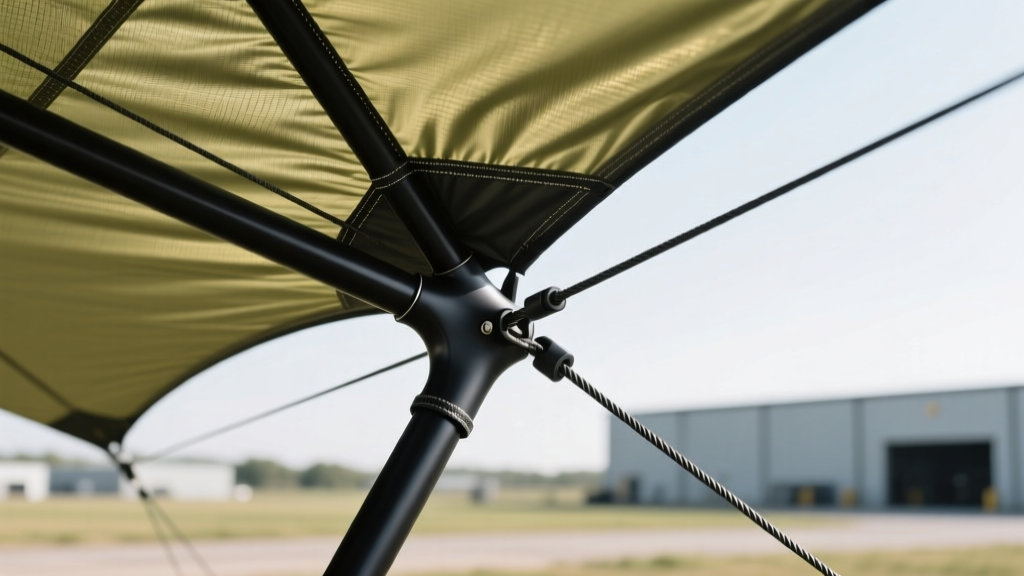
Rigid structural spars provide the kite with its foundational geometry, resisting the compressive and bending forces generated by the tether. While early prototypes utilized aluminum alloys (e.g., 7075-T6), the 2026 standard for industrial kite building materials is exclusively pultruded carbon fiber reinforced polymer (CFRP).
Pultrusion offers a continuous, unidirectional fiber alignment that maximizes longitudinal stiffness (modulus of elasticity). Manufacturers like Toray supply the base carbon tows, with T700 and T800 grades being the industry baseline. T700 carbon fiber provides a tensile strength of 4,900 MPa and a modulus of 230 GPa. For ultra-high-performance kites requiring reduced diameter spars to minimize aerodynamic drag, T800 (5,490 MPa strength, 294 GPa modulus) is specified.
Engineering Note: Resin Matrix Selection
The carbon fibers must be bound in a high-performance epoxy or polyurethane resin matrix. For AWE applications subject to continuous micro-vibrations and cyclic loading, toughened epoxy systems with a glass transition temperature (Tg) exceeding 110°C are mandatory to prevent matrix cracking and subsequent fiber micro-buckling under compression.
Inflatable Struts vs. Rigid Spars
Many modern traction kites utilize hybrid skeletons, replacing rigid cross-spars with inflatable drop-stitch TPU bladders. These bladders operate at internal pressures of 12 to 18 PSI. The drop-stitch construction (using thousands of internal polyester threads) allows the strut to maintain a rigid, flat geometric profile under load, offering superior impact resistance and easier field repair compared to solid CFRP tubes.
Tether Systems: UHMWPE Braiding and Creep Mitigation
The tether is the most critical load-path component in any traction kite system. Steel wire ropes are obsolete in this sector due to their excessive weight and fatigue-induced snapping. The universal standard for industrial kite tethers is Ultra-High-Molecular-Weight Polyethylene (UHMWPE), commercially known under brands like Dyneema or Spectra. Detailed specifications from Avient (Dyneema) highlight the material's specific strength, which is up to 15 times greater than steel on a weight-for-weight basis.
SK78 vs. SK99: Selecting the Correct Grade
For tethers operating under continuous, static high-tension (such as AWE power generation tethers), engineers must account for 'creep'—the permanent, time-dependent elongation of UHMWPE fibers under constant load.
- Dyneema SK78: Offers superior creep resistance and is the preferred choice for tethers that remain under high tension for months without being spooled. Tensile strength is approximately 3,400 MPa.
- Dyneema SK99: Offers the highest breaking strength (up to 4,400 MPa) but exhibits higher creep rates. It is specified for traction kites used in maritime shipping (e.g., wind-assisted ship propulsion) where the tether is frequently spooled and tension is highly dynamic rather than static.
UHMWPE fibers begin to lose tensile strength at temperatures exceeding 70°C. When specifying kite building materials for tethers, engineers must account for internal hysteresis heating caused by cyclic bending over sheaves and winch drums. Tethers must be constructed with a 12-strand or 8-strand braided core encased in a high-melting-point Technora (aramid) or polyester braided sheath to protect against abrasion and UV degradation.
Environmental Degradation and Hardware Interfaces
Operating at 400+ meters exposes the kite to unfiltered UV radiation and sub-zero temperatures. Standard UV inhibitors used in consumer textiles degrade within 200 hours of stratospheric exposure. Industrial membranes require mass-pigmented yarns (where the UV-blocking pigment is extruded directly into the polymer melt) combined with nano-ceramic surface coatings to achieve a 5,000+ hour operational lifespan without embrittlement.
Hardware interfaces (pulleys, shackles, and line connectors) must interface with UHMWPE without causing localized shear failures. Titanium alloys (Grade 5, Ti-6Al-4V) are specified for all primary load-bearing rings and pulleys due to their high strength-to-weight ratio and galvanic compatibility with carbon fiber spars, preventing the severe galvanic corrosion that occurs when carbon fiber contacts standard aluminum or stainless steel in marine environments.
Material Selection Decision Matrix
Use the following framework to finalize your bill of materials (BOM) based on the kite's primary operational profile:
- Static Power Generation (AWE): Prioritize SK78 tethers for creep resistance; T700 pultruded spars for cost-effective stiffness; 70D HTN ripstop for canopy longevity.
- Dynamic Maritime Traction (Cargo Ships): Prioritize SK99 tethers with aramid sheaths for dynamic shock loads; T800 spars for weight reduction; Dimension-Polyant laminates on leading edges to withstand saltwater abrasion and high-speed water impacts during relaunch.
- High-Altitude Atmospheric Research: Prioritize 40D HTN for absolute minimum mass; inflatable drop-stitch struts to allow compact packing in launch canisters; pure Technora tethers to eliminate creep entirely despite the weight penalty.
Frequently Asked Technical Questions
How do you test the fatigue life of carbon fiber spars for kites?
Fatigue life is tested using 4-point bending tests (ASTM D7264) combined with cyclic load application simulating the flapping and torsional vibrations induced by von Kármán vortex streets. Spars must survive a minimum of 10^7 cycles at 40% of their ultimate failure load without exhibiting matrix delamination.
Can Kevlar (Aramid) be used instead of UHMWPE for kite tethers?
While Kevlar offers excellent cut resistance and zero creep, it has a significantly lower specific strength than UHMWPE and is highly susceptible to UV degradation and compressive kinking. It is rarely used as a primary tether material in 2026, except as a protective outer sheath over an UHMWPE core.
What is the recommended adhesive for bonding TPU bladders to ripstop nylon?
Thermoplastic polyurethane films require solvent-based PU adhesives (such as those in the 3M Scotch-Weld or Henkel Loctite industrial lines) activated by heat or RF (Radio Frequency) welding. Standard cyanoacrylates or epoxies will fail due to the flexibility requirements of the membrane.
Written by
Priya KapoorPriya Kapoor is a real estate market analyst and construction economics researcher with expertise in housing affordability, development feasibility, and infrastructure investment. She holds a Master of Regional Planning from Cornell University and previously worked as a senior analyst at CBRE's Investment Properties group, where she modeled returns for $4B in mixed-use development pipelines. Priya now runs an independent research practice advising developers, municipalities, and REITs on construction cost forecasting and market timing. She publishes the quarterly "BuildMat Market Pulse" report tracking material price indices across 12 commodity categories. Based in Austin, TX, Priya serves on the board of Habitat for Humanity Austin and is a marathon runner.
More from Priya Kapoor
View all
Construction Cost
Cost to Build a 1600 Sq Ft Home in 2026: Full Breakdown
Accurate 2026 cost to build a 1600 sq ft home—material, labor, and regional pricing breakdowns included. Plan your budget with real-time estimates.
Aug 11, 2026

Wood & Lumber
Name the Types of Wood for Pressure Treatment and Preservation
Learn how to name the types of wood best suited for pressure treatment. Compare species treatability, chemical retention levels, and 2026 preservation costs.
Aug 4, 2026

Stone & Masonry
Stone Veneer Suppliers Lindenhurst: 2026 Cost Analysis
Analyze 2026 stone veneer costs in Lindenhurst, NY. Compare local supplier pricing, delivery fees, and Suffolk County installation labor rates.
Aug 4, 2026