Bargain Barn Building Materials Salem OR: Technical Specs Guide
Evaluate the technical specifications of bargain barn building materials in Salem, OR. Learn grading, moisture, and code compliance checks.

Navigating Surplus Material Specifications in the Willamette Valley
Sourcing discount construction supplies requires a rigorous understanding of material science. When evaluating bargain barn building materials in Salem, OR, contractors and owner-builders face a unique set of environmental and structural variables. Salem sits in IECC Climate Zone 4C, characterized by mild, wet winters and dry summers. Materials stored in unconditioned, open-air salvage yards or rustic discount barns are subjected to significant hygrothermal cycling. This guide details the exact technical specifications, testing methodologies, and failure modes you must verify before integrating surplus materials into code-compliant residential or commercial structures.
Dimensional Lumber and Engineered Wood: Grading and Moisture Thresholds
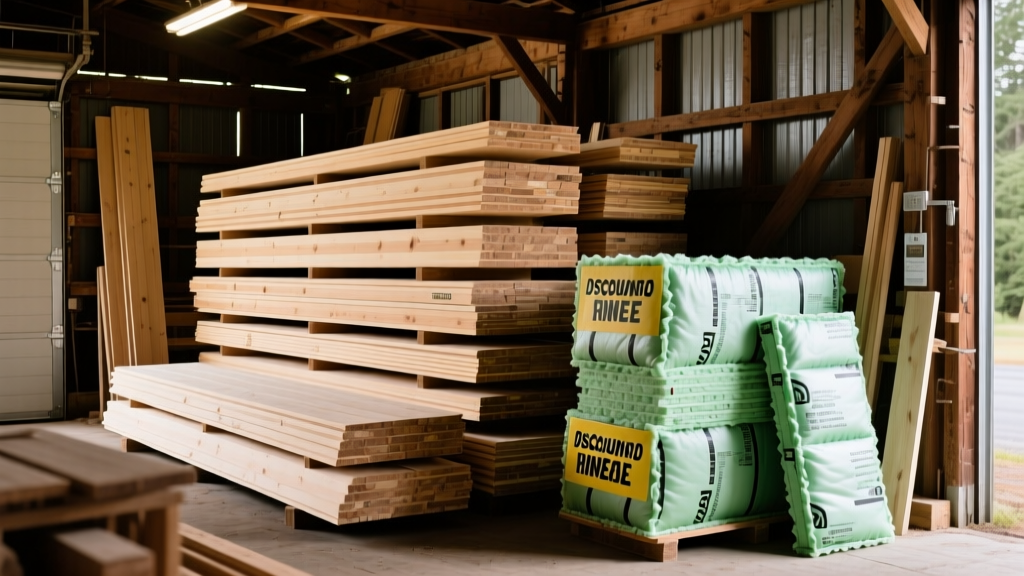
Surplus lumber is the most common find at regional discount yards, but its structural viability hinges on two factors: grade stamp legibility and equilibrium moisture content (EMC). According to the APA - The Engineered Wood Association, any structural sheathing or framing lumber must bear a legible grade stamp indicating the species, moisture content at the time of surfacing, and mill number.
Moisture Content (MC) Verification
In Salem's marine-influenced climate, lumber stored in a poorly ventilated bargain barn will rapidly absorb ambient humidity. For interior conditioned framing, the MC must not exceed 15%. For exterior applications, the maximum allowable MC is 19%.
- Testing Protocol: Use a pin-type resistance moisture meter (e.g., Delmhorst J-2000) driven into the wood at a depth of 1/4-inch and 3/4-inch to detect moisture gradients. Pinless meters only read surface moisture and will miss internal case-hardening or trapped moisture.
- Failure Mode - Honeycomb Checking: Surplus kiln-dried lumber that has been re-wetted and dried improperly often develops internal honeycomb checking. This severely compromises shear strength. Inspect the end-grain for micro-fissures radiating from the pith.
Salem's high annual precipitation means ground-contact lumber in discount yards is highly susceptible to brown rot fungi (Postia placenta). If a 2x6 or 4x4 shows localized softening, cubical cracking, or a musty odor, it has lost its structural load-bearing capacity and must be rejected, regardless of the discount price.
Thermal Insulation: R-Value Degradation and Facer Integrity
Insulation is frequently liquidated at bargain prices due to packaging damage or overstock. However, thermal resistance (R-value) is highly sensitive to physical compression and moisture ingress. Field verification must align with US Department of Energy guidelines for material performance.
| Insulation Type | Nominal Spec | Surplus Degradation Risk | Field Verification Test |
|---|---|---|---|
| Fiberglass Batts | R-3.1 to R-4.3 per inch | High (Compression) | Measure thickness uncompressed. Compressing an R-19 batt into a 2x4 cavity drops it to R-13. |
| XPS Rigid Foam | R-5.0 per inch | Medium (UV Degradation) | Check for surface chalking or powdering. UV exposure destroys the closed-cell structure at the surface. |
| Polyiso (Foil-Faced) | R-6.0 to R-6.5 per inch | High (Facer Delamination) | Peel back a corner of the foil facer. If it separates easily, the radiant barrier and vapor retarder properties are compromised. |
Mineral Wool and Moisture
Rockwool and slag wool are highly resilient surplus finds because they are hydrophobic and do not lose R-value when compressed. However, verify that the binder resins have not degraded. If the batts crumble or fail to spring back to their full 3.5-inch or 5.5-inch width after being removed from the packaging, the structural integrity of the matrix has failed.
Weather-Resistive Barriers (WRBs) and Roofing: Shelf-Life Limits
Discount building supply barns often stock pallets of asphalt shingles and house wraps that are past their optimal shelf life. These materials rely on chemical adhesives and UV stabilizers that degrade over time, even in sealed packaging.
Asphalt Shingle Sealant Strips
Architectural and 3-tab shingles feature thermoplastic sealant strips designed to activate under solar heat (typically requiring roof surface temperatures of 140°F to 160°F). If shingles have been stored in an unconditioned Salem barn for more than 18 months, the sealant strips can oxidize, dry out, or bond prematurely to the release tape.
Specification Check: Perform a manual peel test on the sealant strip. It should exhibit high tack and stringing. If it flakes off or feels hard and brittle, the shingles will fail to seal, leading to wind uplift failures that violate ASTM D3462 standards.
House Wrap UV Stabilizers
Spunbonded polyolefin WRBs (like Tyvek HomeWrap) are manufactured with UV inhibitors rated for 120 to 150 days of exposure. If a discounted roll has been sitting near a barn window or under a translucent roof for a year, the UV stabilizers are depleted. Installing degraded WRB results in micro-tearing during wind loads and a complete loss of water resistivity.
Structural Fasteners: Corrosion Coatings and Galvanic Compatibility
Bulk bins of discounted nails, screws, and joist hangers are common in surplus yards, but using the wrong coating with modern pressure-treated lumber leads to catastrophic galvanic corrosion. According to Building Science Corporation, the transition to Alkaline Copper Quaternary (ACQ) and Copper Azole (CA-C) wood preservatives requires specific fastener coatings.
- G90 Galvanizing: Insufficient for ACQ/CA-C treated lumber. Will corrode rapidly in Salem's damp climate.
- G185 Galvanizing (ASTM A153): The minimum required specification for hot-dip galvanized fasteners used with modern treated wood. It provides 1.85 ounces of zinc per square foot.
- Type 304 / 316 Stainless Steel: Required for coastal zones or ground-contact applications.
Visual identification is difficult, but G185 hot-dip galvanized fasteners typically exhibit a thicker, duller, and more crystalline "spangle" pattern compared to the shiny, smooth finish of electroplated G90 or zinc-flake coatings. If a surplus bin lacks original packaging with the ASTM A153 G185 stamp, reject the batch for structural framing use.
On-Site Verification Framework for Salem Contractors
Before loading discounted materials onto your truck, execute this four-point technical verification protocol to ensure code compliance and structural safety.
- Date Code Extraction: Locate the manufacturing date codes on shingle bundles, PVC pipe extrusions, and adhesive tubes. Reject any solvent-weld primers or construction adhesives older than 12 months, as the volatile organic compounds (VOCs) necessary for curing will have evaporated.
- Dimensional Tolerance Check: Surplus engineered I-joists and LVL beams can warp if stored improperly. String a mason's line from end to end of any LVL beam. Deflection exceeding L/360 indicates permanent creep deformation; do not use for primary load paths.
- Hardware Stamping Audit: Inspect every joist hanger and hold-down for the manufacturer's stamp and ICC-ES evaluation report number. Unstamped, generic steel connectors often lack the required 18-gauge or 14-gauge thickness and will fail structural shear tests.
- Cementitious Product Hydration: If purchasing surplus Portland cement, thinset, or self-leveling underlayment, check for "hard lumps" inside the bag. This indicates premature hydration from ambient humidity. Any bag with calcified nodules must be rejected, as its compressive strength (PSI) will be severely compromised.
Securing bargain barn building materials in Salem, OR, offers significant cost advantages, but only when paired with rigorous technical scrutiny. By enforcing strict moisture, grading, and chemical viability standards, builders can safely integrate surplus inventory into high-performance, code-compliant structures without sacrificing longevity or safety.
Written by
Priya KapoorPriya Kapoor is a real estate market analyst and construction economics researcher with expertise in housing affordability, development feasibility, and infrastructure investment. She holds a Master of Regional Planning from Cornell University and previously worked as a senior analyst at CBRE's Investment Properties group, where she modeled returns for $4B in mixed-use development pipelines. Priya now runs an independent research practice advising developers, municipalities, and REITs on construction cost forecasting and market timing. She publishes the quarterly "BuildMat Market Pulse" report tracking material price indices across 12 commodity categories. Based in Austin, TX, Priya serves on the board of Habitat for Humanity Austin and is a marathon runner.
More from Priya Kapoor
View all
Construction Cost
Cost to Build a 1600 Sq Ft Home in 2026: Full Breakdown
Accurate 2026 cost to build a 1600 sq ft home—material, labor, and regional pricing breakdowns included. Plan your budget with real-time estimates.
Aug 11, 2026

Wood & Lumber
Name the Types of Wood for Pressure Treatment and Preservation
Learn how to name the types of wood best suited for pressure treatment. Compare species treatability, chemical retention levels, and 2026 preservation costs.
Aug 4, 2026

Stone & Masonry
Stone Veneer Suppliers Lindenhurst: 2026 Cost Analysis
Analyze 2026 stone veneer costs in Lindenhurst, NY. Compare local supplier pricing, delivery fees, and Suffolk County installation labor rates.
Aug 4, 2026