Applying BMC Building Materials in Austin: A Texas Climate Guide
Master the application of BMC building materials in Austin. Learn climate-specific framing, siding, and moisture management techniques.

The Austin Climate Factor: Why Material Application Matters
Sourcing BMC building materials in Austin provides contractors and custom home builders with access to premium engineered wood, advanced sheathing, and high-grade structural lumber. However, procuring top-tier materials is only half the battle. Central Texas presents a hostile environmental matrix for building envelopes: expansive Blackland Prairie clay soils, summer ambient temperatures routinely exceeding 105°F, intense UV radiation, and sudden winter polar vortexes that can drop temperatures from 70°F to 15°F in a matter of hours.
Under the 2024 International Residential Code (IRC), which Austin fully adopted for 2026 permitting, structural and envelope applications must account for these extreme thermal and moisture differentials. This guide details the precise application protocols for key materials distributed through Austin BMC yards, ensuring your assemblies survive the Central Texas climate without catastrophic failure.
Framing and Subfloor Application in Expansive Clay
Austin's soil is notorious for its high plasticity index (PI), meaning it swells significantly when wet and shrinks during droughts. This soil movement transfers immense stress to the foundation and, consequently, the floor framing. When utilizing high-performance subflooring like Huber AdvanTech—a staple at Austin BMC locations—application precision is critical to prevent telegraphing and squeaks.
Moisture Management and Gap Spacing
AdvanTech panels feature a highly moisture-resistant resin that prevents edge swelling, but the wood fibers within the panel core still experience dimensional changes based on ambient humidity. Austin's relative humidity swings from 25% in peak summer afternoons to over 90% during spring mornings.
- Edge Spacing: Maintain a strict 1/8-inch gap at all panel edges and ends. Installing panels tight during a dry March will guarantee buckling when the June humidity peaks.
- Fastening Schedule: Use 8d ring-shank nails or 2-3/8-inch wood screws. Space fasteners 6 inches on center (o.c.) at panel edges and 12 inches o.c. in the field.
- Adhesive Application: Apply a continuous 1/4-inch bead of polyurethane-based subfloor adhesive (like AdvanTech or PL Premium) to the joists before laying the panel. This eliminates micro-movements that cause floor squeaks over time.
Austin's Blackland Prairie soil is highly alkaline (pH 7.5 to 8.5) and contains soluble salts. When foundation concrete cures against this soil, it becomes highly corrosive to standard electroplated fasteners. For all sill plate anchoring and structural connections near the slab, never use standard zinc-plated hardware. Specify 304 stainless steel or ASTM A153 hot-dipped galvanized fasteners (such as Simpson Strong-Tie ZMAX equivalents) to prevent premature shear failure.
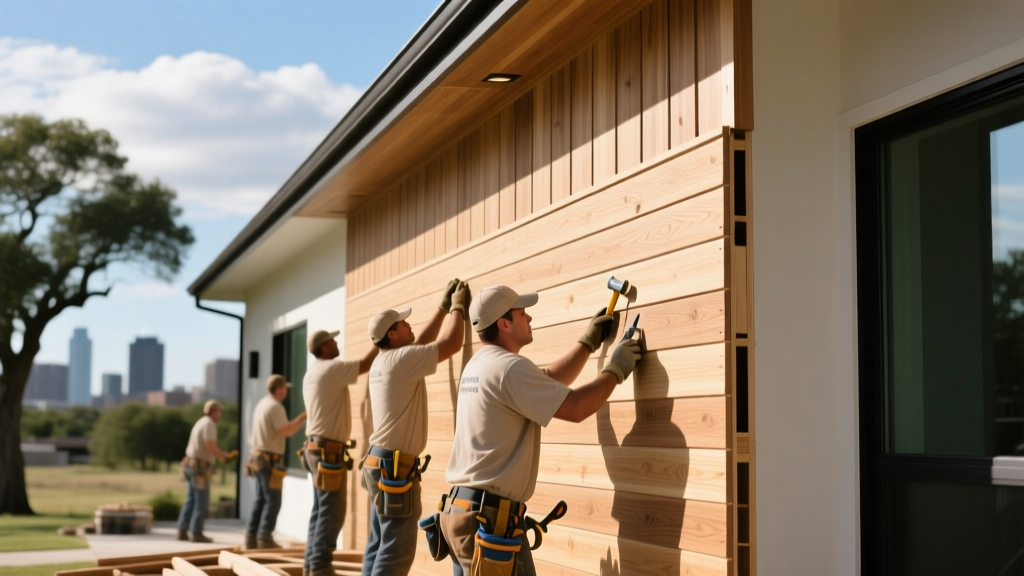
Exterior Cladding: Managing Thermal Expansion
When specifying siding from BMC building materials in Austin, LP SmartSide engineered wood remains a dominant choice due to its impact resistance (crucial for Texas hailstorms) and cost-to-performance ratio. However, the thermal expansion coefficient of engineered wood requires strict adherence to gap tolerances.
Austin's temperature delta can exceed 90°F between a January morning and an August afternoon. The following matrix outlines the required application tolerances for common cladding materials sourced locally to accommodate this extreme thermal swing.
| Material Type | Thermal Expansion Rate | Required Joint Gap (Austin) | Fastener Specification |
|---|---|---|---|
| LP SmartSide Lap (8" reveal) | Moderate (Linear) | 3/16-inch minimum | Hot-dipped galv. 8d |
| Fiber Cement (James Hardie) | Low (Negligible) | 1/8-inch (blind nailed) | SS or hot-dipped 6d |
| PVC / Polypropylene Shakes | High (Volumetric) | 1/4-inch to 3/8-inch | Stainless steel roofing |
LP SmartSide Application Protocol for Central Texas
According to the LP SmartSide Installation Guidelines, the 3/16-inch gap at end joints is non-negotiable. In Austin, where direct sun exposure can heat dark-colored siding to 160°F, failing to leave this gap will result in compressive buckling at the joints. Furthermore, all cut edges must be primed with a high-quality acrylic latex primer within 48 hours of cutting to prevent moisture wicking during Austin's intense spring thunderstorm season.
Roofing and Sheathing: Beating the 100°F+ Summers
The adoption of integrated weather-resistant barriers like the ZIP System roof sheathing (widely stocked at Austin BMC facilities) has revolutionized roof drying times. However, the application of the proprietary tape system requires strict temperature management.
- Surface Preparation: Ensure the OSB surface is completely free of sawdust, dirt, and moisture. Austin's high pollen counts in spring (cedar fever season) can coat roof decks in a fine dust that compromises tape adhesion. Sweep and blow off the deck immediately before taping.
- Temperature Thresholds: ZIP System tape relies on a pressure-sensitive acrylic adhesive. Do not apply tape when the surface temperature of the panel is below 25°F or exceeds 120°F. In July and August, this means taping must occur before 10:00 AM or after 6:00 PM.
- Rolling Protocol: Use the specialized ZIP System tape roller. Apply 50 lbs of pressure, rolling back and forth at least twice. The adhesive requires mechanical pressure to activate the bond, not just hand-smoothing.
- High-Wind Nailing: For homes in the western Austin outskirts (Hill Country transition zones) where basic wind speeds are rated at 120 mph under the 2024 IRC, edge nailing for roof sheathing must be reduced to 4 inches o.c. instead of the standard 6 inches o.c. Verify this with your structural engineer's truss and sheathing layout.
Sourcing and Logistics from Austin BMC Yards
Efficient application begins with efficient logistics. Austin's traffic congestion on I-35 and Mopac Expressway can severely disrupt material delivery schedules, leading to materials sitting on hot asphalt or being exposed to sudden downpours.
Best Practices for Material Handling
- Staged Deliveries: Coordinate with your BMC account manager to stage framing lumber and engineered I-joists on blocking (dunnage) at least 4 inches off the ground. Never store engineered wood products directly on Austin's alkaline soil, as capillary action will draw moisture into the end grains within 24 hours.
- UV Protection for Plastics: PVC trim, composite decking, and housewraps degrade rapidly under Austin's extreme UV index. If materials are delivered before the framing is ready, they must be covered with opaque, breathable tarps. Clear plastic wrap creates a greenhouse effect that can warp PVC trim stock permanently.
- Acclimatization: Solid hardwood flooring and interior millwork sourced through BMC must be delivered to the job site only after the HVAC system is operational and the building envelope is sealed. The interior must be maintained at 60-80°F and 30-50% relative humidity for at least 5 days prior to installation to prevent severe cupping or gapping.
Frequently Asked Questions (FAQ)
Do I need a vapor barrier under my slab in Austin?
Yes. The 2024 IRC requires a minimum 10-mil polyethylene vapor retarder under all concrete slabs-on-grade. Given Austin's high water table in areas near the Colorado River and the Edwards Aquifer recharge zone, upgrading to a 15-mil or 20-mil cross-laminated vapor barrier (like Stego Wrap) is highly recommended to prevent moisture vapor transmission from destroying interior floor finishes.
What is the best insulation for Austin's climate zone?
Austin is in IECC Climate Zone 2A (hot-humid). For wood-framed walls, open-cell spray polyurethane foam (ocSPF) at R-13 to R-15 is highly effective because it acts as an air barrier and prevents humid exterior air from condensing on the interior side of the sheathing. If using fiberglass batts, you must pair them with a continuous exterior rigid foam insulation (minimum R-5) to shift the dew point outward, a principle heavily emphasized by Building Science Corporation for hot-humid climates.
Can I use standard drywall in Austin bathrooms?
Standard gypsum board is not permitted in wet areas. For shower and tub surrounds, utilize glass-mat gypsum panels (like DensShield or Georgia Pacific DensArmor) which feature a built-in moisture-resistant acrylic coating. In Austin's high-humidity bathrooms, this prevents the paper facing of traditional greenboard from becoming a food source for mold spores.
Written by
David NakamuraDavid Nakamura is a licensed architect (AIA) and construction technology writer focused on sustainable building methods, mass timber engineering, and high-performance building envelopes. He holds a Master of Architecture from the University of Washington and is a certified Passive House Consultant (CPHC). David spent eight years at the Seattle firm Mithun, where he led the design of three LEED Platinum projects, before founding his own practice specializing in net-zero residential design. He serves on the editorial advisory board of GreenBuilder Magazine and has authored peer-reviewed papers on cross-laminated timber (CLT) connections for the Journal of Structural Engineering. In his spare time, David teaches woodworking at Pratt Fine Arts Center and kayaks the Puget Sound.
More from David Nakamura
View all
Construction Cost
Labor Cost to Build a Deck Per Sq Ft: 2026 Installation Guide
Discover the exact labor cost to build a deck per sq ft in 2026. This installation guide breaks down contractor rates, complexity factors, and hidden fees.
Aug 4, 2026

Construction Cost
How Much Does It Cost to Build a 3 Bedroom House? Financing Guide
Learn exactly how much it costs to build a 3 bedroom house and explore 2026 financing options, construction loan types, and budget frameworks for your build.
Aug 4, 2026

Construction Cost
Cost to Build a Tennis Court: 2026 Guide
How much does it cost to build a tennis court in 2026? Breakdowns for asphalt, concrete, and synthetic surfaces plus fencing and lighting.
Jul 30, 2026