Chinese Building Materials: 2026 Landed Cost & Tariff Analysis
Analyze the true landed costs of importing Chinese building materials in 2026, including Section 301 tariffs, freight rates, and hidden fees.
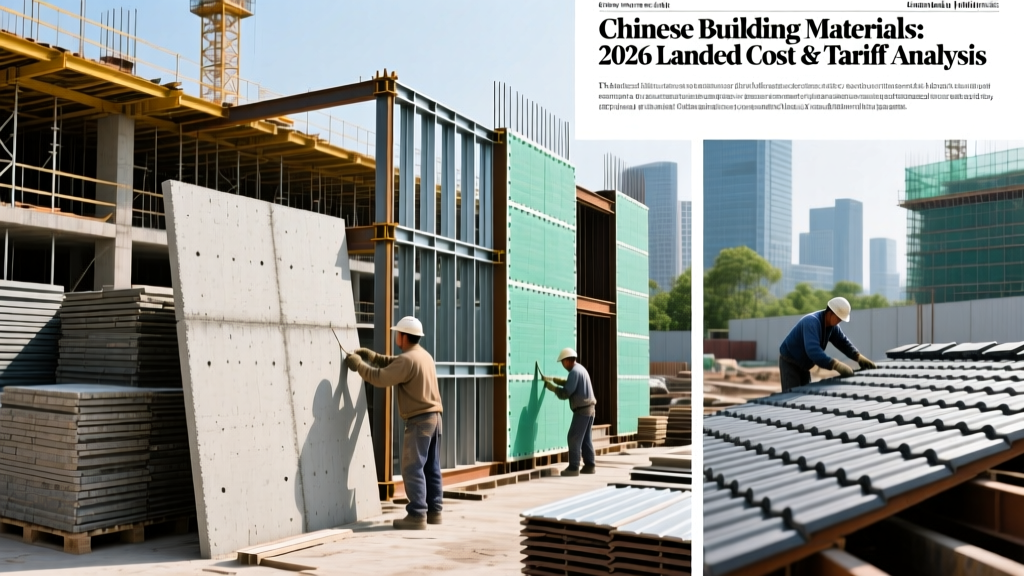
The Illusion of FOB Pricing in Global Sourcing
When evaluating Chinese building materials for commercial or large-scale residential projects, the Free On Board (FOB) price listed on supplier invoices is only a fraction of the actual financial commitment. In 2026, volatile ocean freight rates, entrenched Section 301 tariffs, and complex Anti-Dumping and Countervailing Duties (ADD/CVD) have fundamentally altered the import landscape. Procurement managers who base budgets solely on factory-gate pricing from Guangdong or Fujian provinces routinely face 40% to 110% margin erosion by the time materials reach the job site.
To protect project profitability, general contractors and developers must shift from unit-price comparisons to a comprehensive Landed Cost Analysis. This framework accounts for every logistical, regulatory, and compliance expense incurred between the Chinese factory floor and the American construction site.
Breaking Down the 2026 Landed Cost Formula
Landed Cost = FOB Price + Inland Freight (China) + Ocean Freight + Marine Insurance + Duties (Standard + Sec. 301 + ADD/CVD) + Port/Chassis Fees + US Inland Freight + QA/Compliance Audits
According to data tracked by the Freightos Baltic Index (FBX), trans-Pacific shipping rates have stabilized compared to the pandemic peaks, but a 40-foot High Cube (FEU) container from Shanghai to Los Angeles/Long Beach still commands an average of $3,800 to $4,500 in 2026. When divided by the volumetric capacity of the container, this freight cost adds a significant per-unit premium, especially for low-density materials like insulation or hollow-core doors.
Material-Specific Cost & Tariff Matrix
The financial viability of importing Chinese building materials depends heavily on the product's Harmonized Tariff Schedule (HTS) classification. The table below illustrates the estimated 2026 landed costs for four commonly imported construction materials, highlighting the severe impact of targeted tariffs.
| Material | HTS Code | FOB Price | Est. Freight/Unit | Tariff/Duty Rate | Est. Landed Cost |
|---|---|---|---|---|---|
| Porcelain Tiles (600x600mm) | 6907.21 | $4.50 / sqm | $1.20 / sqm | ~45% (Std + Sec 301) | $8.26 / sqm |
| Structural H-Beam Steel | 7216.33 | $650 / MT | $85 / MT | 25% (Sec 232) + ADD risk | $918 / MT |
| Gypsum Board (1/2" 4x8) | 6809.11 | $2.10 / board | $0.95 / board | 25% (Sec 301) | $3.81 / board |
| Bifacial Solar Glass Panels | 8541.43 | $0.22 / Watt | $0.03 / Watt | ~35% (Sec 201/301) | $0.34 / Watt |
Note: Anti-Dumping Duties (ADD) on steel and aluminum can fluctuate wildly based on the specific Chinese mill. Always verify the manufacturer's exact ADD/CVD cash deposit rate via the U.S. Customs and Border Protection (CBP) trade remedy database before issuing a purchase order.
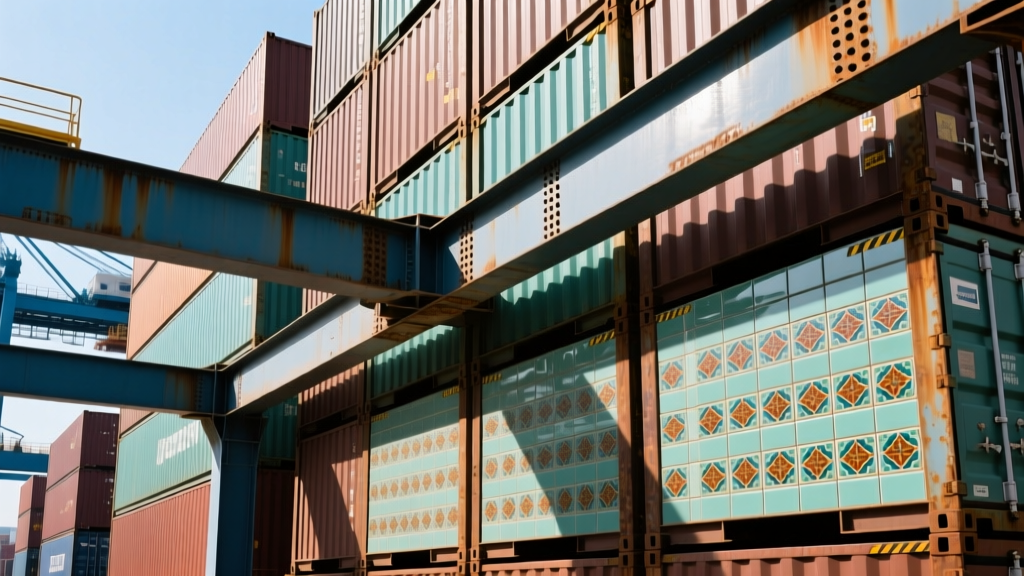
The Hidden Supply Chain Costs That Erase Margins
Beyond base freight and tariffs, importers of Chinese building materials frequently encounter secondary fees that are rarely quoted upfront. Budgeting for these contingencies is mandatory for accurate project forecasting.
- Port Demurrage and Per Diem: If customs clearance or chassis availability is delayed at major hubs like LA/LB or Savannah, demurrage fees accrue rapidly. In 2026, expect to pay $200 to $250 per day, per container, once free time (usually 4-5 days) expires.
- Customs VACIS Exams: Building materials, particularly lumber, steel, and stone, are high-priority targets for Vectorized Advanced Cargo Inspection System (VACIS) X-ray exams. A mandatory exam adds $400 to $800 in handling fees and delays the shipment by 3 to 7 days.
- Third-Party Quality Assurance (QA): Relying on factory self-reporting is a critical error. Hiring an independent inspection firm (e.g., SGS or Intertek) to conduct pre-shipment inspections in China costs $300 to $500 per man-day. This upfront cost prevents the catastrophic expense of receiving non-compliant materials on-site.
- ISF Filing Penalties: The Importer Security Filing (10+2) must be submitted 24 hours before the cargo is laden on the vessel in China. Late or inaccurate filings result in automatic CBP fines of $5,000 per violation.
Quality vs. Cost: The Total Cost of Ownership (TCO) Framework
The National Association of Home Builders (NAHB) frequently highlights that material price is only one variable in construction economics. The Total Cost of Ownership (TCO) must account for installation labor, waste factors, and long-term durability.
Warning: The ASTM Compliance Trap
Importing structural steel or fire-rated drywall from China without explicit, verifiable ASTM or UL certification is a severe liability. If a local building inspector rejects a shipment of Chinese-manufactured H-beams because the mill test reports lack AISC (American Institute of Steel Construction) certification, the material cannot be used. The cost of this failure is not just the lost material cost; it includes demolition, project delays, liquidated damages, and emergency domestic procurement at premium spot prices.
Evaluating the Waste Factor
When sourcing ceramic or porcelain tiles from Chinese manufacturers, dimensional variance is a common issue. While premium domestic tiles maintain a caliber variance of less than 0.5mm, lower-tier imported tiles can vary by 2mm or more. This variance forces installers to use wider grout lines and results in a 12% to 15% cutting waste factor (compared to the standard 10% allowance). When calculating the cost per square foot, you must divide the landed cost by 0.85, not 0.90, to account for this increased waste.
Strategic Sourcing: When to Import and When to Buy Domestic
Not all Chinese building materials make financial sense in the current tariff environment. Use this decision matrix to determine the optimal sourcing strategy for your 2026 project pipeline.
Import from China When:
- High Value-to-Weight Ratio: Products like smart glass, specialized LED architectural lighting, and high-end quartz slabs absorb ocean freight costs easily, leaving a massive margin advantage even after 25% Section 301 tariffs.
- Custom Fabrication is Required: Chinese factories excel at low-cost, high-volume custom CNC machining. If your project requires thousands of unique, custom-milled aluminum facade brackets, the tooling and labor savings will vastly outweigh domestic production costs.
- Non-Structural / Non-Regulated Finishes: Decorative elements, interior millwork, and non-fire-rated acoustic panels carry lower compliance risks and bypass stringent structural inspections.
Buy Domestic (or Nearshore to Mexico/Canada) When:
- High Weight / Low Value: Bulk commodities like standard concrete reinforcement rebar, basic dimensional lumber, and standard gypsum board are economically unviable to ship across the Pacific due to freight-to-value ratios and heavy ADD/CVD exposure.
- Strict Life-Safety Certifications Required: Fire-rated assemblies, structural glazing, and post-tension cables require localized, verifiable chain-of-custody documentation that is difficult to audit from overseas.
- Just-In-Time Delivery is Critical: If your project schedule has zero float, relying on a 35-to-45-day trans-Pacific ocean transit—subject to port congestion and customs holds—introduces unacceptable schedule risk.
Finalizing the Procurement Strategy
Sourcing Chinese building materials in 2026 requires a sophisticated approach to supply chain finance and regulatory compliance. By rigorously calculating the landed cost, auditing HTS codes for hidden anti-dumping duties, and enforcing strict third-party QA inspections prior to shipment, contractors can successfully leverage global manufacturing while protecting project margins and structural integrity.
Written by
Marcus ChenMarcus Chen is a licensed structural engineer (PE) and building materials analyst with over 12 years of experience across residential, commercial, and industrial construction. He holds a Master of Science in Civil Engineering from UC Berkeley and spent six years at Thornton Tomasetti before transitioning to independent consulting and technical writing. Marcus specializes in material selection for seismic-prone regions, concrete reinforcement strategies, and lifecycle cost analysis. His work has been cited by the American Concrete Institute (ACI) and the Structural Engineers Association of California (SEAOC). When he is not on a job site or at his desk, you will find him hiking the Sierra Nevada or restoring a 1920s craftsman bungalow in Oakland, CA.
More from Marcus Chen
View all
Construction Cost
How Much Did the Eiffel Tower Cost to Build?
How much did the Eiffel Tower cost to build in 1889? We adjust for inflation and compare its budget to modern skyscraper construction.
Aug 4, 2026

Fire Resistance
What Is a Fire Resistant Material? Testing & Certification Guide
Discover what is a fire resistant material through ASTM and UL testing. Learn how fire ratings, certifications, and assemblies work in construction.
Aug 4, 2026

Construction Cost
How Much Did the Burj Khalifa Cost to Build?
How much did the Burj Khalifa cost to build? We break down the $1.5B project and extract 5 money-saving strategies for your next build.
Jul 30, 2026