Luxury Building Material Sourcing and Supply: Direct vs Distributor
Compare luxury building material sourcing and supply routes. We analyze direct quarry procurement versus premium distributors for high-end projects.

The Procurement Dilemma in High-End Construction
Executing a luxury residential or boutique hospitality project requires flawless material execution, where the provenance and finish of every surface are scrutinized. For architects and procurement managers, luxury building material sourcing and supply represents one of the most critical path dependencies in the construction schedule. The fundamental decision lies between two distinct supply chain routes: direct sourcing from international quarries and mills, or procuring through domestic premium distributors. Each pathway carries vastly different implications for capital expenditure, lead times, quality control, and risk allocation. Understanding the granular differences between these models is essential for protecting project margins and ensuring design integrity.
Direct Sourcing: Bypassing the Middleman
Direct sourcing involves contracting straight with the origin point—whether that is a Carrara marble quarry in Italy, a French White Oak (Chêne de France) mill in Burgundy, or a Venetian plaster artisan in Verona. This model strips away domestic markups, offering substantial cost savings on the raw material itself.
The Financial Reality of Direct Procurement
The primary allure of direct sourcing is the unit cost reduction. For example, procuring Grade-A Calacatta Viola marble directly from an Italian exporter typically ranges from $180 to $250 per square foot (unfabricated). By contrast, the same material sourced through a high-end domestic slab yard often commands $350 to $500+ per square foot. However, these savings are frequently offset by hidden logistical costs, including international freight, customs brokerage, marine insurance, and domestic drayage.
Direct mills and quarries enforce strict Minimum Order Quantities (MOQs). While a distributor will sell you three slabs of rare Onyx, a direct supplier may require a minimum purchase of 500 to 1,000 square feet to justify the block cutting and resin-filling process. Direct sourcing is only viable for large-scale luxury projects or developers managing multiple high-end units simultaneously.
Premium Distributors: The Turnkey Supply Chain
Premium distributors and high-end slab yards (concentrated in hubs like New Jersey, South Florida, and Southern California) act as the importers of record. They absorb the international freight risks, manage customs clearance, and maintain climate-controlled domestic warehousing.
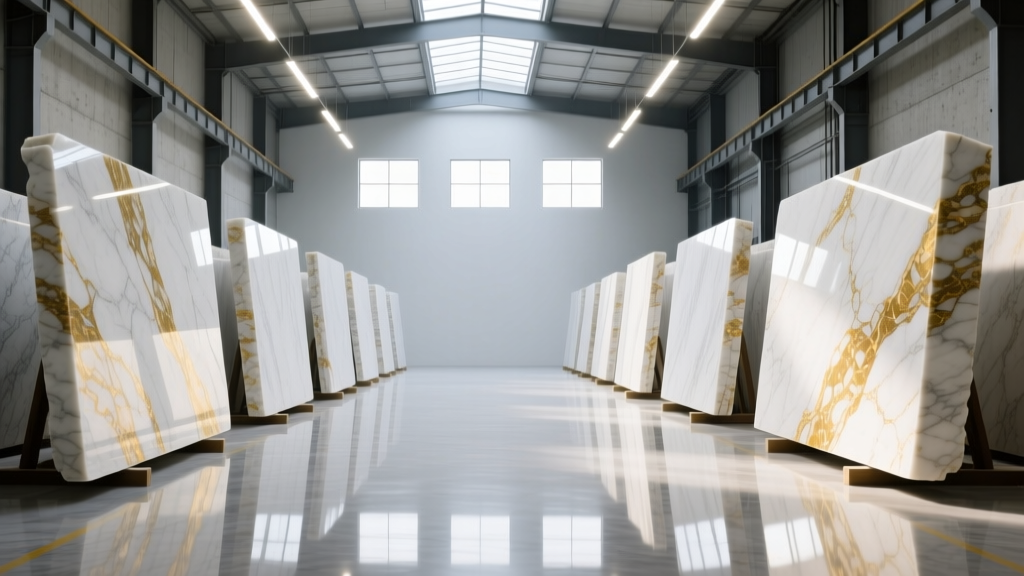
The value proposition of the distributor model is inventory liquidity and visual selection. In luxury design, specifying a stone by its commercial name is insufficient; designers must physically inspect the exact slabs to ensure veining continuity, book-matching potential, and structural integrity. Distributors allow design teams to walk the yard, tag specific slabs with grease pencils, and secure them immediately. Furthermore, domestic distributors typically offer lead times of 2 to 6 weeks, compared to the 14 to 22 weeks required for direct ocean freight and customs processing.
Cost, Lead Time, and Risk Matrix
The following matrix breaks down the operational realities of both supply chains for common luxury materials in the 2026 market environment.
| Metric | Direct Quarry/Mill Sourcing | Premium Domestic Distributor |
|---|---|---|
| Calacatta Viola (Unfabricated) | $180 - $250 / sq ft | $350 - $500+ / sq ft |
| French White Oak (Wide Plank) | $12 - $18 / sq ft | $22 - $35 / sq ft |
| Average Lead Time | 14 - 22 Weeks | 2 - 6 Weeks |
| Visual Selection | Digital scans / Sample blocks only | Full slab inspection in-yard |
| Damage/Defect Risk | Borne by buyer (requires marine insurance) | Borne by distributor until delivery |
| Minimum Order Quantity | High (500+ sq ft typical) | Low (Single slab / box) |
Quality Control: The Hidden Cost of Direct Imports
When managing luxury building material sourcing and supply internationally, quality control (QC) shifts entirely to the buyer. According to guidelines from the Natural Stone Institute, natural stone exhibits immense geological variability. A block of Statuario marble can shift from pristine white to heavily fractured and grey-veined within a few feet of the quarry face.
To mitigate this, direct buyers must mandate a 'dry-lay' inspection at the origin facility. This requires the factory to cut, polish, and lay out the exact slabs on the factory floor, allowing the design team to approve the book-matching and veining flow via high-resolution video or an in-person site visit before the material is crated. Skipping this step routinely results in $100,000+ in unusable material arriving at the job site with no recourse for return.
'In luxury procurement, you are not buying a material category; you are buying specific, individual blocks of earth. If you do not control the dry-lay process at the source, you are gambling with the project's aesthetic continuity.' — Senior Procurement Director, Boutique Hospitality Group.
Navigating Freight and Customs Volatility
The National Association of Home Builders (NAHB) frequently highlights how global supply chain bottlenecks impact construction timelines. For direct importers, ocean freight volatility remains a primary risk. A 20-foot container holding 40,000 lbs of marble slabs is subject to port congestion, chassis shortages, and customs holds.
Direct buyers must also navigate the Harmonized Tariff Schedule (HTS). Misclassifying a finished stone architectural element versus a raw polished slab can result in unexpected duties ranging from 3% to over 15%, entirely eroding the margin gained by bypassing the distributor. Engaging a licensed customs broker who specializes in architectural materials is non-negotiable for direct supply chains.
The 2026 Procurement Decision Framework
Use the following criteria to determine which supply chain route aligns with your specific project parameters:
Route A: Choose Direct Sourcing When...
- Scale: The project requires over 2,000 square feet of a single stone or wood species, easily satisfying factory MOQs.
- Schedule: The construction timeline allows for a 6-month procurement window, accommodating production, ocean freight, and potential port delays.
- Customization: The design demands bespoke milling, specific edge profiles, or custom resin fills that domestic distributors cannot execute on-site.
- Capital: The developer has the liquidity to pay 100% upfront via wire transfer to international mills, which rarely offer net-30 or net-60 terms.
Route B: Choose Premium Distributors When...
- Aesthetic Criticality: The design relies heavily on precise book-matching or continuous veining across multiple walls, requiring physical slab selection.
- Agile Timelines: The project is on a fast-track schedule where materials are needed on-site within 30 to 45 days.
- Risk Aversion: The general contractor or owner refuses to absorb the risk of transit damage, customs holds, or geological defects hidden within shipping crates.
- Phased Procurement: The project requires materials to be delivered in phases, leveraging the distributor's local warehousing as a just-in-time staging area.
Strategic Sourcing FAQs
Can I mix direct sourcing and distributor procurement on the same project?
Yes. A highly optimized strategy involves direct-sourcing high-volume, uniform materials (like exterior limestone cladding or wide-plank European oak flooring) while relying on domestic distributors for low-volume, highly visual materials (like book-matched onyx for a master bath or rare burl wood for a library).
How do I verify the authenticity of direct international suppliers?
Request their ISO 9001 certification for quality management and verify their membership in regional trade organizations, such as Confindustria Marmomacchine in Italy. Always initiate a small sample order via air freight to test their communication, packaging quality, and material accuracy before committing to ocean freight volumes.
Written by
David NakamuraDavid Nakamura is a licensed architect (AIA) and construction technology writer focused on sustainable building methods, mass timber engineering, and high-performance building envelopes. He holds a Master of Architecture from the University of Washington and is a certified Passive House Consultant (CPHC). David spent eight years at the Seattle firm Mithun, where he led the design of three LEED Platinum projects, before founding his own practice specializing in net-zero residential design. He serves on the editorial advisory board of GreenBuilder Magazine and has authored peer-reviewed papers on cross-laminated timber (CLT) connections for the Journal of Structural Engineering. In his spare time, David teaches woodworking at Pratt Fine Arts Center and kayaks the Puget Sound.
More from David Nakamura
View all
Construction Cost
Labor Cost to Build a Deck Per Sq Ft: 2026 Installation Guide
Discover the exact labor cost to build a deck per sq ft in 2026. This installation guide breaks down contractor rates, complexity factors, and hidden fees.
Aug 4, 2026

Construction Cost
How Much Does It Cost to Build a 3 Bedroom House? Financing Guide
Learn exactly how much it costs to build a 3 bedroom house and explore 2026 financing options, construction loan types, and budget frameworks for your build.
Aug 4, 2026

Construction Cost
Cost to Build a Tennis Court: 2026 Guide
How much does it cost to build a tennis court in 2026? Breakdowns for asphalt, concrete, and synthetic surfaces plus fencing and lighting.
Jul 30, 2026