Optimizing Bronx Building Material Supply for Urban Retrofits
Master your Bronx building material supply chain for urban retrofits. Learn NYC code compliance, masonry applications, and dense-city logistics strategies.

Navigating the Unique Demands of Bronx Construction
Sourcing and applying construction materials in the Bronx requires a fundamentally different strategy than suburban or even other New York City borough projects. The borough's architectural landscape is a dense mosaic of pre-war unreinforced masonry, mid-century concrete structures, and modern light-frame multi-family builds. When coordinating your Bronx building material supply, general contractors must account for strict NYC Department of Buildings (DOB) codes, narrow commercial corridors like the Cross Bronx Expressway and Bruckner Boulevard, and the physical limitations of historic building retrofits.
This application guide details the technical specifications, logistical frameworks, and material selections required to execute successful urban retrofits in the Bronx, ensuring compliance with the 2022 NYC Construction Codes and current 2026 enforcement cycles.
NYC Code Compliance: Fire and Acoustic Material Selection
The Bronx features a high concentration of multi-family dwellings and mixed-use zoning. Consequently, party wall fire-resistance and sound transmission class (STC) ratings are heavily scrutinized by DOB inspectors. Sourcing the correct assemblies from local suppliers is critical to passing inspections on the first attempt.
Multi-family residential buildings require a minimum STC rating of 50 for interior partitions separating dwelling units. Standard 1/2-inch drywall on wood framing only achieves an STC of roughly 33. You must specify high-mass or decoupled assemblies from your supplier.
Specifying the Right Interior Assemblies
To achieve an STC 50+ and a 1-hour fire rating (per ASTM E119), instruct your supply yard to deliver the following specific assembly components:
- Mass Layer: 5/8-inch Type X gypsum board (e.g., USG Sheetrock Brand UltraLight Panels Firecode X). Do not accept standard 1/2-inch board as a substitute, even if layered, without engineering approval.
- Damping Compound: Green Glue Noiseproofing Compound applied between two layers of drywall. This viscoelastic polymer converts sound wave energy into microscopic heat, a necessity for low-frequency urban noise (subway rumble, heavy truck traffic).
- Decoupling: 25-gauge resilient channels installed horizontally at 24 inches on center, or staggered-stud framing. Ensure suppliers provide the specific RC-1 or equivalent channels, not standard furring strips, which will short-circuit the acoustic isolation.
- Cavity Insulation: Mineral wool batts (e.g., ROXUL Safe'n'Sound). Mineral wool provides superior acoustic absorption and non-combustible fire resistance compared to standard fiberglass.
Logistics and Delivery: The Bronx Supply Chain Reality
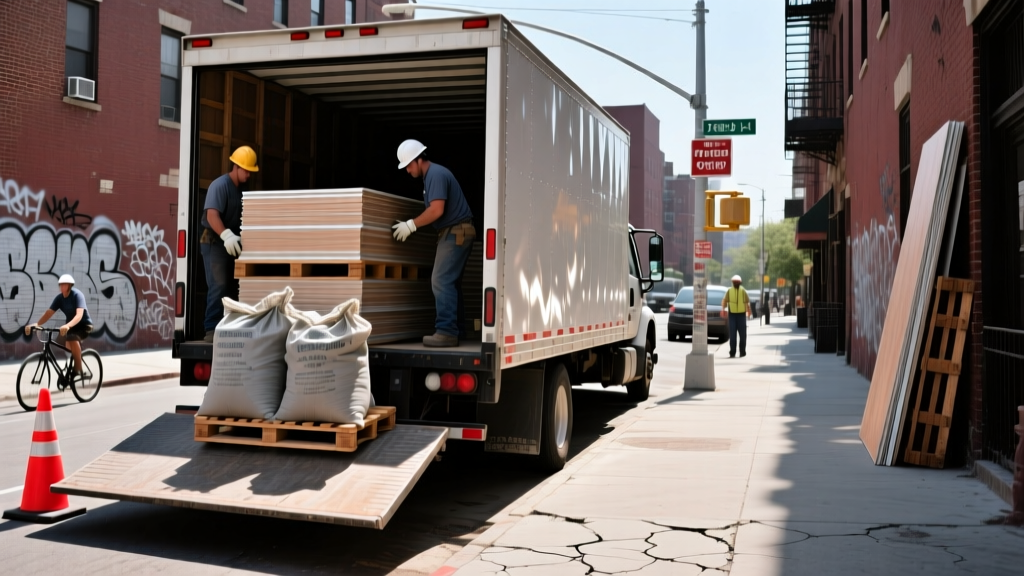
The physical act of getting materials from a supplier's yard to a Bronx job site is often where project margins evaporate. Commercial vehicle parking regulations enforced by the NYC DOT severely restrict flatbed deliveries on residential streets, and sidewalk shed permits dictate how materials can be staged.
According to the NYC Department of Transportation, commercial vehicles cannot park in most residential zones for extended loading/unloading without specific commercial meter receipts or off-hours delivery permits. When planning your material drops, use the following logistics matrix:
| Vehicle Type | Max Payload | Bronx Accessibility | Best Application Scenario |
|---|---|---|---|
| 53' Flatbed Trailer | 45,000 lbs | Poor. Restricted to major arteries (Bruckner, Major Deegan). Requires police detail for street closures. | Large-scale new builds with dedicated off-street loading docks or active sidewalk sheds with crane access. |
| 26' Box Truck with Liftgate | 10,000 lbs | Excellent. Can navigate most commercial and wide residential streets in Mott Haven, Hunts Point, and Fordham. | Interior retrofit materials (drywall, lumber, insulation) where pallets can be dropped directly on the sidewalk. |
| Sprinter Van / Pickup | 3,000 lbs | Superior. Unrestricted by commercial parking rules. | Emergency restocks, specialized fasteners, acoustic sealants, and finish hardware. |
Application Guide: Sourcing and Applying Masonry for Historic Facades
Neighborhoods like Mott Haven and Hunts Point are rich with pre-war, unreinforced masonry buildings. Under the NYC DOB's FISP (Local Law 11) facade inspection cycles, repointing and repairing historic brick is a constant requirement. The most common failure mode in Bronx masonry retrofits is the specification of modern, high-strength Portland cement mortars on soft, historic clay bricks.
The Mortar Mismatch Failure Mode
Pre-1930s bricks in the Bronx were fired at lower temperatures and are significantly softer than modern extruded bricks. If your supplier provides a standard Type S or Type M mortar mix, the mortar will be harder than the brick. During the freeze-thaw cycles characteristic of New York winters, the rigid mortar will not flex, causing the historic brick faces to spall and crack.
You must explicitly order Type N or Type O mortar from your Bronx building material supply yard. For highly deteriorated historic walls, specify a custom lime-putty mix rather than pre-bagged Portland blends.
Step-by-Step Repointing Application
Follow the technical guidelines established by the Brick Industry Association for executing durable masonry repairs:
- Joint Preparation: Rake out deteriorated mortar to a depth of 2 to 2.5 times the joint width. Use a diamond-tipped masonry blade, not a chisel, to prevent micro-fracturing the adjacent historic brick arris.
- Dampening: Thoroughly mist the open joints with water 24 hours before pointing, and again immediately before application. Historic brick acts like a sponge; if dry, it will suck the moisture out of the new Type N mortar, causing premature curing and weak bonds.
- Application: Pack the mortar into the joint in 1/4-inch layers using a pointing trowel and joint filler. Allow each layer to thumbprint-harden before applying the next.
- Tooling: Tool the joint with a convex jointer to compress the mortar against the brick edges, creating a dense, weather-resistant seal. Do not use a flat strike joint, which leaves a microscopic ledge for water infiltration.
- Curing: Mist the repointed joints lightly for 48 to 72 hours. Cover the wall with breathable burlap (never polyethylene, which traps heat and causes efflorescence) to ensure slow, proper carbonation of the lime.
Vetting Local Yards vs. National Big Box Suppliers
Where you source your materials dictates your project's agility. While national big-box stores offer volume pricing on commodity items, specialized urban retrofits require the flexibility and technical inventory of local Bronx or outer-borough supply yards.
| Evaluation Criteria | Local Bronx / NYC Yards | National Big Box Chains |
|---|---|---|
| Specialty Mortars & Lime | High availability. Stock Type N, O, and custom lime putties. Staff understands historic masonry. | Poor. Mostly stock high-strength Type S and Quikrete blends unsuitable for historic retrofits. |
| Delivery Agility | Can dispatch box trucks with Moffett forklifts for tight sidewalk drops on short notice. | Rely on third-party LTL carriers; scheduling a specific 2-hour delivery window is nearly impossible. |
| Commodity Pricing (Lumber/Drywall) | Moderate. Prices fluctuate with local wholesale markets. | Excellent. High-volume purchasing power keeps base material costs low. |
| Credit Terms for GCs | Flexible. Will often establish 30-to-60-day net terms for established local contractors. | Rigid. Requires corporate credit accounts or immediate payment via Pro Desk. |
Strategic Sourcing Framework
Do not rely on a single vendor. Implement a dual-source strategy for your Bronx projects:
- Source A (Local Yard): Use for heavy, specialized, or code-critical materials (masonry, acoustic assemblies, structural steel, fire-stopping compounds). The premium paid is offset by delivery reliability and technical accuracy.
- Source B (Big Box / National): Use for high-volume, low-risk commodity consumables (standard framing lumber, fasteners, plastic sheeting, basic insulation). Have your crew pick these up in cargo vans during off-peak hours to avoid delivery fees entirely.
Mastering the intersection of material science, NYC building codes, and hyper-local logistics is what separates profitable Bronx retrofits from those that stall in DOB inspection purgatory. Specify exactly what you need, understand how it must be transported, and apply it according to the strict tolerances demanded by the urban environment.
Written by
David NakamuraDavid Nakamura is a licensed architect (AIA) and construction technology writer focused on sustainable building methods, mass timber engineering, and high-performance building envelopes. He holds a Master of Architecture from the University of Washington and is a certified Passive House Consultant (CPHC). David spent eight years at the Seattle firm Mithun, where he led the design of three LEED Platinum projects, before founding his own practice specializing in net-zero residential design. He serves on the editorial advisory board of GreenBuilder Magazine and has authored peer-reviewed papers on cross-laminated timber (CLT) connections for the Journal of Structural Engineering. In his spare time, David teaches woodworking at Pratt Fine Arts Center and kayaks the Puget Sound.
More from David Nakamura
View all
Construction Cost
Labor Cost to Build a Deck Per Sq Ft: 2026 Installation Guide
Discover the exact labor cost to build a deck per sq ft in 2026. This installation guide breaks down contractor rates, complexity factors, and hidden fees.
Aug 4, 2026

Construction Cost
How Much Does It Cost to Build a 3 Bedroom House? Financing Guide
Learn exactly how much it costs to build a 3 bedroom house and explore 2026 financing options, construction loan types, and budget frameworks for your build.
Aug 4, 2026

Construction Cost
Cost to Build a Tennis Court: 2026 Guide
How much does it cost to build a tennis court in 2026? Breakdowns for asphalt, concrete, and synthetic surfaces plus fencing and lighting.
Jul 30, 2026