Building Material Donations: A Guide to Tax Deductions and Logistics
Learn how contractors and homeowners can navigate building material donations, qualify for IRS tax deductions, and partner with certified reuse centers.

The Financial and Environmental Case for Material Diversion
The construction and demolition (C&D) industry generates an estimated 600 million tons of debris annually in the United States alone, according to the Environmental Protection Agency (EPA). While much of this is concrete and asphalt, a significant portion consists of high-value, reusable building materials like dimensional lumber, architectural fixtures, and surplus finishing products. For contractors and homeowners, diverting these materials from landfills through strategic building material donations is no longer just an environmental gesture; it is a sophisticated financial strategy.
In 2026, average landfill tipping fees across North America hover between $55 and $85 per ton, with metropolitan areas often exceeding $100 per ton. When you factor in the cost of roll-off dumpsters, transport, and labor, throwing away usable materials is a compounding expense. Conversely, donating surplus or salvaged materials to qualified 501(c)(3) nonprofit organizations unlocks substantial noncash charitable tax deductions, effectively turning project waste into a tangible financial asset.
Eligibility Matrix: What Can and Cannot Be Donated
Not every item pulled from a job site or left over in the warehouse is eligible for donation. Certified reuse centers, such as those affiliated with the Building Materials Reuse Association (BMRA), enforce strict quality and safety standards. Below is a definitive matrix of acceptable materials versus items that will be universally rejected.
| Material Category | Acceptable Condition for Donation | Unacceptable / Red Flags |
|---|---|---|
| Dimensional Lumber & Framing | De-nailed, straight, free of rot. Stamped lumber (e.g., SPF #2 or better) preferred. | Painted pre-1978 wood (lead risk), warped stock, wood with extensive nail/screw damage. |
| Architectural Fixtures | Doors, windows, and cabinetry in working order. Hardware must be included. | Single-pane windows, cracked glass, cabinets with severe water damage or missing faces. |
| Plumbing & Electrical | Unused copper piping, PEX, modern low-flow toilets, LED lighting in original packaging. | Federal Pacific or Zinsco electrical panels, used gas lines, fixtures with corroded threads. |
| Finishes & Surfaces | Unopened boxes of tile, hardwood flooring, surplus paint (must be under 5 years old). | Asbestos-containing materials (ACM), open cans of solvent-based paints, peeled wallpaper. |
| HVAC & Appliances | Working units less than 7 years old with verifiable BTU/SEER ratings and clean coils. | Units requiring R-22 Freon, broken compressors, appliances missing manufacturer data plates. |
Navigating IRS Form 8283 for Noncash Contributions
The financial core of building material donations relies on properly executing IRS Form 8283 (Noncash Charitable Contributions). The IRS distinguishes between the valuation of inventory (for contractors) and capital assets (for homeowners), making precise documentation non-negotiable.
Understanding Fair Market Value (FMV) vs. Cost Basis
A common misconception is that you can deduct the original purchase price of the materials. The IRS mandates that deductions are based on the Fair Market Value (FMV) at the exact time of the donation. FMV is defined as the price a willing buyer would pay a willing seller in the current open market. For surplus, unopened materials (like a pallet of Moen brushed-nickel faucets), the FMV is often very close to the retail or wholesale cost. However, for salvaged materials (like reclaimed oak flooring pulled from a 1920s demolition), the FMV might actually exceed your zero-cost basis, though special IRS rules apply to ordinary income property.
- Section A (Under $5,000): If your total noncash donation for the tax year is under $5,000, you complete Section A of Form 8283. You need a contemporaneous written acknowledgment from the receiving charity and your own reliable records of the FMV.
- Section B (Over $5,000): Donations exceeding $5,000 require a formal, qualified appraisal completed by a certified professional. The appraiser must sign Part I of Section B, and the receiving organization must sign Part IV to acknowledge receipt.
Deconstruction vs. Demolition: A 2026 Cost-Benefit Analysis
To maximize building material donations, contractors must shift from traditional demolition to deconstruction—the systematic dismantling of structures to preserve material integrity. While deconstruction requires higher upfront labor costs, the tax savings and avoided tipping fees frequently result in a net-positive cash flow for whole-home remodels or tear-downs.
| Financial Metric | Traditional Demolition | Selective Deconstruction |
|---|---|---|
| Labor Time (2,000 sq ft) | 2 - 3 Days | 10 - 14 Days |
| Labor Cost (@ $65/hr) | $3,500 | $14,500 |
| Dumpster & Tipping Fees | $4,200 (approx. 40 tons) | $800 (approx. 8 tons to landfill) |
| Material Salvage Value | $0 | $35,000 (Appraised FMV) |
| Estimated Tax Savings (32% Bracket) | $0 | $11,200 |
| Net Project Impact | -$7,700 (Net Cost) | +$11,500 (Net Benefit) |
Note: Tax savings are illustrative and depend on the donor's specific marginal tax rate, state taxes, and whether the materials are classified as inventory or capital assets. Always consult a CPA.
Step-by-Step Appraisal and Documentation Workflow
To ensure your donations withstand an IRS audit, follow this rigorous documentation protocol:
- Pre-Sort and Inventory: Before the charity arrives, categorize materials. Create a spreadsheet detailing quantities, dimensions, and manufacturer model numbers (e.g., 'Kohler K-3817-0 Archer 54-inch Bath Receptor').
- Photographic Evidence: Take high-resolution, time-stamped photos of the materials in situ and staged for pickup. This proves the condition and existence of the items at the time of transfer.
- Secure a Qualified Appraiser: For claims over $5,000, hire an appraiser who holds a recognized designation from a professional appraisal organization (such as the American Society of Appraisers) and has verifiable experience in C&D materials.
- Obtain Form 1098-C or Acknowledgment Letter: The receiving 501(c)(3) must provide a written acknowledgment stating they received the goods, detailing whether any goods or services were provided in exchange, and confirming the date of the transfer.
- File Form 8283: Attach the completed Form 8283, including the appraiser's declaration and the charity's acknowledgment, to your annual tax return.
Frequently Asked Questions
Can I donate materials directly to a homeowner in need and claim a deduction?
No. To claim a charitable tax deduction, the donation must be made to a recognized 501(c)(3) tax-exempt organization. Giving materials directly to an individual, even if they are financially disadvantaged, does not qualify for an IRS write-off.
Who pays for the transportation of donated materials?
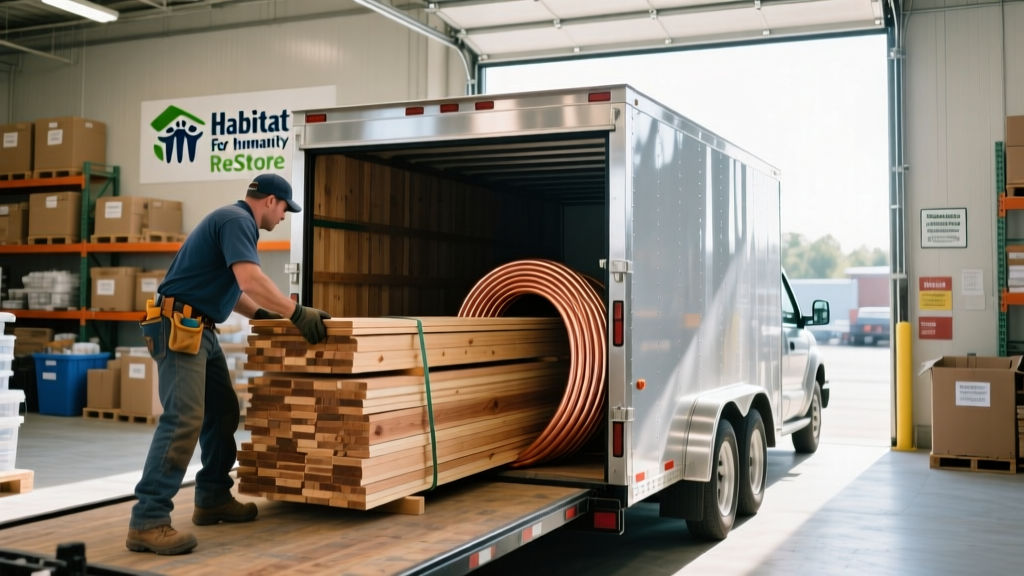
This varies by organization and volume. Large reuse centers like Habitat for Humanity ReStore often provide free truck pickup for substantial donations (typically valued over $500 or requiring a box truck). For smaller loads, the donor is usually responsible for drop-off logistics. Always factor transport costs into your net financial analysis.
What happens if the charity sells my donated materials for less than the appraised FMV?
Your tax deduction is based on the Fair Market Value at the time of the donation, not the price the charity eventually sells the item for on their retail floor. As long as your appraisal is defensible and conducted by a qualified professional, the charity's subsequent retail pricing does not invalidate your deduction.
Written by
Marcus ChenMarcus Chen is a licensed structural engineer (PE) and building materials analyst with over 12 years of experience across residential, commercial, and industrial construction. He holds a Master of Science in Civil Engineering from UC Berkeley and spent six years at Thornton Tomasetti before transitioning to independent consulting and technical writing. Marcus specializes in material selection for seismic-prone regions, concrete reinforcement strategies, and lifecycle cost analysis. His work has been cited by the American Concrete Institute (ACI) and the Structural Engineers Association of California (SEAOC). When he is not on a job site or at his desk, you will find him hiking the Sierra Nevada or restoring a 1920s craftsman bungalow in Oakland, CA.
More from Marcus Chen
View all
Construction Cost
How Much Did the Eiffel Tower Cost to Build?
How much did the Eiffel Tower cost to build in 1889? We adjust for inflation and compare its budget to modern skyscraper construction.
Aug 4, 2026

Fire Resistance
What Is a Fire Resistant Material? Testing & Certification Guide
Discover what is a fire resistant material through ASTM and UL testing. Learn how fire ratings, certifications, and assemblies work in construction.
Aug 4, 2026

Construction Cost
How Much Did the Burj Khalifa Cost to Build?
How much did the Burj Khalifa cost to build? We break down the $1.5B project and extract 5 money-saving strategies for your next build.
Jul 30, 2026