Selecting Good Building Materials: A Lifecycle Cost Guide
Learn how to select good building materials by evaluating lifecycle costs, structural durability, and hygrothermal performance for long-term value.

The True Cost of "Cheap" vs. Good Building Materials
Evaluating construction supplies solely on upfront invoice price is the most common financial error in residential and light commercial building. The distinction between standard code-minimum supplies and genuinely good building materials lies in lifecycle cost, hygrothermal resilience, and maintenance intervals. A material that saves $4,000 during framing but requires $12,000 in remediation for moisture damage within a decade represents a severe net loss. This guide bypasses generic advice to provide specific, data-driven selection criteria for structural, envelope, and roofing assemblies.
Substituting specified continuous insulation or weather-resistive barriers (WRB) with cheaper, non-vapor-permeable alternatives to save 3% on envelope costs frequently leads to interstitial condensation. In Climate Zones 5 and above, this traps moisture inside wall cavities, rotting structural sheathing long before the cladding shows visible distress.
Material Selection Matrix: Upfront Cost vs. Lifecycle Value
The following matrix compares standard builder-grade options against high-performance alternatives, calculating the true 50-year cost when factoring in replacement cycles, energy penalties, and maintenance.
| Material Category | Standard Option (Upfront) | Premium "Good" Option (Upfront) | 50-Year Lifecycle Cost Differential | Primary Failure Mode of Standard |
|---|---|---|---|---|
| Structural Framing | #2 SPF Dimensional Lumber | 20-Gauge (33 mil) Cold-Formed Steel | +$1,800 (Steel requires continuous exterior insulation to offset thermal bridging) | Shrinkage, warping, termite degradation, moisture rot |
| Exterior Cladding | Vinyl Siding (0.040" thick) | Fiber Cement (5/8" thick, e.g., James Hardie Artisan) | -$4,200 (Vinyl requires replacement at year 30; Fiber Cement lasts 50+ years) | UV degradation, thermal expansion cracking, impact shattering |
| Continuous Insulation | XPS Foam Board (R-5/inch) | Mineral Wool Board (Rockwool Comfortboard 80) | +$900 (Mineral wool is more expensive upfront but maintains R-value in extreme cold) | Loss of R-value over time due to HFC blowing agent off-gassing |
| Roofing System | Standard 3-Tab Asphalt Shingles | 24-Gauge Galvalume Standing Seam Metal | -$8,500 (Metal eliminates two 20-year asphalt replacement cycles) | Wind uplift tearing, granule loss, algae staining, 15-year lifespan |
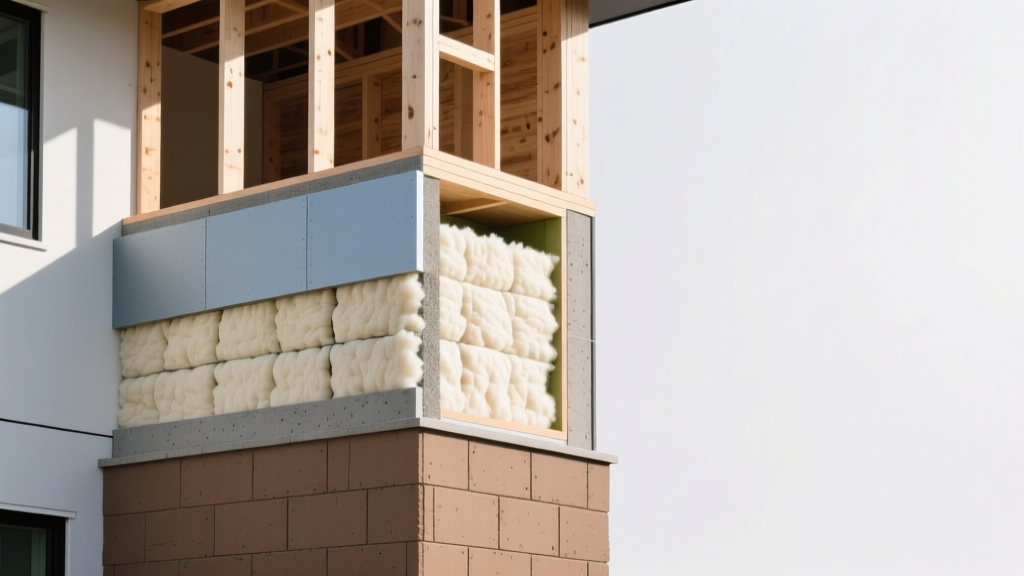
Evaluating Structural Framing: Wood vs. Cold-Formed Steel
When selecting framing materials, dimensional stability and moisture tolerance are the primary decision drivers. Standard #2 Grade Spruce-Pine-Fir (SPF) lumber remains the baseline, but it is highly susceptible to moisture content fluctuations. Lumber installed at >19% moisture content will inevitably shrink as it acclimates to the interior conditioned environment, causing drywall pops, nail squeaks, and truss uplift.
Cold-formed steel (CFS), specifically 20-gauge (33 mil) galvanized studs, eliminates organic shrinkage and pest vulnerabilities. However, steel is a massive thermal bridge. The Department of Energy notes that uninsulated steel studs can reduce the effective R-value of a wall cavity by up to 50%. Therefore, selecting CFS as a good building material strictly mandates the pairing with exterior continuous insulation (ci) to break the thermal bridge and prevent interior condensation on the steel web.
Exterior Envelope Selection: Managing Water and Thermal Bridges
The building envelope dictates the longevity of the entire structure. Good building materials in this category must manage liquid water, water vapor, air leakage, and heat flow simultaneously without compromising the structural sheathing.
Siding and Cladding Options
Vinyl siding is cost-effective initially but becomes brittle in freezing temperatures and softens in high heat, leading to fastener pull-through and wind tearing. For long-term durability, fiber cement and engineered wood are vastly superior.
- Fiber Cement (e.g., James Hardie Artisan Collection): At 5/8" thick, this material is impervious to rot and termites. It requires specific installation protocols, including 1.5" corrosion-resistant roofing nails and 1/8" gaps at joints to accommodate thermal expansion. It holds paint 2-3 times longer than wood due to its dimensional stability.
- Engineered Wood (e.g., LP SmartSide ExpertFinish): At 7/16" thick, this is lighter and easier to cut than fiber cement. It is treated with zinc borate to resist fungal decay and termites. The factory-applied acrylic finish provides a 15-year moisture resistance warranty, but edge sealing during field cuts is mandatory to prevent core water intrusion.
Continuous Insulation (ci) and Weather Barriers
Extruded polystyrene (XPS) has historically dominated the ci market, but its reliance on HFC blowing agents means its R-value degrades over time as the gases off-gas. Furthermore, XPS is vapor-impermeable, which can trap moisture inside wall assemblies in cold climates. Mineral wool boards, such as Rockwool Comfortboard 80, offer a stable R-4.3 per inch that does not degrade with temperature fluctuations or time. More importantly, mineral wool is vapor-open (perm rating > 50), allowing the wall assembly to dry to the exterior.
Pairing this with a fluid-applied WRB like Prosoco R-Guard FastFlash eliminates the tearing and seam-tape failures associated with traditional spunbonded polyolefin housewraps. According to building science principles outlined by the Building Science Corporation, vapor-open exterior insulation combined with a fully adhered fluid WRB is critical for preventing interstitial condensation in high-performance wall assemblies.
Roofing Systems: Impact Resistance and Solar Reflectance
Roofing materials face the most extreme environmental degradation of any building component. Standard 3-tab asphalt shingles typically fail within 15 to 18 years due to UV degradation, thermal shock, and wind uplift.
For a truly durable selection, architectural shingles must meet UL 2218 Class 4 impact resistance to withstand severe hail. The GAF Timberline UHDZ line incorporates a reinforced StrikeZone nailing area and SBS modified asphalt for superior flexibility in freezing temperatures. However, in wildfire-prone areas or regions with high wind loads, 24-gauge Galvalume standing seam metal is the definitive choice. The Insurance Institute for Business & Home Safety (IBHS) FORTIFIED Home standard heavily favors metal roofing and Class 4 impact-rated shingles for wind and hail resilience. Standing seam systems utilize concealed fasteners and interlocking seams that can withstand 140+ mph wind uplift, offering a verified 50-year service life with minimal maintenance. Additionally, specifying a cool-roof coating with a Solar Reflectance Index (SRI) of 50 or higher can reduce peak cooling loads by up to 15%.
The 4-Step Material Vetting Framework for Builders
To systematically evaluate whether a material qualifies as a good building material for your specific project, apply this four-step vetting framework before issuing purchase orders:
- Hygrothermal Risk Assessment: Run the proposed wall or roof assembly through WUFI (Wärme und Feuchte instationär) software. If the material combination shows moisture accumulation exceeding 15% by mass during the winter months, the material selection is fundamentally flawed for that specific climate zone and requires a vapor retarder adjustment.
- Code Baseline vs. Performance Target: Cross-reference the material's specifications against the latest IECC (International Energy Conservation Code) and local amendments. Good materials should exceed code minimums by at least 15% to future-proof the building against impending regulatory tightening and energy cost volatility.
- Supply Chain Lead Time Verification: High-performance materials (like specialized fluid-applied WRBs or specific mineral wool thicknesses) often have 6-to-10-week lead times. Verify distributor stock levels before finalizing the architectural schedule to prevent project delays that force value-engineering down to inferior substitutes.
- Installer Certification Check: The best materials fail if installed incorrectly. Require proof of manufacturer-specific certification for the subcontractor. For example, James Hardie requires installers to pass specific flashing and fastening modules to validate the 30-year product warranty, and fluid-applied WRBs require certified applicators to ensure proper mil-thickness.
Selecting good building materials requires shifting the procurement focus from initial bid pricing to long-term hygrothermal performance and lifecycle durability. By specifying vapor-open insulation, dimensionally stable cladding, and impact-resistant roofing, builders eliminate the hidden costs of premature failure, energy penalties, and warranty callbacks.
Written by
Elena RodriguezElena Rodriguez is a civil engineer and technical writer specializing in concrete technology, masonry systems, and ASTM/ACI compliance. She earned her B.S. in Civil Engineering from Texas A&M University and spent a decade at a materials testing laboratory, performing over 2,000 concrete compressive strength tests and masonry prism evaluations. Elena is an ACI-certified Field Testing Technician (Grade I) and a member of ASTM Committee C12 on Natural Building Stone. She currently consults on forensic engineering cases involving concrete failures and moisture intrusion. Based in San Antonio, TX, Elena is a proud member of the Society of Women Engineers (SWE) and coaches her daughter's FIRST Robotics team.
More from Elena Rodriguez
View all
Walls & Panels
Cost Analysis: Light Gauge Steel Framing Advantages and Disadvantages
Evaluate light gauge steel framing advantages and disadvantages through a strict cost analysis lens, comparing material, labor, and lifecycle expenses.
Aug 4, 2026

Walls & Panels
Gypsum Board Types: Exact Specifications, Thickness & Dimensions
Compare standard, Type X, and moisture-resistant gypsum board types. Get exact specifications, thicknesses, dimensions, and ASTM standards for your project.
Aug 4, 2026

Fire Resistance
Best Fire-Resistant Outdoor Decking Materials: 2026 Buyer Guide
Discover the best fire-resistant outdoor decking materials for 2026. Compare Class A PVC, aluminum, and hardwood options for WUI compliance and safety.
Aug 4, 2026