Guaranty Building Materials: A Comprehensive Warranty Guide
Master the complexities of guaranty building materials. Learn how to evaluate coverage, avoid voided claims, and maximize ROI on construction warranties.
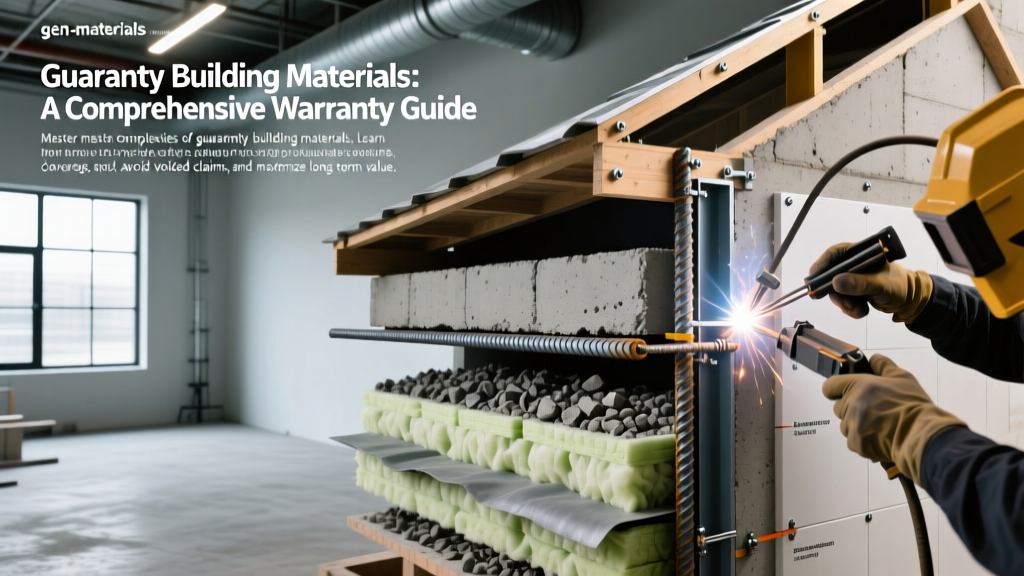
The Legal and Practical Distinction: Guaranty vs. Warranty
In construction procurement, the phrase 'guaranty building materials' is frequently used interchangeably with warranted materials, but the legal distinction carries massive financial implications. Under standard construction law and frameworks outlined in the AIA Contract Documents, a warranty is a manufacturer's assurance regarding the quality and defect-free nature of the product itself. A guaranty, conversely, is typically a third-party promise (often from a surety or parent corporation) to fulfill the manufacturer's obligations or compensate the owner if the manufacturer defaults or goes bankrupt.
When sourcing guaranty building materials for high-performance envelopes or large-scale commercial projects in 2026, you are not just buying the physical product; you are buying the financial stability of the entity backing it. Materials backed by a true third-party guaranty (such as those insured by major sureties) offer vastly superior protection compared to standard manufacturer warranties, which become worthless if the company ceases operations.
Tiered Coverage Matrix: Evaluating Material Guaranties
Not all coverage is created equal. Manufacturers often use marketing terms like 'Lifetime' or '50-Year' to obscure prorated limitations. Below is a technical breakdown of what premium guaranties actually cover across critical building envelope materials.
| Material Category | Standard Warranty | Premium / Third-Party Guaranty | Critical Installation Requirement for Validity |
|---|---|---|---|
| Asphalt Roofing (Architectural) | 30-year prorated (material only) | 50-year non-prorated (material + labor + tear-off) | Must use 5+ same-brand accessories (e.g., GAF Golden Pledge requires specific underlayment, starter strips, and ridge caps). |
| Fiber Cement Siding | 30-year non-prorated (material only) | 30-year with 15-year finish guaranty | Strict adherence to blind-nailing protocols and use of hot-dipped galvanized or stainless steel fasteners (min 0.113' shank). |
| Extruded Vinyl Windows | 10-year parts / 5-year glass seal | 20-year insulating glass seal / Lifetime frame guaranty | Must be installed with manufacturer-specified shimming tolerances and non-expanding, low-pressure polyurethane foam. |
| Weather-Resistant Barriers (WRB) | 10-year material defect | 15-year system guaranty (labor included) | Zero tolerance for mixed-brand flashing tapes or staples; must use cap nails or approved adhesive tapes exclusively. |
The 'Mixed-System' Trap: How Builders Accidentally Void Coverage
The most common reason claims on guaranty building materials are denied in 2026 is the 'mixed-system' exclusion. Manufacturers engineer their premium guaranties around the chemical and physical compatibility of their entire product ecosystem. When a contractor substitutes a secondary component to save money or time, the entire guaranty is immediately voided.
Installing a premium fluid-applied weather-resistant barrier but using a competitor's self-adhered flashing tape at the window rough openings will void the system guaranty. The chemical plasticizers in competitor tapes can degrade the fluid-applied membrane over time. Always verify the manufacturer's published 'Approved Accessories List' before procurement.
Similarly, in roofing, substituting a generic synthetic underlayment for the manufacturer's proprietary high-friction underlayment voids the wind-uplift guaranty. The proprietary underlayment is tested specifically for its tensile strength and friction coefficient with the manufacturer's shingles to meet ASTM D3161 Class F wind resistance standards.
Fastener and Substrate Specifications That Dictate Validity
Hardware and substrate preparation are the silent killers of material guaranties. The National Association of Home Builders frequently highlights that improper fastening accounts for over 30% of exterior cladding failures, none of which are covered under product guaranties.
Fiber Cement and Wood-Composite Cladding
For fiber cement siding, using standard electro-galvanized nails is a guaranty-voiding error. The zinc coating on electro-galvanized nails is too thin and will corrode within 5 to 7 years, leading to rust streaks and structural pull-through. The guaranty explicitly requires hot-dipped galvanized (HDG) or 304/316 stainless steel fasteners. Furthermore, blind-nailing techniques must leave exactly 1/8-inch to 1/4-inch clearance between the panel and the underlying Z-flashing to allow for thermal expansion; failure to maintain this gap voids the buckling and cracking guaranty.
Substrate Moisture Tolerances
Installing moisture-sensitive guaranty materials (like engineered hardwood or certain rigid core LVT flooring) over concrete slabs without conducting and documenting a Calcium Chloride test (ASTM F1869) or an in-situ relative humidity test (ASTM F2170) will nullify the moisture-warping guaranty. The slab must read below 3-5 lbs per 1,000 sq ft per 24 hours, and this data must be logged and submitted with the warranty registration.

Step-by-Step Protocol for Registering and Enforcing Claims
A guaranty is only as strong as your documentation. Under the Magnuson-Moss Warranty Act, consumers and commercial entities have specific rights, but the burden of proof for proper installation rests on the builder or owner. Follow this protocol to ensure enforceability:
- Pre-Installation Photographic Log: Photograph the substrate preparation, fastener types (showing the stamp on the nail head), and weather conditions on the day of installation.
- Batch and Lot Number Retention: Cut the lot number labels off the packaging of roofing, siding, and windows. Tape these to the inside of the electrical panel or store them in the building's physical O&M (Operations and Maintenance) manual. If a defect arises 12 years later, the manufacturer will require the lot number to verify the production run.
- Timely Registration: Most premium guaranties require registration within 30 to 90 days of project completion. Failure to register often results in an automatic downgrade from a non-prorated guaranty to a standard prorated warranty.
- Transferability Documentation: If the property is sold, execute the official guaranty transfer form. In 2026, a transferred premium roofing guaranty can increase a home's appraisal value by up to 1.5%, but only if the transfer fee is paid and recorded within 60 days of the property closing.
Financial Modeling: The True Cost of Extended Guaranties
Upgrading to materials backed by comprehensive, labor-inclusive guaranties requires a higher initial capital outlay, but the lifecycle ROI is substantial. Consider a 2,500 sq. ft. roofing project:
- Standard Material Cost: $1.85 per sq. ft. (30-year prorated, material only).
- Premium Guaranty System Cost: $3.15 per sq. ft. (50-year non-prorated, includes labor, tear-off, and disposal).
- Upfront Premium: $3,250 additional investment.
If a standard roof fails at year 18 due to a manufacturing defect (e.g., premature granule loss or thermal cracking), a prorated warranty will only cover roughly 40% of the material cost at current market rates, leaving the owner responsible for 100% of the tear-off, disposal, and labor costs—which typically constitute 65% of the total replacement invoice. The premium guaranty covers 100% of these costs. When factoring in the 4% annual inflation rate of construction labor, the break-even point for the extended guaranty premium is realized upon the first major claim, effectively acting as a fixed-cost insurance policy against both product defects and future labor inflation.
Written by
Marcus ChenMarcus Chen is a licensed structural engineer (PE) and building materials analyst with over 12 years of experience across residential, commercial, and industrial construction. He holds a Master of Science in Civil Engineering from UC Berkeley and spent six years at Thornton Tomasetti before transitioning to independent consulting and technical writing. Marcus specializes in material selection for seismic-prone regions, concrete reinforcement strategies, and lifecycle cost analysis. His work has been cited by the American Concrete Institute (ACI) and the Structural Engineers Association of California (SEAOC). When he is not on a job site or at his desk, you will find him hiking the Sierra Nevada or restoring a 1920s craftsman bungalow in Oakland, CA.
More from Marcus Chen
View all
Construction Cost
How Much Did the Eiffel Tower Cost to Build?
How much did the Eiffel Tower cost to build in 1889? We adjust for inflation and compare its budget to modern skyscraper construction.
Aug 4, 2026

Fire Resistance
What Is a Fire Resistant Material? Testing & Certification Guide
Discover what is a fire resistant material through ASTM and UL testing. Learn how fire ratings, certifications, and assemblies work in construction.
Aug 4, 2026

Construction Cost
How Much Did the Burj Khalifa Cost to Build?
How much did the Burj Khalifa cost to build? We break down the $1.5B project and extract 5 money-saving strategies for your next build.
Jul 30, 2026