Imperial Building Materials Inc: 2026 Cost Analysis & Pricing
Analyze 2026 pricing, freight, and ROI of sourcing masonry and stucco from Imperial Building Materials Inc versus big-box competitors.

The True Cost of Sourcing from Imperial Building Materials Inc
Sourcing masonry, stucco, and exterior insulation systems requires navigating a complex pricing landscape that extends far beyond the base unit cost. For general contractors and specialized masonry subcontractors, evaluating Imperial Building Materials Inc against big-box home improvement centers or direct mill purchases requires a granular cost analysis. In 2026, supply chain stabilization has shifted the market dynamic; while baseline material costs have plateaued, logistics, minimum order quantities (MOQs), and technical compliance now dictate the true landed cost of exterior building envelopes.
Imperial Building Materials Inc operates primarily as a professional-grade distributor and manufacturer representative, focusing heavily on commercial and high-end residential exterior finishes. Unlike retail-focused suppliers, their pricing models are structured around volume tiers, project-specific quoting, and integrated logistics. According to recent data tracked by the Bureau of Labor Statistics Producer Price Index, specialized masonry and stucco products have seen a 3.2% year-over-year price adjustment in early 2026, largely driven by cement kiln energy costs and regional sand aggregate shortages.
Base Material Pricing vs. Market Averages
To understand the financial viability of using Imperial Building Materials Inc, we must compare their professional-tier pricing against retail pro-desks and direct manufacturer bulk rates. The table below outlines average 2026 unit costs for core exterior materials.
| Material Specification | Imperial Building Materials Inc (Pro Tier) | Big-Box Retail Pro Desk | Direct Manufacturer (FTL Only) |
|---|---|---|---|
| 8x8x16 Standard CMU (ASTM C90) | $2.15 - $2.35 / unit | $2.65 - $2.90 / unit | $1.85 - $2.05 / unit |
| 80 lb Portland Cement Plaster (Stucco Base) | $14.50 - $15.80 / bag | $17.99 - $19.50 / bag | $12.50 - $13.80 / bag |
| EIFS Base Coat (50 lb pail) | $42.00 - $46.50 / pail | Rarely Stocked | $38.00 - $41.00 / pail |
| Welded Wire Lath (1.5 lb, 25 sq yd roll) | $38.50 / roll | $45.00 / roll | $32.00 / roll |
While direct manufacturers offer the lowest per-unit cost, they require Full Truckload (FTL) commitments—typically 40,000 lbs or roughly 10,000 standard CMUs. Imperial Building Materials Inc bridges this gap by offering LTL (Less Than Truckload) consolidation and mixed-pallet configurations, making them highly cost-effective for mid-sized projects requiring 2,000 to 8,000 units.
The Logistics Multiplier: Freight, MOQs, and Handling
Material cost represents only 60% to 70% of the total landed cost for heavy exterior finishes. The remaining percentage is consumed by freight, offloading, and staging. When procuring from Imperial Building Materials Inc, contractors must account for their specific distribution model.
Pallet Configuration and Breakage Allowances
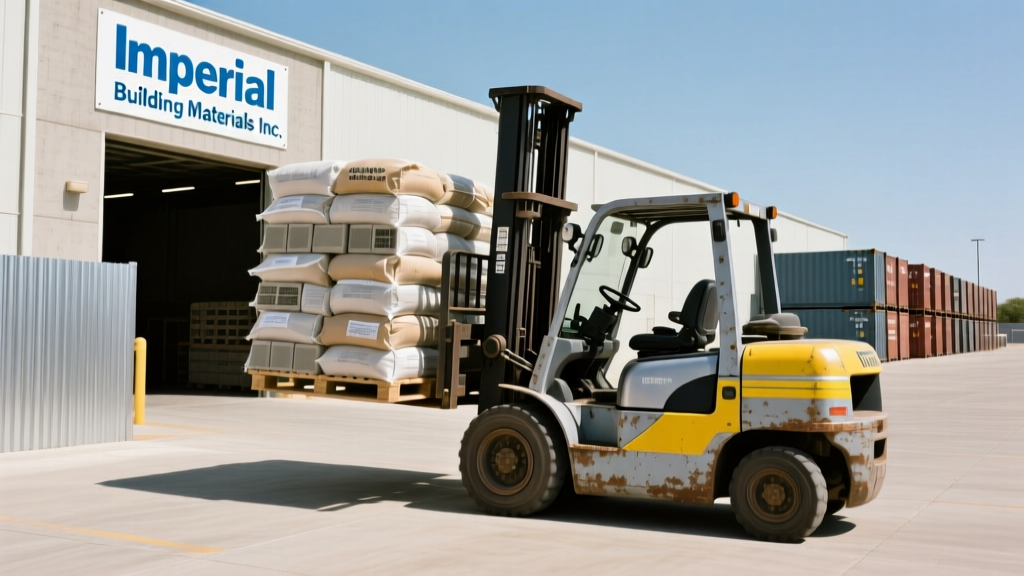
A hidden cost in masonry procurement is breakage and yield loss. Big-box retailers often store CMUs and stucco bags outdoors on degraded pallets, leading to a 4% to 7% breakage rate upon delivery. Imperial Building Materials Inc utilizes shrink-wrapped, corner-boarded pallets stored in climate-controlled or covered bays. Industry data aggregated by the U.S. Census Bureau Construction division indicates that reducing material yield loss from 5% to 1.5% on a $100,000 exterior envelope budget saves $3,500—effectively paying for the slight premium in specialized distribution.
Deep Dive: Exterior Finish Systems Cost Matrix
Imperial Building Materials Inc is particularly dominant in the stucco and Exterior Insulation and Finish Systems (EIFS) markets. These systems are highly sensitive to mix consistency, chemical admixture compatibility, and substrate preparation. Evaluating the cost requires looking at the entire assembly, not just the raw ingredients.
| Cost Factor | Imperial Sourced EIFS/Stucco | Generic / Mixed-Brand Sourcing |
|---|---|---|
| Base Material Cost (per sq ft) | $3.85 - $4.50 | $3.20 - $3.90 |
| Labor Efficiency (Crew Output) | High (Pre-matched admixtures) | Variable (Requires field testing) |
| Warranty / Callback Risk | Low (Single-source warranty) | High (Blame-shifting between brands) |
| Technical Support Availability | Dedicated Field Reps included | Paid third-party consultants ($150/hr) |
When applying a three-coat stucco system over open framing, ASTM C926 standards dictate strict moisture and curing protocols. Imperial provides proprietary liquid bonding agents and acrylic fortifiers that are chemically engineered to interact with their specific Portland cement blends. Attempting to save $0.40 per bag by mixing Imperial base coats with generic acrylic additives from a hardware store frequently results in delamination or efflorescence, leading to remediation costs that can exceed $22 per square foot.
Hidden Savings: Technical Support and Waste Reduction
The most under-quantified financial benefit of partnering with Imperial Building Materials Inc is the mitigation of design and application errors. Commercial exterior envelopes are subject to intense scrutiny regarding thermal bridging and moisture management.
- Pre-Construction Takeoff Audits: Imperial’s estimating team routinely reviews architectural plans to identify missing weep screeds, incorrect control joint spacing, or inadequate flashing integrations. Catching a missing 400-linear-foot run of weep screed before the lath is applied saves approximately $1,800 in tear-out and rework labor.
- Color Matching and Batching: For integral color stucco, Imperial guarantees batch-to-batch consistency by holding reserve lots for specific commercial projects. This eliminates the "paneling" effect on large facades, a defect that requires $4.00 to $6.00 per square foot in elastomeric coating to mask.
- Just-In-Time (JIT) Delivery Sequencing: Stucco and EIFS materials are highly susceptible to moisture damage if staged improperly on-site. Imperial coordinates multi-drop deliveries, ensuring finish coats arrive only after the scratch and brown coats have adequately cured, reducing on-site material degradation.
Strategic Procurement Framework for 2026
Determining whether to route your exterior material budget through Imperial Building Materials Inc or an alternative supplier should be dictated by project scale, complexity, and risk tolerance. Use the following decision matrix to guide your 2026 procurement strategy:
When to Choose Imperial Building Materials Inc:
- Project Type: Commercial facades, multi-family residential, or high-end custom homes requiring strict warranty compliance.
- Material Volume: 2,000+ CMUs, or 1,500+ sq ft of stucco/EIFS application.
- Site Constraints: Urban job sites with limited staging area requiring precise, multi-phase LTL deliveries.
- Risk Profile: Projects where moisture intrusion callbacks carry severe financial penalties or litigation risks.
When to Consider Alternatives:
- Project Type: Minor residential repairs, small retaining walls, or non-structural landscaping masonry.
- Material Volume: Less than 500 CMUs or under 10 bags of stucco mix.
- Logistics: Remote rural sites outside of Imperial’s proprietary route-truck radius, where third-party LTL freight surcharges will obliterate any unit-cost savings.
Ultimately, the cost analysis of Imperial Building Materials Inc reveals a supplier optimized for the mid-to-large scale professional contractor. While the absolute lowest per-unit price will always belong to direct mill FTL purchases, the integration of mixed-pallet logistics, ASTM-compliant chemical matching, and single-source warranty protection positions Imperial as a highly cost-effective partner for complex 2026 exterior envelope projects. Contractors who factor in labor efficiency and callback mitigation will consistently find that the Imperial premium yields a net-positive ROI on the job site.
Written by
Marcus ChenMarcus Chen is a licensed structural engineer (PE) and building materials analyst with over 12 years of experience across residential, commercial, and industrial construction. He holds a Master of Science in Civil Engineering from UC Berkeley and spent six years at Thornton Tomasetti before transitioning to independent consulting and technical writing. Marcus specializes in material selection for seismic-prone regions, concrete reinforcement strategies, and lifecycle cost analysis. His work has been cited by the American Concrete Institute (ACI) and the Structural Engineers Association of California (SEAOC). When he is not on a job site or at his desk, you will find him hiking the Sierra Nevada or restoring a 1920s craftsman bungalow in Oakland, CA.
More from Marcus Chen
View all
Construction Cost
How Much Did the Eiffel Tower Cost to Build?
How much did the Eiffel Tower cost to build in 1889? We adjust for inflation and compare its budget to modern skyscraper construction.
Aug 4, 2026

Fire Resistance
What Is a Fire Resistant Material? Testing & Certification Guide
Discover what is a fire resistant material through ASTM and UL testing. Learn how fire ratings, certifications, and assemblies work in construction.
Aug 4, 2026

Construction Cost
How Much Did the Burj Khalifa Cost to Build?
How much did the Burj Khalifa cost to build? We break down the $1.5B project and extract 5 money-saving strategies for your next build.
Jul 30, 2026