Overcoming Building Materials Industry Challenges: 2024 Lessons for 2026
Analyze how building materials industry challenges from 2024 reshaped 2026 procurement, featuring concrete pricing data, lead times, and risk matrices.

The Hangover Effect: How Past Disruptions Reshaped Current Procurement
When industry analysts look back at the building materials industry challenges 2024 presented to global supply chains, the consensus is clear: the era of Just-In-Time (JIT) delivery for critical construction components is dead. The compounding pressures of geopolitical friction, peak interest rates, and sudden regulatory shifts in 2024 forced general contractors and material suppliers to fundamentally rewrite their procurement playbooks. Now, operating in 2026, the sector has transitioned to a Just-In-Case (JIC) inventory model, but this shift has introduced new complexities regarding carrying costs, material degradation, and capital allocation.
For estimators and project managers, understanding the delta between the 2024 crisis points and the 2026 stabilized realities is critical for accurate bidding. The volatility hasn't disappeared; it has merely migrated from logistics and lead times to compliance, decarbonization premiums, and specialized labor requirements. According to data tracked by the Bureau of Labor Statistics Producer Price Index (PPI), while aggregate construction material inputs have stabilized compared to the wild swings of the early 2020s, specific sub-categories like electrical infrastructure and low-carbon cementitious materials continue to experience localized price shocks.
Material-Specific Bottlenecks: Then vs. Now
To build accurate 2026 budgets, procurement teams must contextualize current pricing against the peak disruption periods. The table below outlines the evolution of four highly volatile material categories, contrasting their 2024 peak challenges with their current 2026 operational realities.
| Material Category | 2024 Peak Challenge | 2026 Current State | Est. 2026 Cost Impact |
|---|---|---|---|
| SPF Dimensional Lumber (2x4x8) | Rail strikes and mill curtailments caused 18% price spikes in Q2. | Stabilized supply, but FSC-certified stock commands a strict premium. | ~$410/MBF (Base), +12% for certified sustainable stock. |
| Portland-Limestone Cement (Type IL) | Regional shortages due to rapid transition away from Type I/II. | Standardized in 34 states; supply is robust but baseline costs are higher. | $14-$18/ton premium over legacy Type I/II equivalents. |
| Pad-Mounted Electrical Transformers | Lead times stretched to 60-80 weeks due to GOES steel shortages. | Lead times reduced to 24-32 weeks, but unit pricing remains elevated. | +22% unit cost increase driven by copper and grain-oriented steel. |
| Commercial VRF HVAC Units | Refrigerant transition (HFC phasedown) caused severe allocation limits. | A2L refrigerant models are standard; supply normalized but requires new certifications. | +8% equipment cost, plus 15% increase in specialized labor rates. |
The Decarbonization Premium: Navigating Type IL Cement and EPDs
One of the most enduring legacies of the regulatory environment that accelerated during the 2024 challenges is the strict enforcement of embodied carbon limits in public and large-scale commercial projects. The shift toward Type IL (Portland-limestone) cement is no longer a pilot program; it is the baseline. By replacing up to 15% of the clinker with ground limestone, Type IL reduces the carbon footprint of the binder significantly. The Portland Cement Association (PCA) notes that this transition has permanently altered the cost structure of concrete mixes.
However, the true procurement hurdle in 2026 isn't just the cementitious binder—it is the Environmental Product Declaration (EPD). Project specifications now routinely require Type III (facility-specific) EPDs for structural steel, concrete, and glass. Sourcing materials from suppliers who have not invested in the lifecycle analysis (LCA) required to generate these documents will result in immediate bid disqualification on projects governed by Buy Clean policies or LEED v5 standards.
Do not accept generic, industry-average (Type I) EPDs when the project specifications explicitly demand facility-specific (Type III) data. In Q1 2026, multiple major municipal infrastructure bids were rejected because suppliers provided outdated 2023 industry-average EPDs instead of current, plant-specific documentation. Always verify the EPD issue date and the specific manufacturing facility code against your concrete batch plant or steel mill source before finalizing subcontracts.
Strategic Framework: The 2026 Material Risk Matrix
Relying on historical square-foot costs is a fast track to margin erosion. Leading general contractors are now utilizing a Material Risk Matrix during the preconstruction phase to classify procurement strategies. This framework categorizes materials based on supply volatility and schedule impact, dictating the appropriate contracting and purchasing method.
Quadrant 1: High Volatility / High Schedule Impact
- Examples: Switchgear, custom curtain wall extrusions, large-capacity chillers.
- 2026 Strategy: Owner Direct Purchase (ODP) or early release packages. Contractors should negotiate these items as owner-furnished equipment (OFE) to transfer the price escalation risk, or secure early procurement agreements with guaranteed maximum price (GMP) caps tied to specific raw material indices.
Quadrant 2: Low Volatility / High Schedule Impact
- Examples: Structural steel, precast concrete panels, elevators.
- 2026 Strategy: Long-lead lock-in. Utilize ConsensusDocs 200.1 or similar material escalation addendums to lock in pricing at the time of the GMP, while securing warehouse space for early delivery if the site is not ready to receive the materials.
Quadrant 3: High Volatility / Low Schedule Impact
- Examples: Dimensional lumber, drywall, copper piping.
- 2026 Strategy: Algorithmic purchasing and bulk hedging. Leverage predictive ERP modules that track commodity futures and automatically trigger purchase orders when prices dip below the 90-day moving average.
Quadrant 4: Low Volatility / Low Schedule Impact
- Examples: Interior finishes, standard insulation, basic fasteners.
- 2026 Strategy: Just-In-Time (JIT) delivery. Maintain standard subcontractor flow-down terms and rely on local distributor stock to minimize on-site storage and theft risk.
Contractual Protections: Moving Beyond Standard Escalation Clauses
The standard force majeure and material escalation clauses found in legacy AIA documents proved woefully inadequate during the compounding crises of the early 2020s. The Associated General Contractors of America (AGC) has continually emphasized that standard clauses often cap relief at a fixed percentage (e.g., 5% or 10%), which fails to cover the 30%+ spikes seen in commodities like copper and electrical steel.
For 2026 projects, sophisticated estimators are embedding dynamic escalation triggers tied directly to the Bureau of Labor Statistics PPI indices. Instead of a flat percentage buffer, the contract stipulates that if the specific PPI index for "Electrical Wiring Supplies" or "Fabricated Structural Metal" increases by more than 4% between the date of the bid and the date of the actual purchase order, the owner absorbs the delta. This requires meticulous documentation: contractors must save the exact PPI index value published on the day the bid was submitted and compare it to the index published the month the material is fabricated.
Technology Interventions: AI-Driven Predictive Ordering
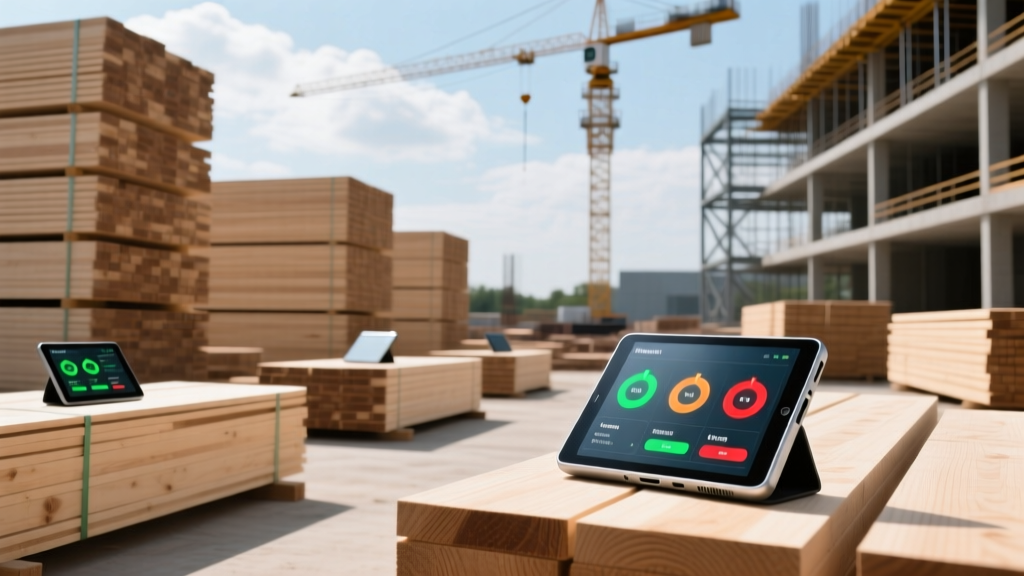
The final major evolution stemming from past supply chain failures is the integration of AI-driven predictive ordering within construction management software. Platforms have moved beyond simple inventory tracking to predictive analytics. By ingesting global shipping data, raw commodity futures, and local weather patterns, these systems can forecast localized material shortages up to 12 weeks in advance.
For example, if a system detects a slowdown in resin production in the Gulf Coast due to an approaching weather system, it will automatically flag all upcoming PVC piping and synthetic roofing membrane orders for the affected region, prompting the procurement team to authorize alternative suppliers or expedite shipping before the broader market reacts and prices surge. This proactive stance is the defining characteristic of successful 2026 material management, turning historical challenges into a competitive advantage through data superiority.
Written by
Marcus ChenMarcus Chen is a licensed structural engineer (PE) and building materials analyst with over 12 years of experience across residential, commercial, and industrial construction. He holds a Master of Science in Civil Engineering from UC Berkeley and spent six years at Thornton Tomasetti before transitioning to independent consulting and technical writing. Marcus specializes in material selection for seismic-prone regions, concrete reinforcement strategies, and lifecycle cost analysis. His work has been cited by the American Concrete Institute (ACI) and the Structural Engineers Association of California (SEAOC). When he is not on a job site or at his desk, you will find him hiking the Sierra Nevada or restoring a 1920s craftsman bungalow in Oakland, CA.
More from Marcus Chen
View all
Construction Cost
How Much Did the Eiffel Tower Cost to Build?
How much did the Eiffel Tower cost to build in 1889? We adjust for inflation and compare its budget to modern skyscraper construction.
Aug 4, 2026

Fire Resistance
What Is a Fire Resistant Material? Testing & Certification Guide
Discover what is a fire resistant material through ASTM and UL testing. Learn how fire ratings, certifications, and assemblies work in construction.
Aug 4, 2026

Construction Cost
How Much Did the Burj Khalifa Cost to Build?
How much did the Burj Khalifa cost to build? We break down the $1.5B project and extract 5 money-saving strategies for your next build.
Jul 30, 2026