Technical Specs for Building Materials in Jackson, MS
Technical specifications for building materials in Jackson, MS. Engineering solutions for Yazoo clay, ASHRAE Zone 3A humidity, and termite resistance.

The Geotechnical Reality: Designing for Expansive Yazoo Clay
Constructing in Jackson, Mississippi, requires navigating one of the most challenging soil profiles in the United States: the Yazoo clay formation. This highly expansive soil possesses a Liquid Limit (LL) frequently exceeding 60 and a Plasticity Index (PI) ranging from 40 to 90. According to USGS geotechnical data, soils with a PI above 40 exhibit severe volumetric swelling when moisture content fluctuates, generating uplift pressures that can exceed 5,000 pounds per square foot (psf).
Standard slab-on-grade foundations with simple thickened edges will inevitably fail in these conditions. Technical specifications for Jackson foundations must incorporate the following engineering controls:
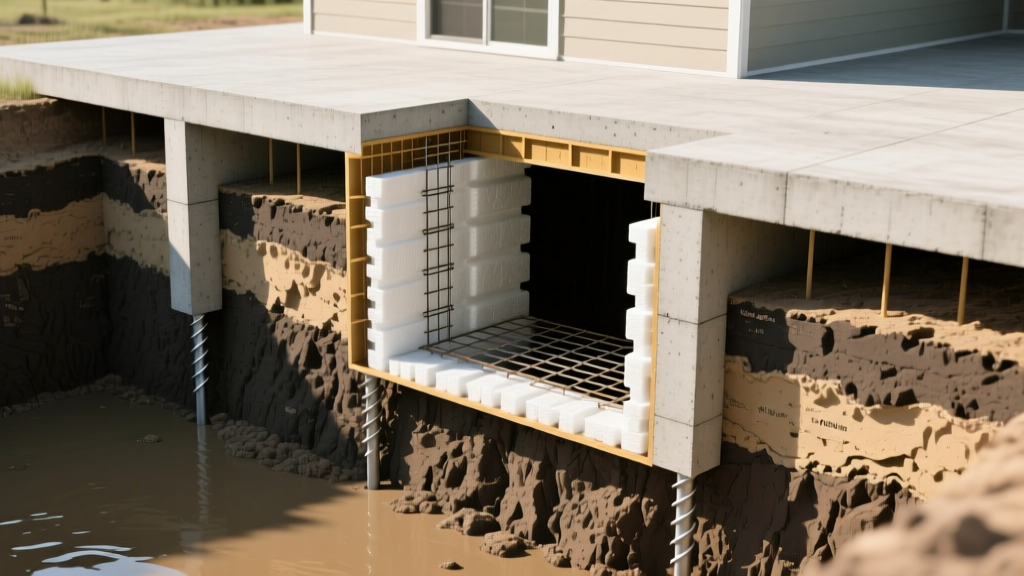
- Structural Slabs with Void Forms: Specify 3-inch to 6-inch collapsible cardboard void forms (e.g., Sonovoid or equivalent) beneath the structural slab. These forms support the wet concrete during the pour but degrade over time, leaving an air gap that accommodates clay heave without transferring uplift pressure to the slab.
- Post-Tensioned (PT) Concrete: For slab foundations, specify 270 ksi low-relaxation, seven-wire steel strands. Tendons must be stressed to an effective prestress of 33 ksi to 50 ksi post-concrete-cure to counteract bending moments induced by differential soil movement.
- Drilled Bell Piers: Where structural loads dictate deep foundations, specify drilled shafts extending a minimum of 10 to 15 feet below the active moisture fluctuation zone (typically 9 feet in Jackson) into the stable Jackson Group formation. Piers must be reinforced with a minimum 4-bar #5 rebar cage and belled at the base to increase end-bearing capacity.
ASHRAE Zone 3A: Moisture and Vapor Control Specifications
Jackson falls squarely into ASHRAE Climate Zone 3A (Hot-Humid). The PNNL Building America Solution Center defines this zone by its high cooling loads and persistent summer dew points that frequently exceed 70°F. Managing vapor drive in this environment requires a precise understanding of building physics to prevent interstitial condensation.
Never specify a Class I vapor retarder (e.g., 6-mil polyethylene sheeting) on the interior face of the wall studs in Jackson. During the cooling season, moisture-laden exterior air will migrate inward, hit the cold interior drywall surface, and condense behind the polyethylene, leading to catastrophic mold growth and structural rot within 24 months.
Correct Wall Assembly Specifications
To maintain the sheathing above the dew point, the wall assembly must utilize exterior continuous insulation (ci) paired with a vapor-permeable interior finish.
- Exterior Insulation: Specify minimum R-5 continuous rigid insulation (e.g., 1-inch unfaced EPS or polyiso) over 2x4 framing, or R-7.5 over 2x6 framing. This shifts the condensing surface outward.
- Weather-Resistant Barrier (WRB): Use a fluid-applied membrane or self-adhered sheet (e.g., Henry Blueskin VP100) with a minimum 60-mil thickness and a vapor permeance of 10 to 20 perms to allow outward drying.
- Interior Finish: Specify a Class III vapor retarder, which is achieved simply by using two coats of standard vapor-permeable latex paint (vapor permeance of 5 to 10 perms) over paperless drywall.
Biological Threats: Termite and Fungi Resistance
Jackson sits in a high-pressure zone for both Eastern Subterranean and Formosan termites. The University of Kentucky Entomology Department notes that Formosan colonies can exceed 5 million individuals, capable of consuming structural timber at an accelerated rate. Relying solely on soil termiticides is insufficient; the building materials themselves must possess inherent resistance.
Wood Framing Specifications
If utilizing wood framing, specify Southern Yellow Pine treated with Disodium Octaborate Tetrahydrate (DOT) or SBX (Sodium Borate). The treatment must achieve a minimum retention level of 0.25 pounds per cubic foot (pcf) for above-ground applications and 0.80 pcf for sill plates in contact with concrete. Borate treatments are odorless, non-corrosive to metal fasteners, and provide dual protection against both termites and wood-decay fungi.
Cold-Formed Steel (CFS) Alternative
For maximum biological resistance, specify Cold-Formed Steel (CFS) framing compliant with AISI S100 standards.
- Load-Bearing Walls: Minimum 54 mil (16 gauge) thickness with 33 ksi minimum yield strength.
- Non-Load-Bearing Partitions: Minimum 33 mil (20 gauge) thickness with 33 ksi yield strength.
- Coating: Specify G60 galvanization (0.60 oz/ft² of zinc) for interior studs, upgrading to G90 for any exterior or high-moisture cavity applications.
Material Specification Matrix for Jackson, MS
The following matrix outlines the precise technical specifications required to mitigate regional environmental stressors.
| Component | Material Specification | Relevant Standard | Primary Regional Threat Mitigated |
|---|---|---|---|
| Foundation Slab | Post-Tensioned Concrete (4000 psi, 270 ksi strands) | PTI DC10.5 / ASTM C94 | Yazoo Clay Heave / Differential Settlement |
| Wall Sheathing | Structural OSB with Integrated WRB (e.g., ZIP System) | APA ESR-3373 / ASTM E331 | Wind-Driven Rain / Air Infiltration |
| Interior Drywall | Fiberglass-Mat Gypsum Board (Paperless) | ASTM C1658 | Interior Humidity / Mold Propagation |
| Sill Plates | Borate-Treated SYP (0.80 pcf retention) | AWPA U1 / ASTM D3200 | Subterranean Termites / Capillary Moisture |
| Roofing Shingles | Architectural Asphalt (Class H Wind Rating) | ASTM D7158 | Severe Thunderstorm Uplift |
Roofing and Wind Uplift Specifications
Jackson experiences frequent severe thunderstorms, squall lines, and occasional tropical storm remnants that produce straight-line winds exceeding 90 mph. Standard 3-tab shingles are inadequate for this wind load profile.
Specify architectural laminated asphalt shingles tested to ASTM D7158, Class H (withstands 150 mph wind speeds) or Class F (110 mph). Installation must strictly adhere to the 6-nail pattern per shingle rather than the standard 4-nail pattern. Furthermore, all roofing nails must be ring-shank or screw-shank (compliant with ASTM F1667) with a minimum 12-gauge shank and 3/8-inch head to prevent withdrawal under cyclic wind loading.
Fastener and Hardware Corrosion Ratings
The combination of high ambient humidity and aggressive air conditioning usage creates severe condensation risks on interior metal hardware. When warm, moist attic air meets cold ceiling joist hangers, rapid galvanic and atmospheric corrosion occurs.
Engineering Directive: Electrogalvanized connectors are strictly prohibited in Jackson residential and commercial construction. All joist hangers, hold-downs, and structural straps must be Hot-Dipped Galvanized (HDG) to ASTM A153 Class C (minimum 1.0 oz/ft² zinc coating) or fabricated from Type 304 Stainless Steel for high-moisture zones.
When connecting borate-treated lumber (which is mildly corrosive to standard steel due to the borate salts), the fastener specification must be upgraded. Specify hot-dipped galvanized nails and connectors with a minimum G185 coating (1.85 oz/ft²) or Type 316 stainless steel to prevent premature fastener degradation at the critical structural connections.
Written by
James ThorntonJames Thornton is a construction industry veteran with 25 years of hands-on experience in wood framing, lumber grading, and residential building codes. He started as a framing carpenter in rural Oregon, earned his ICC Residential Building Inspector certification, and eventually became a senior plan reviewer for the City of Portland Bureau of Development Services. James holds a B.S. in Wood Science & Technology from Oregon State University and is a certified lumber grader through the West Coast Lumber Inspection Bureau (WCLIB). He has inspected over 3,000 residential construction sites and authored the city's internal guide on advanced framing techniques (2x6 at 24" O.C.). James lives in Bend, OR, where he builds custom timber-frame cabins and competes in lumberjack sports.
More from James Thornton
View all
Insulation
Best Home Insulation Materials: Complete 2026 Guide
Compare top home insulation materials for 2026. Find R-values, installed costs per square foot, and best uses for fiberglass, spray foam, and mineral wool.
Aug 4, 2026

Sustainable Building
Certify Your Green Building Material for LEED and WELL
Step-by-step guide to certifying a green building material for LEED v5 and WELL v2. Master EPDs, HPDs, and VOC limits for 2026 project specifications.
Aug 4, 2026

Stone & Masonry
Veneer Stacked Stone Panels: Interior Design & Style Showcase
Discover how veneer stacked stone panels transform interiors. Explore modern design profiles, material pairings, and technical installation specs.
Aug 4, 2026