Choosing Raised Bed Building Materials: A Complete Guide
Compare top raised bed building materials. Expert analysis on wood, Corten steel, composite, and masonry costs, lifespans, and structural limits for gardens.

The Material Selection Framework
Selecting raised bed building materials requires balancing hydrostatic soil pressure, constant moisture exposure, and budget constraints. Soil expands when wet, exerting lateral loads that can bow, crack, or shear poorly chosen materials. Use this decision framework to align your material choice with your project parameters:
- Budget under $4/linear foot: Untreated Pine (5-year lifespan) or standard CMU concrete blocks.
- Budget $4–$9/linear foot: Western Red Cedar, Redwood, or modern MCA-treated lumber.
- Budget $10–$25/linear foot: 14-gauge Corten steel, capped composite, or poured concrete.
- Target lifespan 20+ years: Corten steel, masonry, or structural PVC.
Wood Options: Rot Resistance vs. Budget
Untreated Hardwoods and Softwoods
Western Red Cedar and Redwood are the traditional standards for garden boxes due to their natural tannins and extractives, which resist fungal decay and insect damage. However, not all cedar is equal. You must specify heartwood grades (such as Clear All Heart or Construction Heart). Sapwood lacks these protective extractives and will rot within 3 to 4 years in constant soil contact.
Untreated pine or spruce is a budget alternative, typically costing $2 to $3 per linear foot. To extend its lifespan from 3 years to roughly 7 years, treat the interior-facing boards with a non-toxic, raw linseed oil or a dedicated wood sealer like Seal It Green before backfilling with soil.
Modern Pressure-Treated Lumber (MCA and ACQ)
Chromated Copper Arsenate (CCA) was banned for residential use in 2003. Modern pressure-treated lumber uses Micronized Copper Azole (MCA) or Alkaline Copper Quaternary (ACQ). According to the EPA Wood Preservatives guidelines, MCA and ACQ are considered safe for use around edible gardens once the wood has fully cured and dried. However, the high copper content in ACQ is highly corrosive to standard steel fasteners, requiring hot-dipped galvanized or stainless steel hardware.
If you are growing root vegetables (carrots, potatoes) in MCA-treated beds, line the interior walls with 6-mil polyethylene sheeting. This prevents direct contact between the edible root mass and the copper-impregnated wood fibers, providing an absolute barrier against any potential leaching.
Composite and PVC: The Low-Maintenance Trade-offs
Composite boards (like Trex or TimberTech) and cellular PVC (like AZEK) offer a zero-maintenance, rot-proof alternative to wood. However, they present unique structural engineering challenges in raised bed applications.
Thermal Expansion and Bowing: Composite and PVC materials expand and contract significantly with temperature fluctuations. PVC can expand up to 1/8 inch per 10 linear feet for every 50°F change. Furthermore, these materials lack the stiffness (modulus of elasticity) of natural wood. When subjected to the lateral hydrostatic pressure of wet soil, composite boards will bow outward if not properly braced.
Installation Requirements: For any composite or PVC raised bed exceeding 12 inches in height, you must install aluminum or composite cross-braces every 4 feet. Use slip-joint connections at the corners to allow for thermal expansion without cracking the corner brackets.
Metals: Corten, Galvanized, and Aluminum
Corten Steel (ASTM A588)
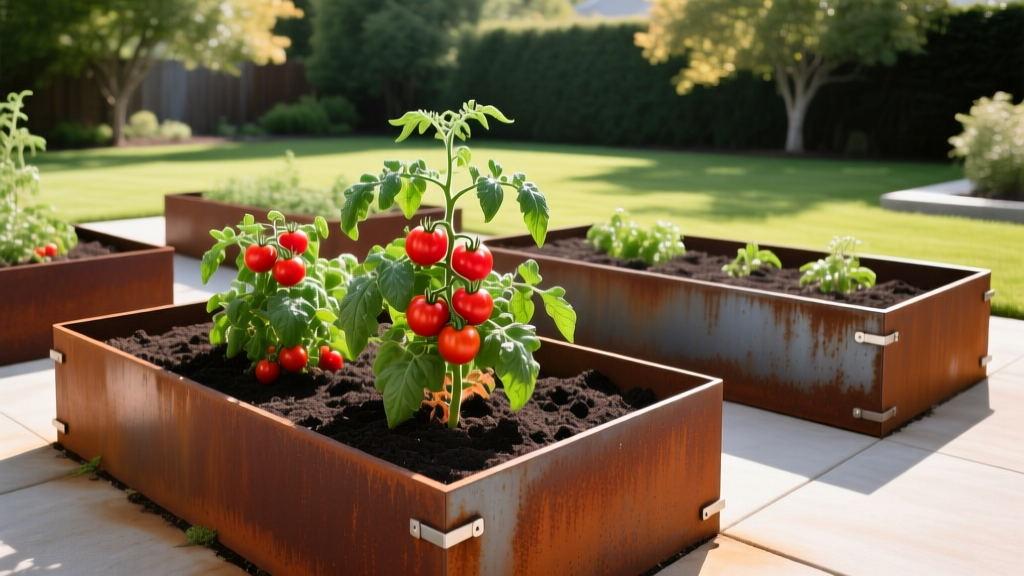
Corten steel, governed by the ASTM A588 specification, is the premium choice for modern landscape architecture. It forms a stable, rust-like patina that seals the core metal from further corrosion. For raised beds, you must use 14-gauge (0.0747 inches) or thicker steel. 18-gauge or 20-gauge corrugated roofing panels are too thin and will buckle under the weight of saturated soil.
Corten beds typically cost $15 to $25 per square foot of wall space. They retain heat efficiently, which can extend your growing season in colder climates but may require more frequent watering in peak summer.
Galvanized Steel and Aluminum
Galvanized steel troughs (often sold as stock tanks) are cost-effective and durable. The zinc coating protects against rust, but as the zinc slowly degrades in acidic soils (pH below 6.0), it can leach into the garden bed. While zinc is a necessary plant micronutrient, excessive levels can cause toxicity. Aluminum is highly resistant to corrosion and lightweight, but it is prone to denting from wheelbarrows and garden tools, and it costs upwards of $20 per linear foot for structural extrusions.
Masonry and Concrete: Permanent Installations
Concrete Masonry Units (CMUs), brick, and poured concrete offer permanent, multi-generational raised beds. A standard 8x8x16 inch CMU block costs roughly $2.50 to $3.50 per block, making it highly economical for large perimeters.
Structural Reinforcement: Dry-stacked CMU blocks are only stable up to 16 inches (two courses). For beds 24 inches or higher, you must use Type S mortar, insert #4 (1/2-inch) steel rebar vertically through the block cores, and fill the cores with poured concrete to resist soil shear forces. The Oregon State University Extension recommends incorporating weep holes at the base of masonry beds to prevent hydrostatic pressure buildup behind the wall during heavy rainfall.
The Alkalinity Factor: Fresh concrete and mortar leach calcium hydroxide, which can spike soil pH to 8.0 or higher, locking out essential nutrients like iron and manganese. To cure this, either seal the interior masonry with a silane-siloxane penetrating sealer or heavily amend the soil with elemental sulfur and peat moss during the first year.
Comprehensive Material Comparison Matrix
| Material | Cost (Per Lin. Ft.) | Lifespan | Max Height (Unbraced) | Soil Safety Profile |
|---|---|---|---|---|
| Untreated Pine | $2.00 - $3.00 | 3 - 7 Years | 12 Inches | Excellent |
| Cedar (Heartwood) | $6.00 - $10.00 | 10 - 15 Years | 18 Inches | Excellent |
| MCA Treated Wood | $3.50 - $5.50 | 20+ Years | 18 Inches | Good (Line for roots) |
| Capped Composite | $9.00 - $14.00 | 25+ Years | 12 Inches (w/ bracing) | Excellent |
| 14-Gauge Corten | $15.00 - $25.00 | 30+ Years | 36 Inches | Good (Monitor pH) |
| CMU Blocks | $5.00 - $8.00 | 50+ Years | 16 Inches (Dry stack) | Fair (Initial pH spike) |
Hardware and Fasteners: The Hidden Failure Point
The most common cause of raised bed failure is not the rotting of the wood, but the shearing of cheap fasteners. Wet soil is incredibly heavy (up to 100 lbs per cubic foot), and standard zinc-plated drywall or deck screws will snap under the lateral tension or corrode within two seasons.
- For Cedar and Redwood: Use 304 stainless steel structural screws (e.g., Simpson Strong-Tie SDWS or GRK RSS). The #10 x 3.5-inch size provides the necessary 2-inch embedment into corner posts.
- For MCA/ACQ Treated Wood: The copper preservatives will rapidly corrode standard steel and even 304 stainless steel over time. You must use 316 marine-grade stainless steel or hot-dipped galvanized structural screws.
- Corner Brackets: For beds longer than 8 feet, install heavy-duty steel corner brackets (minimum 10-gauge thickness) secured with 1/4-inch lag bolts to prevent the corners from pulling apart as the soil settles.
Frequently Asked Questions
Should I line the bottom of my raised bed?
Never line the bottom of a raised bed with solid plastic or landscape fabric. This creates a perched water table, trapping moisture and suffocating plant roots. If you need to prevent weeds or burrowing pests like gophers, staple a layer of 1/2-inch galvanized hardware cloth to the bottom frame. This allows water to drain freely while blocking intruders. For more on soil drainage dynamics, refer to the Penn State Extension guidelines on raised bed hydrology.
How deep should a raised bed be?
For shallow-rooted crops like lettuce, radishes, and herbs, 8 to 10 inches of soil depth is sufficient. For deep-rooted crops like tomatoes, carrots, and parsnips, you need a minimum of 18 to 24 inches of uncompacted soil. If building a 24-inch bed, consider filling the bottom 10 inches with coarse organic matter (hugelkultur style) or clean gravel to reduce the volume of expensive topsoil required while maintaining adequate drainage.
Written by
Elena RodriguezElena Rodriguez is a civil engineer and technical writer specializing in concrete technology, masonry systems, and ASTM/ACI compliance. She earned her B.S. in Civil Engineering from Texas A&M University and spent a decade at a materials testing laboratory, performing over 2,000 concrete compressive strength tests and masonry prism evaluations. Elena is an ACI-certified Field Testing Technician (Grade I) and a member of ASTM Committee C12 on Natural Building Stone. She currently consults on forensic engineering cases involving concrete failures and moisture intrusion. Based in San Antonio, TX, Elena is a proud member of the Society of Women Engineers (SWE) and coaches her daughter's FIRST Robotics team.
More from Elena Rodriguez
View all
Walls & Panels
Cost Analysis: Light Gauge Steel Framing Advantages and Disadvantages
Evaluate light gauge steel framing advantages and disadvantages through a strict cost analysis lens, comparing material, labor, and lifecycle expenses.
Aug 4, 2026

Walls & Panels
Gypsum Board Types: Exact Specifications, Thickness & Dimensions
Compare standard, Type X, and moisture-resistant gypsum board types. Get exact specifications, thicknesses, dimensions, and ASTM standards for your project.
Aug 4, 2026

Fire Resistance
Best Fire-Resistant Outdoor Decking Materials: 2026 Buyer Guide
Discover the best fire-resistant outdoor decking materials for 2026. Compare Class A PVC, aluminum, and hardwood options for WUI compliance and safety.
Aug 4, 2026