Best Luxury Commercial Building Materials for 2026
Discover the best luxury commercial building materials for 2026. Compare costs, specs, and premium finishes for high-end corporate and hospitality projects.

The 2026 Paradigm: Performance-Driven Luxury
The definition of luxury in commercial architecture has fundamentally shifted. In 2026, high-end corporate headquarters, boutique hospitality venues, and premium retail spaces no longer rely solely on rare natural stones or exotic hardwoods. The new standard for luxury commercial building materials demands a synthesis of hyper-aesthetic precision, extreme durability, and verifiable ESG (Environmental, Social, and Governance) compliance. According to recent material trend analyses by ArchDaily, architects are specifying ultra-compact surfaces, advanced architectural alloys, and high-performance acoustic textiles that meet rigorous LEED v5 criteria without compromising visual opulence.
This overview dissects the top-tier materials defining luxury commercial projects today, providing exact specifications, installation gotchas, and real-world pricing to guide your procurement strategy.
Tier 1: Sintered Stone and Ultra-Compact Surfaces
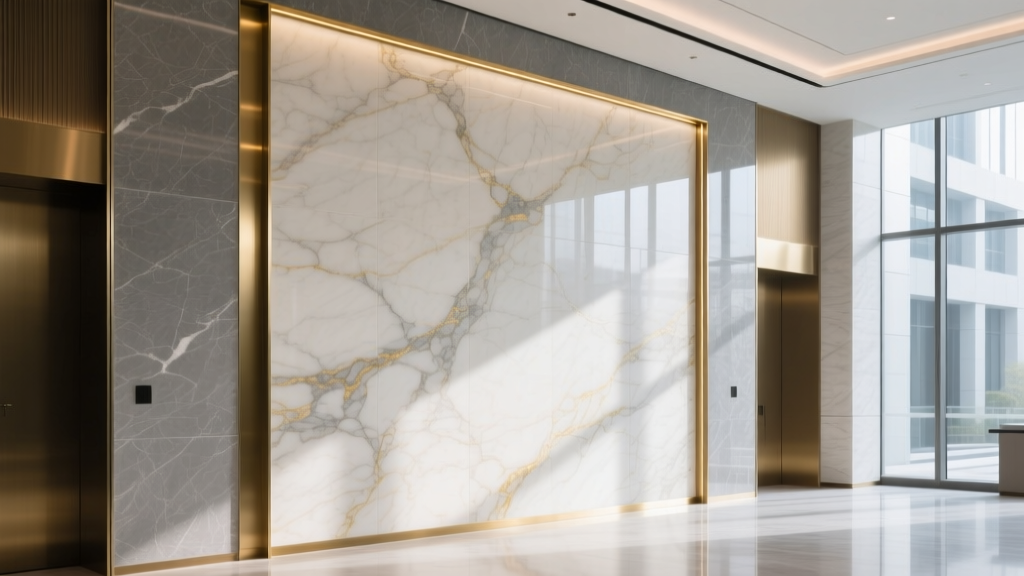
Natural marble, particularly Calacatta and Statuario, has long been the benchmark for luxury lobbies and executive washrooms. However, its porosity and susceptibility to etching from acidic cleaners make it a liability in high-traffic commercial zones. Sintered stone has emerged as the definitive 2026 alternative.
The Thermal Sintering Process (TSP)
Brands like Cosentino’s Dekton and TheSize’s Neolith manufacture ultra-compact surfaces by subjecting a blend of porcelain, glass, and quartz minerals to pressures exceeding 25,000 tons and temperatures of 1,200°C. This replicates the metamorphic rock formation process in hours rather than millennia. The result is a non-porous slab (water absorption rate of <0.05%) that is entirely resistant to UV degradation, chemical etching, and thermal shock.
Specification Spotlight: Dekton Kairos & Neolith Calacatta
- Optimal Thickness: 12mm for interior wall cladding; 20mm for heavy-duty commercial flooring and reception desks.
- Maximum Slab Dimensions: 3200mm x 1440mm (minimizes grout lines in expansive lobby walls).
- Installed Cost Range: $65 – $110 per square foot (includes specialized handling and fabrication).
Installation Failure Mode: Spelching and Micro-Chipping
The most common error contractors make with sintered stone is treating it like standard porcelain. Standard wet saws with segmented diamond blades will cause "spelching" (micro-chipping) along the cut edges, ruining the seamless luxury aesthetic. Fabricators must use continuous rim turbo blades specifically engineered for ultra-compact surfaces, paired with high-pressure water cooling to prevent thermal fracturing during the cut.
Tier 2: Architectural Metals and Rainscreen Alloys
For exterior facades and high-end interior feature walls, luxury commercial design has moved away from painted Aluminum Composite Material (ACM) toward natural, weathering architectural metals. These materials develop a protective patina over time, offering a dynamic, living finish that signals bespoke craftsmanship.
VMZINC and Copper Alloys
VMZINC (specifically the Quartz-Zinc and Anthra-Zinc pre-weathered lines) provides a sophisticated, matte-grey aesthetic that is highly sought after for premium corporate campuses. Similarly, architectural copper alloys offer warm, antimicrobial surfaces ideal for luxury hospitality touchpoints.
Never install zinc or copper panels as a direct-applied face-sealed system. These metals require a ventilated rainscreen cavity with a minimum 1-inch (25mm) air gap behind the panel. Without this ventilation, trapped condensation will cause rapid back-corrosion, leading to panel warping and catastrophic failure within 3 to 5 years.
Material Specification & Cost Matrix
When budgeting for luxury commercial projects, material costs must be evaluated alongside fabrication complexity and lifecycle maintenance. The table below outlines the 2026 baseline specifications for premium commercial materials.
| Material Category | Premium Brand / Model | Installed Cost (per sq. ft.) | Key ASTM Standard |
|---|---|---|---|
| Sintered Stone (12mm) | Dekton / Neolith | $65 - $110 | ASTM C170 (Slip Resistance) |
| Architectural Zinc | VMZINC Quartz-Zinc | $32 - $48 | ASTM B69 (Zinc Sheet) |
| Acoustic PET Felt | FilzFelt (Knoll) / EchoPanel | $18 - $28 | ASTM E84 (Flame Spread) |
| Sintered Glass/Tile | AGROB BUCHTAL Tepex | $45 - $70 | ASTM C627 (Floor Load) |
Tier 3: High-NRC Acoustic Textiles and Biophilic Substrates
Visual luxury is instantly undermined by poor acoustic performance. In 2026, executive boardrooms, luxury private dining rooms, and high-end open-plan offices mandate a Noise Reduction Coefficient (NRC) of 0.85 or higher to ensure speech privacy and eliminate reverberation.
100% Wool Felt and PET Integrations
Products like FilzFelt by Knoll offer 100% pure virgin wool acoustic panels that provide an NRC up to 0.90 when mounted with an air gap. Unlike synthetic foams, wool is naturally flame-resistant (meeting ASTM E84 Class A without chemical treatments) and regulates ambient humidity. For a more contemporary, sustainable aesthetic, PET (polyethylene terephthalate) felt panels made from recycled plastics offer rigid, CNC-millable surfaces that can be routed with intricate corporate branding or biophilic leaf patterns.
Sintered Stone vs. Natural Calacatta Marble: The 2026 Decision Framework
Choosing between natural stone and its ultra-compact counterpart requires weighing aesthetic authenticity against commercial pragmatism. According to procurement data tracked by BDC Network, commercial developers are increasingly favoring sintered stone for high-liability zones.
✔ Sintered Stone (Dekton/Neolith)
- Pros: Zero porosity, immune to etching, UV stable, consistent veining across massive slab runs, minimal maintenance.
- Cons: Higher fabrication costs, requires specialized tooling, lacks the true geological depth and unique translucency of natural marble.
✘ Natural Calacatta Marble
- Pros: Unmatched visual depth, unique geological variations, traditional luxury prestige, can be polished on-site to remove minor scratches.
- Cons: Highly porous (requires annual sealing), etches instantly upon contact with citrus or acidic cleaners, high replacement cost for damaged slabs.
Critical Failure Modes in Premium Installations
Luxury materials demand flawless execution. A $100-per-square-foot material installed with $2-per-square-foot methodology will inevitably fail. Here are the most costly edge cases to avoid:
1. Galvanic Corrosion in Mixed Metals
When specifying architectural zinc or copper facades, the fastening hardware must be meticulously matched. Using standard carbon steel or unisolated stainless steel fasteners in direct contact with zinc panels creates a galvanic cell. In the presence of atmospheric moisture, the zinc will act as a sacrificial anode and corrode rapidly around the fastener head. Always specify 316-grade stainless steel fasteners with neoprene or EPDM isolation washers for zinc and copper assemblies.
2. Lippage in Large-Format Stone and Sintered Panels
When installing 1200mm x 3000mm sintered panels on commercial floors, traditional thin-set mortar application is insufficient. The sheer size of the panels traps air voids if not properly back-buttered, leading to lippage (uneven edges) and catastrophic cracking under point-loads (e.g., heavy luggage carts in hotel lobbies). Installers must use a large-and-heavy-tile (LHT) mortar, applied with a 1/2-inch U-notch trowel, combined with a mechanical leveling clip system to ensure a perfectly planar surface.
Procurement and Lead Time Realities
Supply chain stabilization in 2026 has improved lead times, but luxury materials remain heavily dependent on European manufacturing hubs. Expect 12 to 16 weeks for custom-veined sintered stone slabs imported from Spain or Italy. Domestic architectural metal fabricators typically quote 6 to 10 weeks for custom brake-formed zinc panels. To prevent project delays, general contractors must finalize material submittals and secure factory slots during the schematic design phase, well before the construction documents are fully stamped.
"When specifying luxury commercial materials, the true cost is rarely the initial procurement; it is the lifecycle maintenance and the risk of catastrophic installation failure. Budget for specialized fabricators, not just the raw material."
By prioritizing advanced sintered surfaces, properly detailed architectural metals, and high-performance acoustic textiles, developers and architects can deliver luxury commercial spaces that are as resilient and sustainable as they are visually stunning.
Written by
David NakamuraDavid Nakamura is a licensed architect (AIA) and construction technology writer focused on sustainable building methods, mass timber engineering, and high-performance building envelopes. He holds a Master of Architecture from the University of Washington and is a certified Passive House Consultant (CPHC). David spent eight years at the Seattle firm Mithun, where he led the design of three LEED Platinum projects, before founding his own practice specializing in net-zero residential design. He serves on the editorial advisory board of GreenBuilder Magazine and has authored peer-reviewed papers on cross-laminated timber (CLT) connections for the Journal of Structural Engineering. In his spare time, David teaches woodworking at Pratt Fine Arts Center and kayaks the Puget Sound.
More from David Nakamura
View all
Construction Cost
Labor Cost to Build a Deck Per Sq Ft: 2026 Installation Guide
Discover the exact labor cost to build a deck per sq ft in 2026. This installation guide breaks down contractor rates, complexity factors, and hidden fees.
Aug 4, 2026

Construction Cost
How Much Does It Cost to Build a 3 Bedroom House? Financing Guide
Learn exactly how much it costs to build a 3 bedroom house and explore 2026 financing options, construction loan types, and budget frameworks for your build.
Aug 4, 2026

Construction Cost
Cost to Build a Tennis Court: 2026 Guide
How much does it cost to build a tennis court in 2026? Breakdowns for asphalt, concrete, and synthetic surfaces plus fencing and lighting.
Jul 30, 2026