Composite Building Material Overview: Types, Costs and Uses
Explore the complete composite building material overview. Compare structural, cladding, and decking composites with 2026 pricing and ASTM standards.

What Defines a Composite Building Material?
A composite building material is engineered by combining two or more distinct constituents—a matrix and a reinforcement—that remain separate and distinct at a macroscopic level within the finished structure. The matrix (typically a polymer, cementitious, or metallic binder) transfers loads between the reinforcement (fibers, particles, or structural strands) while protecting it from environmental degradation. Unlike homogeneous materials like steel or solid timber, the composite building material leverages the synergistic properties of its components to achieve high strength-to-weight ratios, corrosion resistance, or tailored thermal performance.
According to the American Composites Manufacturers Association (ACMA), the global shift toward advanced composites in construction is driven by the need for longer lifecycles and reduced maintenance in corrosive environments, such as coastal infrastructure and water treatment facilities. To specify these materials correctly, builders must look beyond generic labels and understand the specific matrix-reinforcement pairings dictated by ASTM and ISO standards.
Core Categories of Construction Composites
1. Fiber-Reinforced Polymers (FRP)
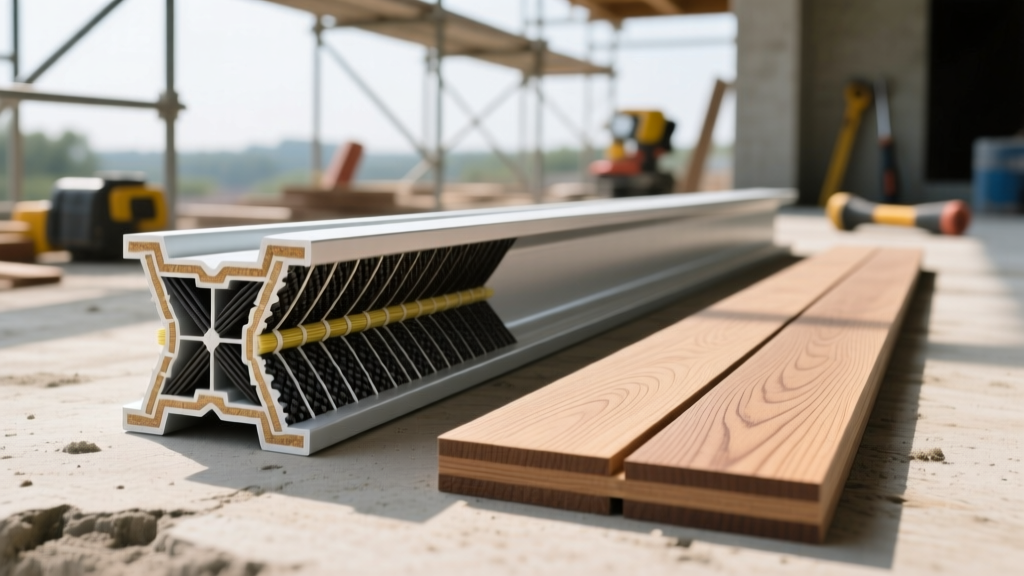
FRP composites utilize a polymer matrix (polyester, vinyl ester, or epoxy) reinforced with glass, carbon, or basalt fibers. In structural applications, Glass Fiber Reinforced Polymer (GFRP) rebar is increasingly replacing epoxy-coated steel in concrete bridge decks and marine sea walls. GFRP rebar (ASTM D7958) offers a tensile strength of 90,000 to 110,000 psi—roughly double that of Grade 60 steel—while weighing 75% less. Carbon FRP (CFRP) is primarily used in structural retrofitting, where unidirectional carbon fabric is bonded to existing concrete columns using an epoxy matrix to increase shear and flexural capacity without adding significant dead load.
2. Wood-Plastic Composites (WPC)
WPC materials blend wood flour or cellulose fibers with thermoplastic matrices like High-Density Polyethylene (HDPE), Polypropylene (PP), or Polyvinyl Chloride (PVC). While early-generation WPCs suffered from moisture absorption and fungal decay, modern co-extruded WPCs feature a fully encapsulated polymer cap (often ASA or PVC) that renders the core impervious to water. Governed by ASTM D7032, structural-grade WPC is now approved for non-continuous load-bearing applications like deck joists and guardrail posts, though it remains most prevalent in decking, cladding, and fencing.
3. Engineered Cementitious Composites (ECC)
Often referred to as "bendable concrete," ECC replaces coarse aggregates with fine silica sand and incorporates 2% by volume of Polyvinyl Alcohol (PVA) microfibers. The micromechanical design of ECC allows it to exhibit strain-hardening behavior under tension, achieving a tensile strain capacity of 3% to 5%, compared to the 0.01% typical of conventional concrete. This extreme ductility prevents catastrophic brittle failure, making ECC ideal for seismic retrofitting, coupling beams in high-rise shear walls, and patch repairs where tight crack-width control (typically under 60 micrometers) is required to prevent rebar corrosion.
4. Engineered Wood Products (EWP)
As highlighted by the American Wood Council, engineered wood products like Cross-Laminated Timber (CLT), Glued-Laminated Timber (Glulam), and Laminated Veneer Lumber (LVL) are structural composites that utilize wood as both the matrix and reinforcement, bound by structural adhesives (MDI, phenol-resorcinol). CLT panels, composed of orthogonally stacked dimensional lumber, provide two-way spanning capabilities and are driving the mass timber revolution in mid-rise commercial construction.
2026 Cost Matrix and Performance Comparison
Pricing for composite materials fluctuates based on petrochemical feedstock costs and supply chain logistics. The table below outlines baseline material costs (excluding labor and fasteners) and mechanical benchmarks for 2026.
| Material Type | Matrix / Reinforcement | Approx. Material Cost (2026) | Tensile / Flexural Strength | Primary Application |
|---|---|---|---|---|
| GFRP Rebar (#4) | Vinyl Ester / E-Glass | $2.80 - $3.50 / linear ft | 110,000 psi (Tensile) | Marine concrete, bridge decks |
| Capped WPC Decking | HDPE / Wood Flour + ASA Cap | $9.50 - $13.00 / sq ft | 4,500 psi (Flexural) | Exterior decking, cladding |
| CLT Panels (3-ply) | SPF Lumber / PUR Adhesive | $8.00 - $11.50 / sq ft | 3,500 psi (Bending) | Mass timber floors, shear walls |
| ECC Mortar | Cement / PVA Microfibers | $18.00 - $24.00 / cu ft | 600 psi (Tensile) | Seismic joints, patch repair |
| Fiber Cement Siding | Portland Cement / Cellulose | $3.50 - $6.00 / sq ft | 1,500 psi (Flexural) | Exterior cladding, soffits |
Structural and Environmental Failure Modes
Specifying a composite building material without accounting for its specific failure mechanisms is a primary cause of premature building envelope and structural degradation. Unlike isotropic materials, composites fail in highly specific, often non-obvious ways.
Galvanic and Alkaline Degradation in FRP
While Carbon FRP is immune to rust, it is highly conductive. When CFRP laminates are used to strengthen steel beams and the epoxy barrier is compromised, a galvanic cell forms. The carbon acts as a cathode, accelerating the anodic corrosion of the underlying steel. Furthermore, GFRP rebar is susceptible to alkaline hydrolysis. If the vinyl ester resin matrix is too thin or improperly cured, the high pH (12.5+) of the surrounding concrete pore solution degrades the E-glass fibers, leading to a catastrophic loss of tensile capacity over 15 to 20 years. Always specify GFRP with an alkali-resistant (AR) glass formulation and a minimum 70% fiber volume fraction.
Creep-Rupture in Sustained Loading
Polymers are viscoelastic. When an FRP or WPC member is subjected to a continuous, sustained load (dead load), it undergoes creep. If the sustained stress exceeds a critical threshold—typically 20% to 30% of its ultimate short-term strength for GFRP—the material will eventually experience creep-rupture, snapping without warning. Structural engineers must apply rigorous creep-rupture reduction factors (often dropping the allowable design stress to 0.20 of ultimate strength) when sizing composite joists or tension members.
Moisture-Induced Delamination in Mass Timber
Cross-Laminated Timber relies on structural adhesives to transfer shear forces between orthogonal plies. If CLT panels are exposed to bulk water during construction or left unsealed in high-humidity interiors, the wood swells. Because the dimensional movement is constrained by the cross-lamination and the rigid adhesive, massive internal shear stresses develop, leading to ply delamination and checking. CLT must be protected from weather immediately upon erection, and interior moisture content must be stabilized below 16% before encapsulating the timber in drywall or vapor barriers.
Procurement and Specification Framework
Because composite materials often fall outside the prescriptive paths of standard building codes, procurement requires rigorous verification of third-party testing.
- ICC-ES Evaluation Reports (ESR): For proprietary WPC joists, FRP structural profiles, and fiber-cement panels, always demand a current ESR from the International Code Council Evaluation Service. The ESR will explicitly state the allowable spans, fire ratings (ASTM E84), and fastener schedules that the local building department will accept.
- Environmental Product Declarations (EPDs): For projects targeting LEED v4.1 or the Living Building Challenge, request Type III EPDs. Composites like WPC and FRP have high embodied energy due to polymer extrusion and resin curing; EPDs provide the exact Global Warming Potential (GWP) per functional unit, allowing for accurate lifecycle carbon modeling.
- Resin and Matrix Verification: Do not accept generic "fiberglass" or "composite" submittals. Require the manufacturer to specify the exact resin system (e.g., Isophthalic Polyester vs. Vinyl Ester) and the fiber architecture (e.g., continuous unidirectional roving vs. chopped strand mat), as these dictate the structural modulus and chemical resistance.
"The transition from traditional materials to advanced composites in civil infrastructure is no longer experimental. With standardized ASTM testing and validated long-term creep data, GFRP and CFRP are now the baseline specification for aggressive environments where a 100-year design life is mandated."
— Structural Engineering Institute (SEI) Guidelines on FRP Composites
Frequently Asked Questions
Can composite building materials be recycled?
Recyclability depends entirely on the matrix. Thermoplastic composites like WPC (HDPE/PVC based) can be reground and re-extruded, though fiber degradation limits them to non-structural applications in their second life. Thermoset composites (FRP using epoxy or polyester resins) cannot be melted down; they must be mechanically pulverized for use as filler, or subjected to energy-intensive pyrolysis to recover carbon fibers.
Are composite materials fire-resistant?
Most polymer-matrix composites are inherently combustible. However, they can be engineered to meet stringent fire codes. FRP structural profiles can be manufactured with phenolic resins or intumescent additives to achieve low Flame Spread and Smoke Developed indices (ASTM E84 Class A). WPC decking often requires an underlying fire-retardant sub-structure or specialized spacing to meet Wildland-Urban Interface (WUI) codes in fire-prone regions.
How do composites perform in extreme cold?
Composites generally perform exceptionally well in sub-zero temperatures. Unlike steel, which can undergo a ductile-to-brittle transition, and concrete, which suffers from freeze-thaw spalling, polymer matrices typically exhibit increased tensile strength and stiffness at -40°F. GFRP rebar and structural profiles are highly favored in arctic infrastructure and cold-storage facility construction for this reason.
Written by
David NakamuraDavid Nakamura is a licensed architect (AIA) and construction technology writer focused on sustainable building methods, mass timber engineering, and high-performance building envelopes. He holds a Master of Architecture from the University of Washington and is a certified Passive House Consultant (CPHC). David spent eight years at the Seattle firm Mithun, where he led the design of three LEED Platinum projects, before founding his own practice specializing in net-zero residential design. He serves on the editorial advisory board of GreenBuilder Magazine and has authored peer-reviewed papers on cross-laminated timber (CLT) connections for the Journal of Structural Engineering. In his spare time, David teaches woodworking at Pratt Fine Arts Center and kayaks the Puget Sound.
More from David Nakamura
View all
Construction Cost
Labor Cost to Build a Deck Per Sq Ft: 2026 Installation Guide
Discover the exact labor cost to build a deck per sq ft in 2026. This installation guide breaks down contractor rates, complexity factors, and hidden fees.
Aug 4, 2026

Construction Cost
How Much Does It Cost to Build a 3 Bedroom House? Financing Guide
Learn exactly how much it costs to build a 3 bedroom house and explore 2026 financing options, construction loan types, and budget frameworks for your build.
Aug 4, 2026

Construction Cost
Cost to Build a Tennis Court: 2026 Guide
How much does it cost to build a tennis court in 2026? Breakdowns for asphalt, concrete, and synthetic surfaces plus fencing and lighting.
Jul 30, 2026