Best Energy Efficient Building Materials for Net-Zero Homes 2026
Compare top energy efficient building materials for 2026 net-zero builds. Explore R-values, costs, and selection criteria for insulation and framing.
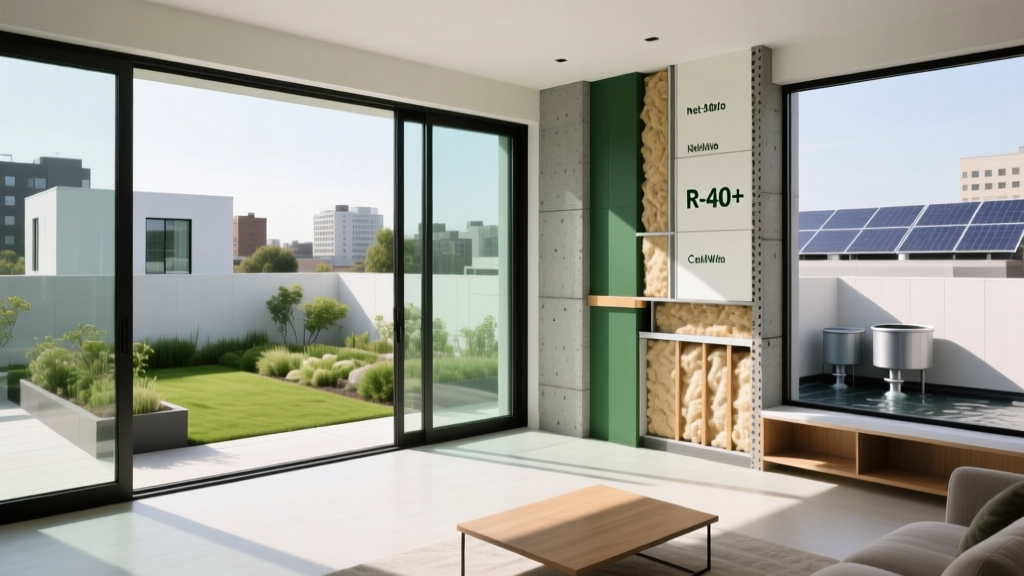
The Net-Zero Mandate: Shifting from Code-Minimum to Performance-Driven
The transition toward net-zero energy buildings has fundamentally altered material procurement strategies. Under the latest 2026 International Energy Conservation Code (IECC) updates and the U.S. Department of Energy's Zero Energy Ready Home program, standard code-minimum assemblies are no longer sufficient to offset operational carbon. Selecting the right energy efficient building materials requires a granular understanding of thermal bridging, latent heat storage, and airtightness metrics. This guide provides a technical selection framework for high-performance enclosures, moving beyond generic R-value recommendations to specific product categories, spatial constraints, and lifecycle costs.
Insulation Selection Matrix: R-Value vs. Spatial Constraints
Choosing cavity insulation is no longer a binary decision between fiberglass and spray foam. Modern high-performance enclosures rely on hybrid assemblies that mitigate thermal bridging and manage moisture. The following matrix compares advanced insulation materials based on thermal resistance, cost, and ideal application scenarios.
| Material Type | R-Value per Inch | Est. Cost (per sq. ft.) | Best Application & Edge Cases |
|---|---|---|---|
| Aerogel Blankets | R-10.0 to R-10.4 | $8.00 - $12.00 | Space-constrained retrofits, parapets, and structural steel wraps where thickness is limited. |
| Polyisocyanurate (Polyiso) | R-6.0 to R-6.5 | $1.10 - $1.50 | Continuous exterior insulation (ci). Must be detailed carefully to avoid condensation in cold climates. |
| Mineral Wool Batts | R-4.2 to R-4.5 | $0.80 - $1.20 | Interior cavity fill, fire-stopping, and exterior rainscreen drainage planes. Highly vapor-permeable. |
| Vacuum Insulation Panels (VIPs) | R-30.0 to R-50.0 | $10.00 - $15.00 | Ultra-thin assemblies (e.g., balcony connections). Cannot be cut or penetrated on-site. |
| Dense-Pack Cellulose | R-3.6 to R-3.8 | $0.60 - $0.90 | Net-zero cavity fill. Excellent sound attenuation and moisture buffering, but requires netting and high-density blowing. |

Fenestration Framework: Matching Glazing to Climate Zones
Windows are traditionally the weakest link in the building envelope. For net-zero projects, standard double-pane vinyl windows (typically U-0.30) will compromise the overall enclosure performance. Selection must be dictated by the specific climate zone's heating and cooling degree days.
Climate Zones 1-3 (Hot/Humid & Hot/Dry)
Target Metric: Solar Heat Gain Coefficient (SHGC) ≤ 0.23.
Material Selection: Double-pane, low-emissivity (Low-E) glass with a spectrally selective coating that blocks infrared heat while allowing visible light. Aluminum-clad wood or thermally broken aluminum frames are preferred for durability in high-UV and hurricane-prone regions. Tinted interlayers (e.g., PVB) can further reduce cooling loads by 15-20%.
Climate Zones 4-8 (Mixed, Cold & Very Cold)
Target Metric: U-Factor ≤ 0.17 (ideally ≤ 0.12 for Passive House standards).
Material Selection: Triple-pane, argon or krypton-filled glazing with dual Low-E coatings. Fiberglass window frames (such as those from Alpen High Performance Products or Inline Fiberglass) are critical here; fiberglass expands and contracts at nearly the exact same rate as glass, preventing seal failure over decades of extreme temperature swings.
Advanced Framing and Thermal Bridging Mitigation
Standard 2x4 framing at 16 inches on-center (o.c.) creates a thermal bridge every 1.5 feet, reducing the effective R-value of a wall by up to 25%. To maximize the performance of energy efficient building materials, structural framing must be optimized for cavity insulation volume.
- 2x6 at 24" o.c. Advanced Framing: Aligns floor joists, wall studs, and roof rafters to transfer loads directly, allowing for single top plates and insulated headers. This increases cavity space for dense-pack cellulose or mineral wool by 5-7% compared to conventional framing.
- California Corners (2-Stud Corners): Eliminates the traditional 3- or 4-stud corner, which creates a massive thermal bridge and an uninsulated void. A 2-stud corner with drywall clips allows insulation to fill the entire corner cavity.
- Exterior Continuous Insulation (ci): If advanced framing is not structurally viable for the design, applying a minimum of R-10 continuous polyiso or mineral wool board over standard sheathing breaks the thermal bridge of the wood studs entirely.
Latent Heat Storage: Integrating Phase Change Materials (PCMs)
While insulation resists heat flow, thermal mass absorbs it. In lightweight wood-frame construction, the lack of thermal mass (like concrete or masonry) can lead to rapid temperature swings, increasing HVAC cycling. Phase Change Materials (PCMs) solve this by integrating microencapsulated paraffin wax into gypsum drywall.
"When room temperatures reach the PCM's melting point (typically tuned to 72°F or 22°C), the material absorbs latent heat as it transitions from solid to liquid, effectively flattening peak cooling loads by up to 30%. At night, as temperatures drop, it solidifies and releases the heat back into the space."
For selection purposes, specify PCM-infused drywall in west-facing rooms or spaces with high solar gain. Expect a premium of $3.50 to $5.00 per square foot over standard 5/8-inch Type X gypsum, but factor in the potential to downsize the HVAC tonnage required for the zone.
The Airtightness Imperative: Fluid-Applied vs. Taped Membranes
According to the Building Science Corporation, air leakage accounts for up to 40% of a building's heat loss and is the primary driver of interstitial condensation. Achieving the net-zero target of ≤ 1.0 ACH50 (Air Changes per Hour at 50 Pascals) requires a continuous air control layer. You must choose between fluid-applied membranes and self-adhered tapes.
Fluid-Applied Membranes
These are rolled or sprayed liquid polymers that cure into a seamless, monolithic rubberized coating. They are ideal for complex geometries, around electrical penetrations, and over irregular masonry substrates. However, they require strict mil-thickness control (usually 40-60 wet mils) using a wet mil gauge during application to ensure proper vapor permeability and structural integrity.
Self-Adhered Tapes and Membranes
Products like Siga Wigluv or Pro Clima Tescon Vana utilize high-performance acrylic adhesives that actually increase in bond strength over time. They are superior for flat sheathing joints and window bucks. The failure mode here is almost always surface preparation; these tapes will fail if applied over dusty, damp, or frozen OSB. A specialized primer is mandatory for porous substrates in high-humidity conditions.
ROI and Lifecycle Cost Analysis
Premium energy efficient building materials carry a higher upfront capital expenditure, typically adding 4% to 8% to total construction costs. However, the National Renewable Energy Laboratory (NREL) notes that when factoring in utility incentives, reduced HVAC equipment sizing (due to lower peak loads), and 30-year energy savings, the net-present value of a high-performance enclosure is overwhelmingly positive. Procurement teams should evaluate these materials not as line-item expenses, but as permanent infrastructure investments that immunize the building against future energy price volatility.
Written by
Priya KapoorPriya Kapoor is a real estate market analyst and construction economics researcher with expertise in housing affordability, development feasibility, and infrastructure investment. She holds a Master of Regional Planning from Cornell University and previously worked as a senior analyst at CBRE's Investment Properties group, where she modeled returns for $4B in mixed-use development pipelines. Priya now runs an independent research practice advising developers, municipalities, and REITs on construction cost forecasting and market timing. She publishes the quarterly "BuildMat Market Pulse" report tracking material price indices across 12 commodity categories. Based in Austin, TX, Priya serves on the board of Habitat for Humanity Austin and is a marathon runner.
More from Priya Kapoor
View all
Construction Cost
Cost to Build a 1600 Sq Ft Home in 2026: Full Breakdown
Accurate 2026 cost to build a 1600 sq ft home—material, labor, and regional pricing breakdowns included. Plan your budget with real-time estimates.
Aug 11, 2026

Wood & Lumber
Name the Types of Wood for Pressure Treatment and Preservation
Learn how to name the types of wood best suited for pressure treatment. Compare species treatability, chemical retention levels, and 2026 preservation costs.
Aug 4, 2026

Stone & Masonry
Stone Veneer Suppliers Lindenhurst: 2026 Cost Analysis
Analyze 2026 stone veneer costs in Lindenhurst, NY. Compare local supplier pricing, delivery fees, and Suffolk County installation labor rates.
Aug 4, 2026