Building Material Supply: Big Box vs Local Pro Yards 2026
Compare building material supply options for 2026. We analyze big box stores vs. local pro lumberyards on pricing, lead times, and contractor perks.
The 2026 Shift in Building Material Supply Chains
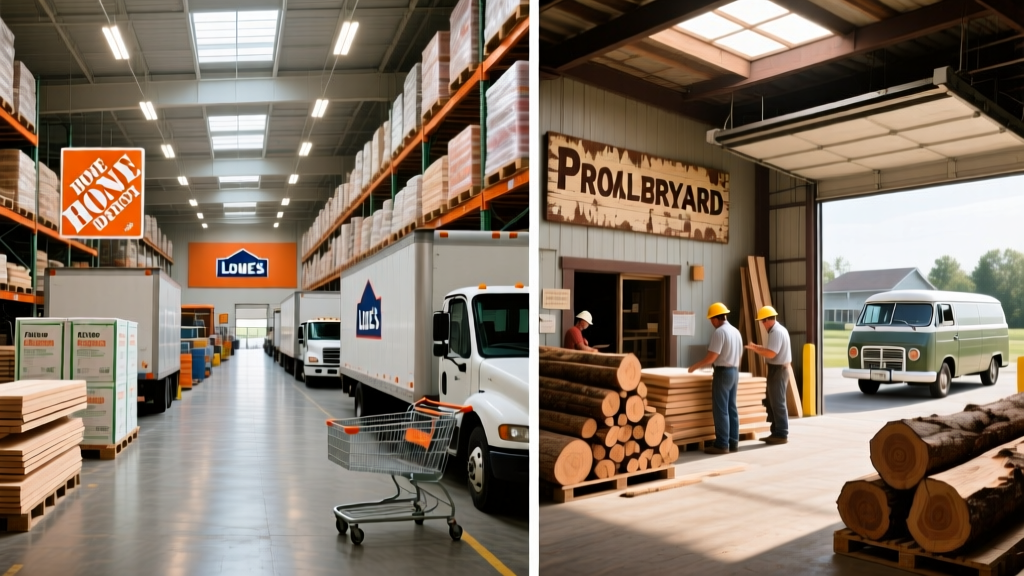
The building material supply landscape has permanently bifurcated. General contractors and custom homebuilders operating in 2026 can no longer rely on a single sourcing strategy without sacrificing either margin or schedule. While national big box retailers have optimized their logistics for high-volume commodity goods, regional pro lumberyards have doubled down on specialized structural components, engineered wood, and credit flexibility. Choosing the right building material supply partner is no longer about finding the lowest sticker price on a 2x4; it is about aligning your sourcing strategy with the specific phase of construction, cash flow requirements, and site access constraints.
Head-to-Head Sourcing Matrix
Before breaking down the specific use cases, review this direct comparison of how the two primary supply channels stack up across critical operational metrics.
| Criteria | Big Box Retailers (Home Depot, Lowe's) | Local Pro Lumberyards |
|---|---|---|
| Commodity Lumber Pricing | Highly competitive; frequent volume promos | 5-8% higher on basic stick lumber |
| Engineered Wood (LVL, I-Joists) | Limited stock; 2-3 week special order | 15-20% cheaper; 48-hour regional fulfillment |
| Delivery Capabilities | Flatbed/box truck; ground-level drops only | Articulating boom cranes; second-story drops |
| Credit Terms | Commercial credit card or immediate payment | Net-30 to Net-60 house accounts for LLCs |
| Returns & Restocking | Lenient; easy in-store returns | Strict; 15-20% restocking fees on cut goods |
Big Box Retailers: The Commodity & Convenience Play
National chains leverage massive purchasing power to dominate the market for standardized, high-turnover items. If your project requires thousands of linear feet of PVC, bulk fasteners, or standard fiberglass batt insulation, the big box building material supply chain is mathematically superior.
Where Big Box Wins: Rough-In and Finishes
For MEP (Mechanical, Electrical, Plumbing) rough-ins and interior finishes, big box stores offer unbeatable convenience and pricing. A standard 1/2-inch x 100ft roll of PEX-A tubing or a 5-gallon bucket of premium interior acrylic latex paint will almost always be cheaper at a national retailer due to direct-from-manufacturer volume rebates that local yards cannot negotiate. Furthermore, the ability to send a laborer to the local store for a $40 top-up of missed fasteners or connectors without waiting for a delivery truck is a significant schedule-saver.
The Hidden Costs of Big Box Sourcing
The primary failure mode when relying on big box stores for structural framing is inventory depth. While they stock 2x4 and 2x6 SPF (Spruce-Pine-Fir) #2 & Btr in abundance, finding specialized dimensional lumber like 2x10 or 2x12 in lengths over 16 feet is increasingly difficult. In early 2026, a standard 2x4x8 SPF board hovers between $3.15 and $3.40 at retail. However, if your framing crew runs out of 2x12x20 floor joists, the big box special-order lead time can stretch to 14 days, idling your crew and costing thousands in delayed labor.
Local Pro Lumberyards: The Structural & Custom Advantage
Independent and regional pro yards operate on a B2B model designed specifically for the rhythms of active construction sites. Their building material supply strategy prioritizes structural integrity, specialized engineering, and site-specific logistics over walk-in retail traffic.
The 'House Account' Cash Flow Advantage
Perhaps the most critical advantage of a pro yard is the credit structure. Residential construction is draw-based; you do not get paid until the bank inspector approves the framing or drywall phase. Big box stores require immediate payment via commercial credit card, forcing contractors to float material costs at 18-24% APR. Pro yards offer 'house accounts' with Net-30 or Net-60 terms to established LLCs. This aligns your material payables with your construction draw receivables, effectively providing interest-free short-term financing that can make or break a custom builder's annual cash flow.
Do not wait until the week before groundbreak to apply. Pro yard credit managers require an EIN, a copy of your LLC articles of organization, and at least three trade references (usually from other suppliers or subcontractors). The underwriting process typically takes 7 to 14 business days. Apply during your off-season to ensure your credit line is active when spring starts.
Specialized Inventory and Boom-Truck Delivery
When sourcing engineered lumber like Weyerhaeuser Trus Joist TJI 110 I-Joists or LVL beams, pro yards bypass retail markups by dealing directly with regional mill distributors. More importantly, their delivery fleet is purpose-built. While a big box delivery truck will drop a pallet of roof trusses in the driveway (requiring you to rent a telehandler and operator to lift them), pro yards utilize trucks equipped with HIAB articulating boom cranes. The driver will crane the trusses, engineered floor cassettes, or heavy composite decking bundles directly onto the second-floor deck or top plates, saving you $800 to $1,200 per drop in equipment rental and labor.
Decision Framework: Sourcing by Project Phase
To maximize efficiency and protect margins in 2026, split your building material supply orders based on the construction phase. Use this framework to route your purchase orders:
- Site Work & Foundation: Pro Yard. Source pressure-treated mudsills, anchor bolts, and ICF (Insulated Concrete Form) blocks here. Pro yards understand local code requirements for foundation hardware better than retail desk staff.
- Framing & Sheathing: Pro Yard. Order your entire structural package (dimensional lumber, OSB, LVLs, I-joists, and roof trusses) as a single 'house package'. This guarantees matched lead times and qualifies you for bulk freight discounts and free boom-truck delivery.
- MEP Rough-In: Big Box. Buy your Romex wire, PVC drain lines, PEX fittings, and metal stud framing for interior non-load-bearing walls at retail. The volume pricing on these commodities is unbeatable.
- Insulation & Drywall: Hybrid. Buy standard R-15 fiberglass batts at the big box, but order 5/8-inch Type X fire-rated drywall and specialized spray foam from the pro yard, which often stocks the 54-inch wide sheets that reduce butt joints and finishing labor.
- Exterior Finishes: Pro Yard. Source fiber cement siding (like James Hardie), composite decking (Trex/TimberTech), and custom exterior doors through the pro yard. They have certified reps who will visit the site to take exact measurements and assume liability for material takeoff errors.
Navigating 2026 Tariff and Freight Volatility
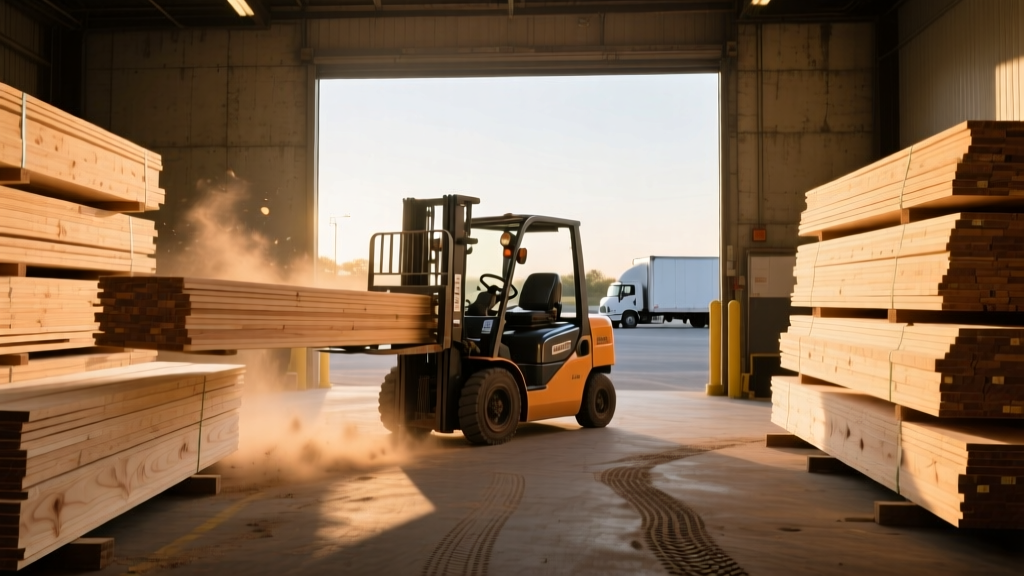
Contractors must actively monitor macroeconomic factors affecting the building material supply chain. According to the U.S. Census Bureau's Construction Materials data, softwood lumber and steel prices remain highly susceptible to cross-border tariff adjustments and rail freight bottlenecks. When Canadian softwood lumber tariffs fluctuate, big box retailers typically pass the exact percentage increase to the consumer shelf within 48 hours. Local pro yards, however, often hold 30 to 45 days of physical inventory in their warehouses, allowing them to shield their house account customers from immediate price shocks.
Furthermore, the National Association of Home Builders (NAHB) continues to highlight that localized supply chain disruptions—such as regional resin shortages affecting PVC and PEX production—can halt plumbing rough-ins entirely. To mitigate this, savvy contractors are now utilizing a dual-sourcing strategy: maintaining a primary relationship with a local pro yard for structural and custom components, while keeping a secondary commercial account at a national retailer to act as an emergency buffer for commodity shortages. By treating your building material supply chain as a diversified portfolio rather than a single vendor relationship, you insulate your project schedules from the volatility inherent in the 2026 construction market.
Written by
James ThorntonJames Thornton is a construction industry veteran with 25 years of hands-on experience in wood framing, lumber grading, and residential building codes. He started as a framing carpenter in rural Oregon, earned his ICC Residential Building Inspector certification, and eventually became a senior plan reviewer for the City of Portland Bureau of Development Services. James holds a B.S. in Wood Science & Technology from Oregon State University and is a certified lumber grader through the West Coast Lumber Inspection Bureau (WCLIB). He has inspected over 3,000 residential construction sites and authored the city's internal guide on advanced framing techniques (2x6 at 24" O.C.). James lives in Bend, OR, where he builds custom timber-frame cabins and competes in lumberjack sports.
More from James Thornton
View all
Insulation
Best Home Insulation Materials: Complete 2026 Guide
Compare top home insulation materials for 2026. Find R-values, installed costs per square foot, and best uses for fiberglass, spray foam, and mineral wool.
Aug 4, 2026

Sustainable Building
Certify Your Green Building Material for LEED and WELL
Step-by-step guide to certifying a green building material for LEED v5 and WELL v2. Master EPDs, HPDs, and VOC limits for 2026 project specifications.
Aug 4, 2026

Stone & Masonry
Veneer Stacked Stone Panels: Interior Design & Style Showcase
Discover how veneer stacked stone panels transform interiors. Explore modern design profiles, material pairings, and technical installation specs.
Aug 4, 2026