Flagler County Surplus & Salvage Building Materials LLC: 2026 Trends
Explore 2026 industry trends with Flagler County Surplus & Salvage Building Materials LLC, focusing on reclaimed pricing, LEED v5 credits, and Florida codes.
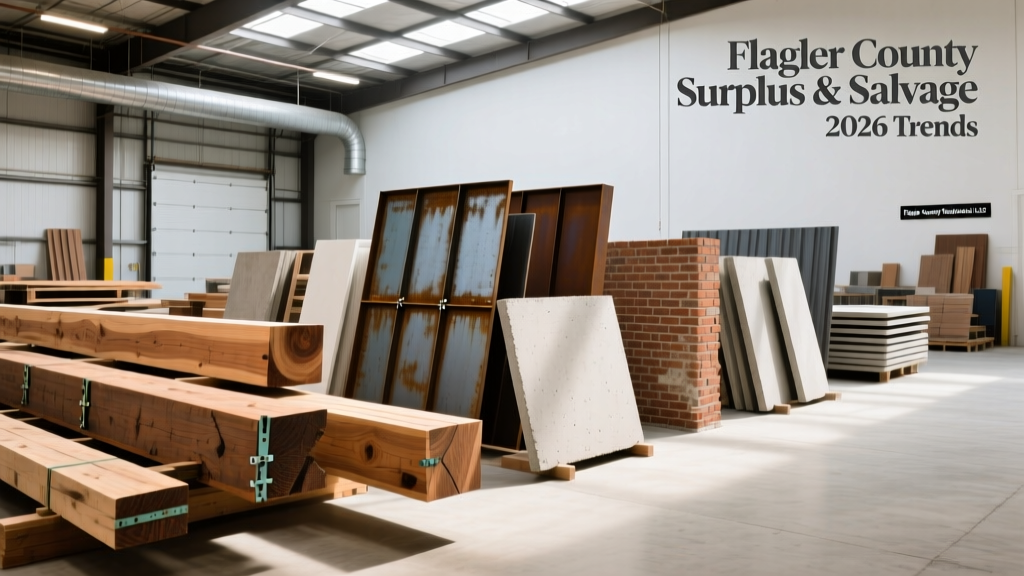
The Shift to Hyper-Local Material Recovery
The construction industry in 2026 is defined by a strict pivot toward circular economy principles, driven by both volatile virgin material pricing and stringent ESG (Environmental, Social, and Governance) mandates. At the regional level, facilities like Flagler County Surplus & Salvage Building Materials LLC have transitioned from niche liquidation hubs to critical nodes in the local supply chain. Rather than relying on global freight networks for new dimensional lumber and structural steel, general contractors in Central and Northeast Florida are increasingly sourcing directly from regional salvage yards to mitigate lead times and reduce embodied carbon.
- Freight Reduction: Sourcing within a 100-mile radius of Flagler County cuts transport-related emissions by up to 68% compared to importing new materials from Pacific Northwest mills.
- Waste Diversion: Deconstruction and salvage operations now divert an average of 75% of commercial tear-down waste from local landfills, aligning with updated EPA diversion targets.
- Cost Stabilization: Surplus pricing remains largely decoupled from global commodity indexes, offering contractors a 15-22% cost hedge against virgin material inflation.
According to the EPA's guidelines on Sustainable Management of Construction and Demolition Materials, the systematic recovery of building components is no longer just an environmental preference but a regulatory imperative in many municipalities. Flagler County Surplus & Salvage Building Materials LLC exemplifies this shift by processing high-value architectural salvage, reclaimed heavy timber, and surplus commercial fixtures that would otherwise incur tipping fees at local transfer stations.
Inventory Breakdown & 2026 Pricing Matrix
Understanding the exact inventory velocity and pricing structure at a regional salvage yard is critical for accurate project estimating. The team at Flagler County Surplus & Salvage Building Materials LLC moves specific high-demand categories faster than others, largely dictated by local residential remodeling and commercial tenant-improvement projects.
| Material Category | 2026 Salvaged Cost | 2026 Virgin Cost | Embodied Carbon Reduction |
|---|---|---|---|
| Reclaimed Longleaf Heart Pine (2x8, 12ft) | $11.50 - $14.00 / bf | $18.00 - $24.00 / bf | 85% |
| Surplus Structural Steel (W8x10 Beams) | $0.65 - $0.85 / lb | $1.15 - $1.40 / lb | 72% |
| Architectural Hollow Metal Doors (3070) | $180 - $250 / unit | $450 - $600 / unit | 90% |
| Corrugated Galvalume Roofing (26-gauge) | $1.10 - $1.40 / sq ft | $2.20 - $2.80 / sq ft | 65% |
| Salvaged Brick (Chicago Common Style) | $0.45 - $0.60 / brick | $0.85 - $1.10 / brick | 80% |
Navigating Florida's HVHZ Building Codes with Salvage
A unique challenge when sourcing from Flagler County Surplus & Salvage Building Materials LLC is navigating the proximity to Florida's High Velocity Hurricane Zone (HVHZ) regulations. While Flagler County itself is not strictly within the Miami-Dade/Broward HVHZ, many regional contractors build to HVHZ standards for insurance premium reductions and structural resilience.
Salvaged impact-resistant windows and exterior doors can only be reused in HVHZ-compliant projects if they retain their original, legible manufacturer labels and the specific Miami-Dade Notice of Acceptance (NOA) documentation can be verified. Reusing structural roof trusses from a salvage yard requires a licensed structural engineer to re-certify the load-bearing capacity and joint plate integrity, which often negates the cost savings. Therefore, smart contractors restrict salvaged inventory to non-structural applications: interior partition framing, architectural cladding, decking, and finish carpentry.
When purchasing older architectural salvage, specifically painted millwork, doors, and reclaimed flooring, contractors must mandate XRF (X-ray Fluorescence) testing for lead-based paint. Furthermore, salvaged acoustic ceiling tiles or older cementitious siding must be tested for asbestos before any mechanical cutting or sanding occurs on-site.
Strategic Sourcing for LEED v5 and ESG Compliance
For commercial projects pursuing LEED v5 certification, the inventory at Flagler County Surplus & Salvage Building Materials LLC provides a direct pathway to earning points under the Materials and Resources (MR) category. Specifically, the U.S. Green Building Council (USGBC) LEED Framework rewards projects that utilize salvaged, refurbished, or reused materials.
'Integrating salvaged materials is no longer just about aesthetic character; it is a quantifiable strategy for reducing a building's whole-life carbon footprint. Regional salvage yards provide the necessary chain-of-custody documentation required for modern green building rating systems.' — National Institute of Building Sciences (NIBS) Salvaged Materials Guide
To maximize LEED credits, procurement managers must request a 'Salvage Certificate of Origin' from the yard. This document traces the material back to its original deconstruction site, proving that the material was diverted from a landfill and transported within the preferred 500-mile regional radius. This documentation is vital for satisfying the MRc3 credit: Building Product Disclosure and Optimization - Sourcing of Raw Materials.
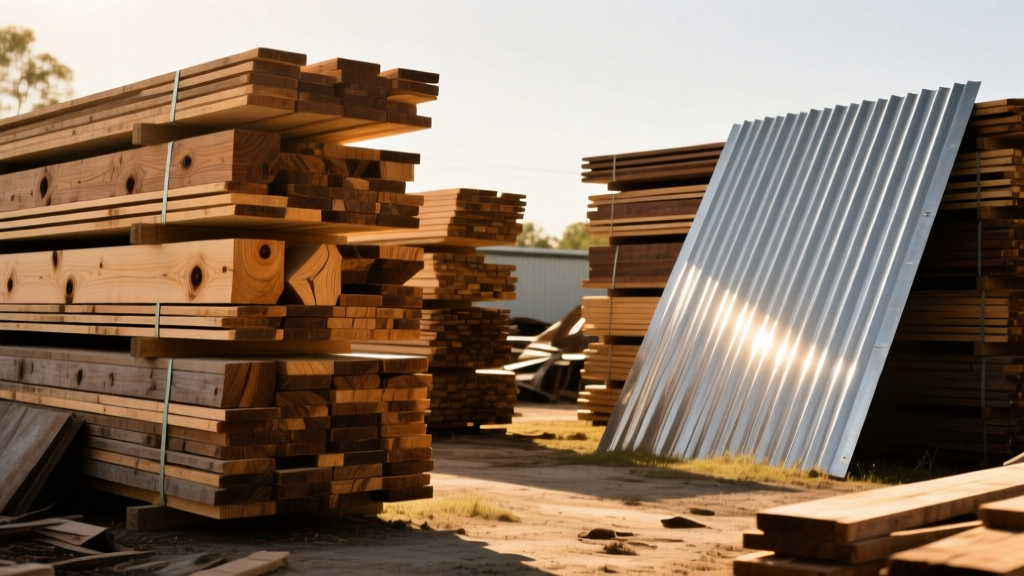
Actionable Procurement Framework for General Contractors
Integrating surplus and salvage materials into a standardized construction schedule requires a departure from traditional just-in-time ordering. Because salvage inventory is inherently finite and non-replenishable, contractors must adopt an 'acquire-then-design' or 'early-lock' methodology.
- Phase 1: Early Site Scouting (Pre-Design)
Visit Flagler County Surplus & Salvage Building Materials LLC during the schematic design phase. Identify available lots of reclaimed flooring, structural timber, or architectural fixtures. Have the architect design around the specific dimensions and quantities available, rather than specifying a generic product and hoping the salvage yard can fulfill it. - Phase 2: Off-Site Storage and Staging
Salvaged lumber requires acclimatization. Purchase reclaimed wood 4 to 6 weeks before installation and store it in a climate-controlled environment on-site to reach equilibrium moisture content (EMC) with the interior space, preventing post-installation warping or gapping. - Phase 3: Specialized Labor Allocation
Reclaimed materials often contain hidden nails, embedded hardware, or irregular dimensions. Allocate a 15% premium in your labor budget for carpentry and milling. Ensure your tradesmen use carbide-tipped or diamond-coated blades to prevent rapid dulling when cutting salvaged timber or masonry. - Phase 4: Contingency Sourcing
Always maintain a 10-15% overage buffer. If a specific salvaged lot runs out, identify a compatible secondary material (e.g., new FSC-certified pine stained to match the reclaimed heart pine) to ensure the project schedule does not stall due to inventory exhaustion.
By treating regional salvage yards as primary supply partners rather than secondary novelty shops, contractors in 2026 can secure significant margin improvements, accelerate their ESG reporting, and build structures with a deeply rooted sense of local material history.
Written by
Marcus ChenMarcus Chen is a licensed structural engineer (PE) and building materials analyst with over 12 years of experience across residential, commercial, and industrial construction. He holds a Master of Science in Civil Engineering from UC Berkeley and spent six years at Thornton Tomasetti before transitioning to independent consulting and technical writing. Marcus specializes in material selection for seismic-prone regions, concrete reinforcement strategies, and lifecycle cost analysis. His work has been cited by the American Concrete Institute (ACI) and the Structural Engineers Association of California (SEAOC). When he is not on a job site or at his desk, you will find him hiking the Sierra Nevada or restoring a 1920s craftsman bungalow in Oakland, CA.
More from Marcus Chen
View all
Construction Cost
How Much Did the Eiffel Tower Cost to Build?
How much did the Eiffel Tower cost to build in 1889? We adjust for inflation and compare its budget to modern skyscraper construction.
Aug 4, 2026

Fire Resistance
What Is a Fire Resistant Material? Testing & Certification Guide
Discover what is a fire resistant material through ASTM and UL testing. Learn how fire ratings, certifications, and assemblies work in construction.
Aug 4, 2026

Construction Cost
How Much Did the Burj Khalifa Cost to Build?
How much did the Burj Khalifa cost to build? We break down the $1.5B project and extract 5 money-saving strategies for your next build.
Jul 30, 2026