7 New Building Materials Reshaping Construction in 2026
Explore 7 new building materials for 2026, including self-healing concrete, CLT, and aerogel. Compare costs, specs, and procurement data.

The Shift from Traditional to Advanced Material Science
The commercial and residential construction sectors are undergoing a fundamental transition in material specification. Driven by stringent 2026 IECC thermal envelope mandates, embodied carbon tracking requirements, and chronic skilled labor shortages, architects and general contractors are moving away from legacy commodities. Instead, they are specifying advanced composites, bio-engineered substrates, and nanotechnology-enhanced building products. These new building materials are no longer experimental prototypes; they possess established ASTM testing profiles, predictable supply chains, and quantifiable life-cycle cost advantages.
Specifying advanced materials requires moving beyond basic R-values and compressive strength. Procurement teams must now evaluate moisture-sensitivity during transit, CNC-prefabrication tolerances, and specific biological or chemical activation requirements. According to the Whole Building Design Guide (WBDG), integrating high-performance materials early in the schematic design phase reduces field-change orders by up to 18% compared to late-stage value engineering.
Performance Matrix: Next-Gen Materials at a Glance
The following matrix provides a baseline comparison of the most commercially viable advanced materials currently available for mid-to-large-scale projects.
| Material Category | Specific Product / Type | Key Performance Metric | Approx. Cost Premium | Primary Application |
|---|---|---|---|---|
| Bio-Concrete | Basilisk BioConcrete | Autogenous crack healing up to 0.8mm | +$85 / cubic yard | Subterranean retaining walls, water tanks |
| Mass Timber | 5-Ply CLT (e.g., Stora Enso) | Char rate: 0.7mm/min (Eurocode 5) | $55 - $65 / sq ft | Mid-rise floor decks, shear walls |
| Nano-Insulation | Aspen Spaceloft Aerogel | R-10.3 per inch thickness | $4.20 / sq ft | Thermal bridge mitigation, historic retrofits |
| Bio-Composites | Mycelium Acoustic Boards | NRC Rating: 0.75 - 0.85 | $3.50 / sq ft | Interior partition walls, ceiling baffles |
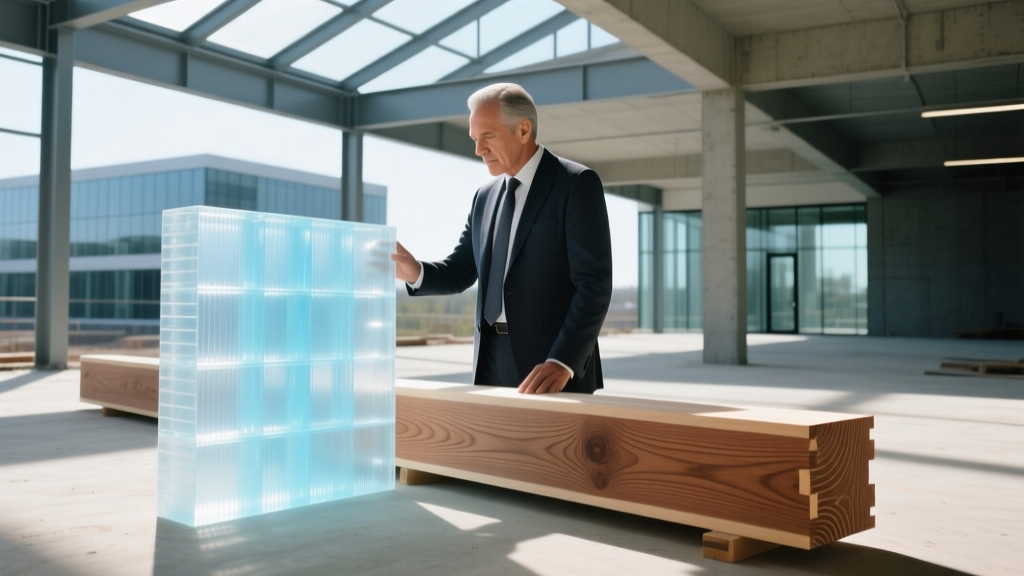
| Advanced Glazing | Transparent Aluminum (ALON) | Hardness: 9 Mohs, 85% transmission | 5x - 8x standard glass | Secure facades, blast-resistant windows |
| Enhanced Metals | Graphene-Infused Steel | 30% higher tensile yield strength | +12% / ton | High-load structural columns, seismic framing |
| Additive Mfg. | Geopolymer 3D Print Mix | 4,000 PSI at 24 hours | $180 / cubic yard | Complex formwork, custom architectural facades |
Technical Deep Dive: 4 High-Impact New Building Materials
1. Bio-Receptive Self-Healing Concrete
Traditional concrete cracking leads to rebar corrosion and spalling, accounting for billions in annual infrastructure maintenance. Bio-receptive concrete solves this via embedded biological agents. Products like Basilisk BioConcrete utilize Bacillus pseudofirmus bacteria encapsulated in 2mm biodegradable PLA (polylactic acid) pellets alongside a calcium lactate nutrient source.
When a micro-crack forms and water infiltrates, the bacterial spores germinate, consuming the calcium lactate and excreting limestone (calcium carbonate) to seal the fissure. This autogenous healing process effectively seals cracks up to 0.8mm wide within 28 days, drastically reducing permeability and chloride ion penetration.
2. Cross-Laminated Timber (CLT) for Mid-Rise Structures
Mass timber has graduated from niche architectural statements to a standard structural system for 6-to-18-story buildings. Modern 5-ply CLT panels (typically 175mm thick) offer an exceptional strength-to-weight ratio, reducing foundation loads by up to 30% compared to cast-in-place concrete. According to WoodWorks, the leading authority on mass timber engineering, CLT floor assemblies can achieve 2-hour fire resistance ratings not through chemical treatments, but through predictable charring.
Under Eurocode 5 and IBC guidelines, thick timber chars at a nominal rate of 0.7mm per minute. This char layer insulates the inner core, preserving the structural integrity of the unburned wood. A 175mm panel will sacrifice roughly 84mm of its cross-section over two hours, leaving sufficient intact fiber to support design loads.
- CNC Precision: Panels are milled to 1/16-inch tolerances, allowing for integrated MEP (Mechanical, Electrical, Plumbing) chases routed directly in the factory.
- Acoustic Decoupling: To meet IBC STC 50 requirements for multi-family residential, CLT decks must be paired with a 1.5-inch acoustic mat and a 2-inch gypsum concrete topping slab to mitigate low-frequency impact noise.
3. Silica Aerogel Blanket Insulation
As building codes demand continuous exterior insulation (ci) without increasing wall cavity depths, silica aerogel has emerged as the premier solution. Aerogels are created via a supercritical drying process that replaces the liquid component of a silica gel with gas, resulting in a matrix that is 90% air. Products like Aspen Aerogels' Spaceloft deliver an unprecedented R-10.3 per inch.
This allows a 1-inch aerogel blanket to match the thermal performance of 2.5 inches of rigid XPS foam. Furthermore, aerogel blankets are inherently hydrophobic yet vapor-permeable, eliminating the risk of trapped interstitial condensation that often plagues rigid foam assemblies in mixed-humid climates.
4. Mycelium-Based Acoustic and Partition Boards
For interior fit-outs, mycelium composites offer a zero-VOC, carbon-negative alternative to fiberglass and mineral wool. Companies like Ecovative grow these panels by inoculating agricultural waste (such as hemp hurds or corn stover) with fungal mycelium. The mycelium acts as a natural, self-assembling binder, digesting the waste and forming a dense, chitinous matrix over a 7-to-14-day period before being heat-pressed to halt biological activity.
While strictly non-load-bearing (compressive strength peaks around 15-20 PSI), mycelium boards excel in acoustic dampening. Their complex, porous internal structure yields Noise Reduction Coefficients (NRC) of 0.75 to 0.85, making them ideal for open-plan office baffles, theater wall linings, and residential media rooms. They are naturally fire-retardant due to the chitin structure, typically achieving Class A flame spread ratings without halogenated chemical treatments.
Procurement, Storage, and Supply Chain Realities
Integrating new building materials requires overhauling standard procurement timelines. Unlike commodity materials (CMU, standard batt insulation) available via local distributor stock, advanced materials operate on engineered-to-order models.
| Material | Standard Lead Time | Critical Storage Requirement |
|---|---|---|
| Bio-Concrete | 3 - 4 Weeks | Batch plant must flush lines; calcium lactate must be kept dry pre-mix. |
| CLT Panels | 12 - 16 Weeks | Must remain wrapped. Moisture content cannot exceed 16% prior to enclosure. |
| Aerogel Blankets | 4 - 6 Weeks | Store flat. Do not stack heavy pallets on top to prevent matrix crush. |
| Mycelium Boards | 6 - 8 Weeks | Climate-controlled interior only. Protect from bulk water exposure. |
General contractors must sequence site delivery carefully. For CLT, just-in-time delivery is mandatory; leaving engineered timber exposed to seasonal rain on-site leads to surface checking, swelling, and potential delamination, which voids manufacturer warranties. Similarly, aerogel blankets must be kept in their UV-protected packaging until the exact moment of installation, as prolonged UV exposure degrades the hydrophobic surface treatment.
Decision Framework: When to Specify New Building Materials
Specifying advanced materials should be driven by specific project constraints rather than novelty. Use the following framework to determine material viability:
- If site logistics severely limit crane capacity or foundation depth: Specify Mass Timber (CLT/Glulam). The 30% weight reduction allows for smaller foundation footings and faster, lighter crane lifts in dense urban infill sites.
- If wall thickness is constrained by zoning setbacks or historic preservation: Specify Aerogel Insulation. It provides maximum continuous R-value in minimal profile, crucial for maximizing leasable square footage or preserving historic masonry sightlines.
- If the project involves subterranean water-retaining structures with high maintenance costs: Specify Bio-Receptive Concrete. The 8-12% upfront material premium is easily offset by eliminating the need for epoxy crack-injection maintenance over a 50-year lifecycle.
- If the project mandates strict embodied carbon limits (e.g., LEED v5, Living Building Challenge): Specify Mycelium Composites and Mass Timber. These materials sequester carbon and eliminate the high-temperature kiln firing associated with traditional mineral wools and gypsum boards.
By aligning the unique physical properties of these new building materials with specific architectural and logistical constraints, project teams can achieve superior performance metrics while mitigating long-term operational liabilities. For further guidance on envelope detailing and material compatibility, refer to the ENERGY STAR Insulation Guidelines and manufacturer-specific BIM libraries.
Written by
Sarah WhitfieldSarah Whitfield is a chartered quantity surveyor (MRICS) and construction cost analyst with 15 years of experience in material pricing, procurement strategy, and project budgeting. She earned her degree in Construction Management from the University of Reading (UK) and has worked on projects ranging from $2M custom homes to $180M mixed-use developments across North America and Europe. Sarah currently leads cost estimating for BuildMat Insight, maintaining a proprietary database of 4,000+ material price points updated quarterly. She is a frequent contributor to RSMeans cost data panels and has presented at the International Cost Engineering Council (ICEC) congress. Based in Denver, CO, Sarah is an avid trail runner and volunteer mentor for Women in Construction.
More from Sarah Whitfield
View all
Wood & Lumber
What Are the Different Types of Wood? A Builder's Guide
Compare structural softwoods, finish hardwoods, and engineered lumber. Analyze Janka ratings, MOE values, and 2026 pricing for construction.
Aug 4, 2026

Walls & Panels
Steel Framing vs Wood Framing: Corrosion and Moisture Defense
Compare steel framing vs wood framing for moisture resistance. Learn about galvanized coatings, condensation risks, and corrosion protection strategies.
Jul 21, 2026

Stone & Masonry
How to Cut Stone Veneer: Wet Saw vs Grinder Comparison
Compare the best tools for cutting stone veneer. We review wet saws, angle grinders, and chop saws to help you achieve clean, chip-free cuts.
Jul 21, 2026