Building Materials Japan News: 2026 Supply & Innovation Trends
Explore the latest building materials Japan news for 2026, covering CLT mass timber, self-healing concrete, and supply chain shifts.

The Macro Shift: Labor Caps and Material Prefabrication
When tracking building materials Japan news over the past twelve months, a clear pattern emerges: the industry is aggressively pivoting toward off-site manufacturing and bio-based materials. This is not merely an environmental initiative; it is a direct response to severe demographic constraints. The Ministry of Land, Infrastructure, Transport and Tourism (MLIT) has strictly enforced overtime caps on construction workers, a regulatory shift that has permanently reduced available on-site labor hours by an estimated 15% to 20% across major urban centers.
To maintain project timelines, Japanese general contractors (zenekon) are demanding materials that require minimal on-site assembly. This has triggered a massive capital reallocation into prefabricated modular components, automated rebar tying systems, and advanced timber engineering. For international procurement officers and developers, understanding these localized supply chain shifts is critical for sourcing high-performance materials that are currently scaling in the Japanese market before hitting global mainstream adoption.
Key 2026 Market Drivers in Japan
- Labor Deficit: Approximately 33% of Japan's skilled construction workforce is over the age of 55, accelerating the need for lightweight, easy-to-install materials.
- Carbon Neutrality 2050: Strict embodied carbon mandates for public works are forcing a shift away from traditional Portland cement and blast-furnace steel.
- Seismic Resilience: Post-Noto earthquake building code revisions are prioritizing ductile materials and base-isolation compatible structural frames.
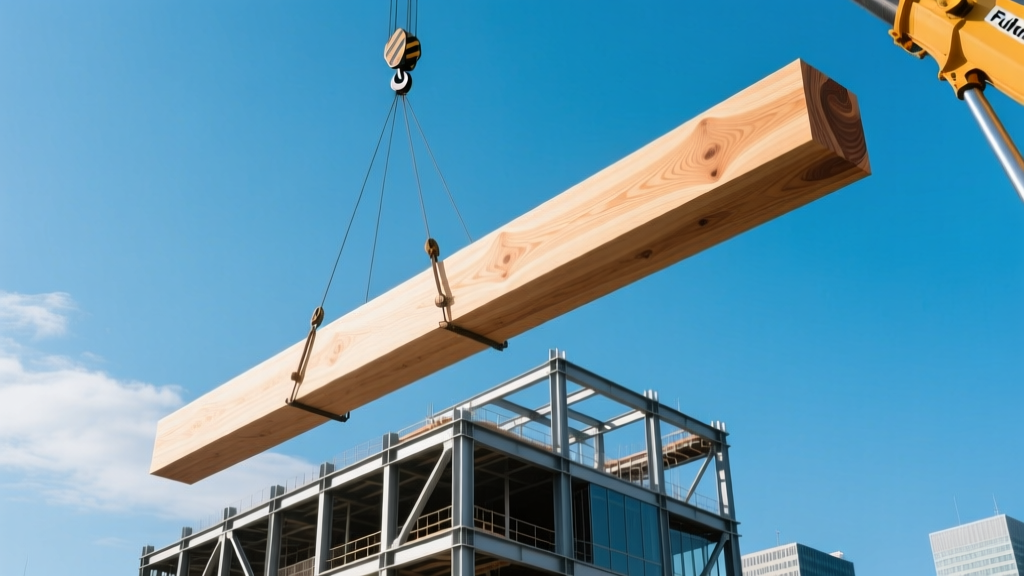
Cross-Laminated Timber (CLT): The New Structural Standard
Japan has historically been a concrete-and-steel market for commercial mid-rises, but 2026 marks a definitive tipping point for Cross-Laminated Timber (CLT). Driven by the Ministry of Agriculture, Forestry and Fisheries pushing for domestic timber utilization, CLT production capacity in Japan has expanded to meet the demands of 5- to 10-story commercial and institutional buildings.
Technical Specifications and JAS Certification
Japanese CLT is manufactured under stringent Japanese Agricultural Standards (JAS). Unlike some European imports that use standard melamine-urea-formaldehyde (MUF) adhesives, top-tier Japanese manufacturers like Sumitomo Forestry and Mokuseika are increasingly utilizing Polyurethane Reactive (PUR) adhesives. PUR offers superior moisture resistance and eliminates formaldehyde emissions entirely, a critical factor for Japan's strict indoor air quality sick-building syndrome regulations.
Furthermore, recent fire-resistance certifications from the MLIT now allow specific 5-ply and 7-ply CLT panels (minimum 175mm thickness) to achieve 2-hour fire resistance ratings without the need for supplemental gypsum board encapsulation, drastically reducing finishing labor.
| Metric | Steel Frame (S-Frame) | CLT Mass Timber |
|---|---|---|
| Material Cost (per m³) | ¥140,000 - ¥180,000 | ¥95,000 - ¥125,000 |
| On-Site Assembly Time | Baseline (100%) | 40% - 50% faster |
| Embodied Carbon (kgCO2e/m²) | 350 - 450 | -150 to +50 (Biogenic storage) |
| Seismic Weight Factor | High (Requires deeper piles) | Low (Reduces foundation costs by ~20%) |
Bio-Receptive and Self-Healing Concrete
Japan's aging infrastructure—specifically its vast network of highway viaducts and coastal seawalls—requires constant, expensive maintenance. In response, Japanese chemical and construction conglomerates have commercialized self-healing concrete at an unprecedented scale.
The leading technology embeds microcapsules containing Bacillus subtilis bacteria and a calcium lactate precursor into the concrete mix. When micro-cracks form and water ingress occurs, the bacteria activate, consuming the calcium lactate and excreting limestone (calcium carbonate) to seal the crack.
Performance Metrics and Cost Premiums
Field tests conducted by the Ministry of Land, Infrastructure, Transport and Tourism on coastal retaining walls demonstrate that bio-concrete can autonomously seal cracks up to 0.8mm in width within 28 days. While the initial material cost carries a 15% to 22% premium over standard high-performance Portland cement (HPC), the lifecycle cost analysis (LCCA) shows a break-even point at year 12 due to the elimination of epoxy injection maintenance cycles.
"The integration of biological agents into structural concrete is no longer a laboratory experiment in Japan; it is a specified requirement for several major municipal water treatment and coastal defense projects scheduled for completion in 2028."
"Urban Mined" Steel and EAF Dominance
While global markets still rely heavily on Blast Furnace (BF) steel production, Japan's steel sector has aggressively transitioned toward Electric Arc Furnace (EAF) technology utilizing "urban mined" scrap steel. Companies like Tokyo Steel Manufacturing are producing structural H-beams and rebar that boast a carbon footprint up to 75% lower than virgin BF steel.
For structural engineers, the historical concern with EAF steel was the inconsistency in tensile strength due to residual tramp elements (copper, tin) in the scrap. However, advanced AI-driven spectroscopic sorting at Japanese recycling facilities in 2026 ensures that JIS G 3106 (SM490) grade steel produced via EAF meets the exact same ductility and yield strength tolerances as virgin ore steel, making it fully compliant for high-seismic zone moment-resisting frames.
Procurement Framework for International Buyers
Sourcing these advanced materials from Japan requires navigating specific export certifications and supply chain logistics. Below is a decision matrix for international procurement teams evaluating Japanese material exports.
Sourcing Decision Matrix
| Material Category | Export Viability | Key Certification Required | Primary Logistics Constraint |
|---|---|---|---|
| CLT Panels | High (Growing demand in NA/EU) | JAS / APA PRG-320 equivalency | High volumetric weight; requires specialized flat-rack shipping. |
| Self-Healing Admixtures | Very High (Low volume, high value) | ISO 9001 / Local EPA approvals | Temperature-controlled transit required to preserve bacterial viability. |
| EAF Structural Steel | Moderate (Regional competitiveness) | JIS / ASTM A992 equivalency | Heavy bulk freight costs negate carbon savings if shipped >3,000 nautical miles. |
| Prefabricated MEP Racks | Low (Customized to local codes) | Local electrical/plumbing codes | Design incompatibility; better to license the BIM fabrication software. |
Actionable Next Steps for Procurement Teams
If your firm is looking to integrate Japanese material innovations into upcoming projects, begin by requesting technical data sheets (TDS) specifically referencing the 2025-2026 JAS revisions for timber products. For bio-concrete admixtures, initiate a 90-day pilot pour with local batching plants to calibrate the bacterial activation thresholds to your specific regional climate and humidity levels, as the Bacillus strains optimized for Japan's humid summers may require formulation adjustments for arid environments.
By aligning your supply chain with Japan's labor-driven material innovations, you secure access to some of the most rigorously tested, high-performance building products in the global market.
Written by
David NakamuraDavid Nakamura is a licensed architect (AIA) and construction technology writer focused on sustainable building methods, mass timber engineering, and high-performance building envelopes. He holds a Master of Architecture from the University of Washington and is a certified Passive House Consultant (CPHC). David spent eight years at the Seattle firm Mithun, where he led the design of three LEED Platinum projects, before founding his own practice specializing in net-zero residential design. He serves on the editorial advisory board of GreenBuilder Magazine and has authored peer-reviewed papers on cross-laminated timber (CLT) connections for the Journal of Structural Engineering. In his spare time, David teaches woodworking at Pratt Fine Arts Center and kayaks the Puget Sound.
More from David Nakamura
View all
Construction Cost
Labor Cost to Build a Deck Per Sq Ft: 2026 Installation Guide
Discover the exact labor cost to build a deck per sq ft in 2026. This installation guide breaks down contractor rates, complexity factors, and hidden fees.
Aug 4, 2026

Construction Cost
How Much Does It Cost to Build a 3 Bedroom House? Financing Guide
Learn exactly how much it costs to build a 3 bedroom house and explore 2026 financing options, construction loan types, and budget frameworks for your build.
Aug 4, 2026

Construction Cost
Cost to Build a Tennis Court: 2026 Guide
How much does it cost to build a tennis court in 2026? Breakdowns for asphalt, concrete, and synthetic surfaces plus fencing and lighting.
Jul 30, 2026