Florence Building Materials in Huntington: 2026 Supply Guide
Explore the 2026 supply guide for Florence building materials in Huntington. Compare masonry, hardscaping costs, lead times, and coastal specs.

The Huntington Market Landscape for Premium Materials
Sourcing high-grade construction supplies on Long Island's North Shore requires navigating a unique intersection of coastal building codes, historic preservation overlays, and strict municipal zoning. When contractors and architects specify Florence building materials in Huntington, they are typically targeting premium masonry, architectural stone, and advanced hardscaping products designed to withstand the region's aggressive freeze-thaw cycles and salt-laden coastal air. As of 2026, the local supply network has stabilized, but lead times for custom-cut natural stone and specialized permeable pavers still require precise logistical planning.
The Town of Huntington Building Department strictly enforces the New York State Uniform Fire Prevention and Building Code, with local amendments that heavily impact material selection for properties situated near the Long Island Sound. Structures in designated flood zones require materials that can withstand hydrostatic pressure and resist saltwater corrosion, making the selection of appropriate mortars, fasteners, and base aggregates just as critical as the finish materials themselves.
Core Material Categories Available
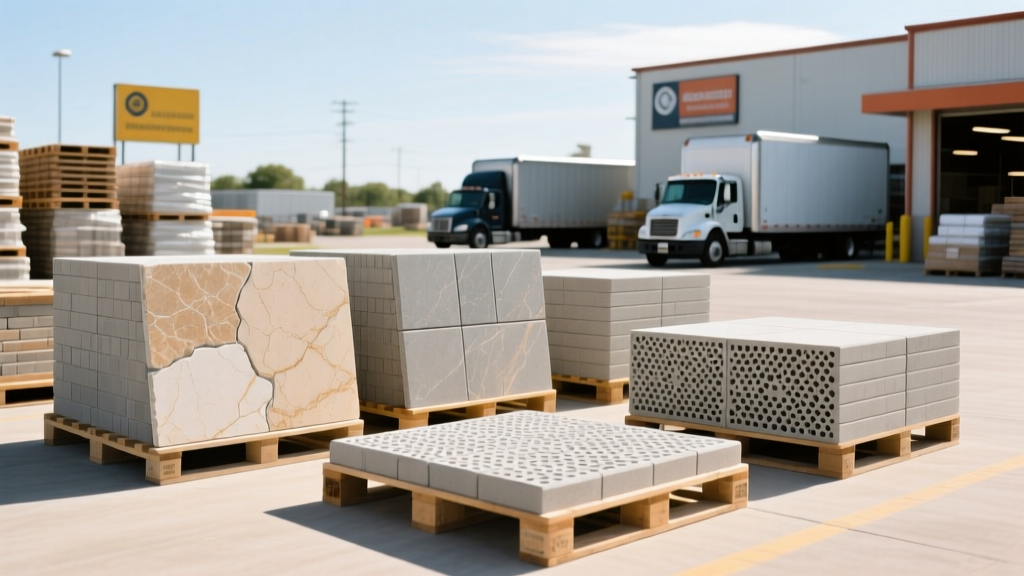
The Florence supply channels serving the Huntington market focus heavily on exterior envelope and landscape architecture materials. The primary categories include:
- Architectural Stone Veneer: Both natural thin veneer (NTV) and high-density manufactured equivalents, specified for exterior cladding and interior feature walls.
- Permeable Hardscaping: Permeable Interlocking Concrete Pavers (PICP) and permeable clay brick, driven by Huntington's strict stormwater management and runoff reduction ordinances.
- Premium Masonry Supplies: Type S and Type N mortars with specialized polymer admixtures, stainless steel wall ties, and through-wall flashing systems.
- Cellular PVC Millwork: Rot-proof trim, fascia, and soffit materials engineered to replace traditional wood in high-moisture coastal environments.
2026 Pricing and Lead Time Matrix
Material costs and availability fluctuate based on quarry output and regional freight rates. The table below outlines current 2026 baseline estimates for premium materials frequently specified in Huntington residential and commercial projects.
| Material Category | Specific Product / Grade | Est. Cost (Per Sq. Ft.) | Current Lead Time | Best Application |
|---|---|---|---|---|
| Natural Thin Stone | Limestone / Fieldstone Blend | $14.50 - $19.00 | 3 - 5 Weeks | Exterior facade, chimney chases |
| Permeable Pavers | PICP (80mm thickness) | $8.25 - $11.50 | 2 - 4 Weeks | Driveways, municipal plazas |
| Cellular PVC Trim | 5/4x6 Smooth Finish | $4.80 - $6.20 (Linear Ft) | 1 - 2 Weeks | Corner boards, water tables |
| Masonry Admixtures | Acrylic Polymer (Liquid) | $45.00 - $60.00 (Gallon) | In Stock | Veneer mortar, stucco base |
Specification Guide: Top 3 Materials for Long Island Projects
1. Natural Thin Stone Veneer (ASTM C1670 Compliance)
When specifying natural stone for exterior applications in Huntington, the material must comply with ASTM C1670 standards for thin stone veneer. The maximum weight is strictly capped at 15 pounds per square foot. For coastal installations, avoid highly porous stones like certain sandstones that can spall during rapid freeze-thaw cycles. Instead, specify high-density limestone or quartzite. Installation requires a Type S mortar mixed with an acrylic polymer admixture to increase flexural strength and bond adhesion, preventing cracking when the structural backing experiences thermal expansion. Weep holes must be integrated into the flashing system at 16-inch intervals to allow incidental moisture to escape the cavity.
2. Permeable Interlocking Concrete Pavers (PICP)
Huntington's environmental regulations heavily incentivize low-impact development (LID). PICP systems are the standard for managing stormwater on-site. According to guidelines published by the National Concrete Masonry Association (NCMA), a proper PICP installation requires a specific open-graded aggregate base. The bedding course must utilize ASTM No. 8 or No. 9 washed stone, while the base and sub-base courses require No. 57 and No. 2 aggregates, respectively. Do not use stone dust or mason sand for bedding, as these will clog the joints and destroy the system's infiltration rate, which must exceed 200 inches per hour to meet local code.
3. Cellular PVC Trim and Millwork
Wood trim fails rapidly in the North Shore's humid, salt-heavy environment. Cellular PVC is the mandated alternative for fascia, rake boards, and water tables. However, PVC has a high coefficient of thermal expansion—approximately 1/8 inch per 10 feet of material for every 10°F change in temperature. Installers must leave a 1/8-inch gap at all end joints and use shiplap or scarf joints rather than square butt joints. Fastening schedules must utilize 316-grade stainless steel nails or screws; 304-grade stainless or galvanized fasteners will eventually bleed rust stains through the white PVC when exposed to Long Island's salt spray.
Sourcing Logistics and Local Constraints
Delivering heavy masonry and hardscape materials to Huntington job sites presents unique logistical hurdles. The Long Island Rail Road (LIRR) overpasses on local arteries like Route 110 and New York Avenue impose strict vertical clearances, often limiting flatbed delivery trucks to 11 feet 6 inches. Furthermore, many residential streets in the Village of Huntington and surrounding hamlets have strict seasonal weight restrictions to protect aging asphalt and subsurface utilities.
Logistics Pro-Tip: For projects located in dense residential zones like West Neck or Lloyd Neck, specify boom truck delivery rather than standard flatbed with forklift offloading. Boom trucks can lift pallets of stone veneer or pavers directly over fence lines and landscaping, eliminating the need for temporary plywood road protection and preventing damage to mature root systems.
Common Installation Failure Modes
Even premium materials will fail if installed incorrectly. The most frequent warranty claims and municipal inspection failures in the Huntington area involve the following errors:
- Efflorescence on Stone Veneer: Caused by using unwashed masonry sand or failing to install a proper weather-resistive barrier (WRB) and weep system. The soluble salts in the mortar migrate to the surface and crystallize.
- Paver Joint Erosion: Occurs when installers use standard polymeric sand in joints wider than 1/2 inch, or fail to compact the pavers with a vibratory plate compactor before activating the polymer with water.
- PVC Trim Buckling: Happens when installers drive nails flush or countersink them without leaving room for thermal expansion, or when dark-colored paints are applied to PVC without using specialized heat-reflective coatings (like AquaSurTech), causing the material to warp under solar heat gain.
By adhering to precise material specifications, understanding local municipal constraints, and planning for the unique logistical realities of the North Shore, contractors can ensure their projects meet both the aesthetic demands of the client and the rigorous environmental codes of the region. For the most current permitting requirements, always consult the FEMA Building Science publications alongside local municipal amendments before finalizing coastal material schedules.
Written by
James ThorntonJames Thornton is a construction industry veteran with 25 years of hands-on experience in wood framing, lumber grading, and residential building codes. He started as a framing carpenter in rural Oregon, earned his ICC Residential Building Inspector certification, and eventually became a senior plan reviewer for the City of Portland Bureau of Development Services. James holds a B.S. in Wood Science & Technology from Oregon State University and is a certified lumber grader through the West Coast Lumber Inspection Bureau (WCLIB). He has inspected over 3,000 residential construction sites and authored the city's internal guide on advanced framing techniques (2x6 at 24" O.C.). James lives in Bend, OR, where he builds custom timber-frame cabins and competes in lumberjack sports.
More from James Thornton
View all
Insulation
Best Home Insulation Materials: Complete 2026 Guide
Compare top home insulation materials for 2026. Find R-values, installed costs per square foot, and best uses for fiberglass, spray foam, and mineral wool.
Aug 4, 2026

Sustainable Building
Certify Your Green Building Material for LEED and WELL
Step-by-step guide to certifying a green building material for LEED v5 and WELL v2. Master EPDs, HPDs, and VOC limits for 2026 project specifications.
Aug 4, 2026

Stone & Masonry
Veneer Stacked Stone Panels: Interior Design & Style Showcase
Discover how veneer stacked stone panels transform interiors. Explore modern design profiles, material pairings, and technical installation specs.
Aug 4, 2026