Hemp Building Materials Selection Guide: Hempcrete vs Batts
Compare hemp building materials for your 2026 project. This selection guide contrasts hempcrete, hemp batts, and fiberboard with real costs and specs.

Navigating the Biogenic Building Boom
The transition toward biogenic construction materials has moved hemp from an agricultural novelty to a highly engineered building product. However, specifying "hemp building materials" on a blueprint is insufficient. The term encompasses three fundamentally different product categories: cast-in-place hemp-lime (hempcrete), friction-fit hemp insulation batts, and compressed hemp fiberboard. Each serves a distinct structural and thermal function, and substituting one for another will lead to severe moisture management failures or structural deficiencies.
This selection guide breaks down the exact specifications, 2026 market pricing, and application frameworks required to choose the correct hemp material for your specific building envelope or interior assembly.
Rapid Selection Framework
- Scenario A (New Build / Timber Frame / High Thermal Mass): Select Cast-in-Place Hempcrete. It provides a monolithic, airtight, vapor-permeable envelope that regulates interior humidity.
- Scenario B (Retrofit / Standard Stud Framing / Cavity Fill): Select Hemp Insulation Batts. They drop into standard 16" or 24" on-center stud bays without requiring specialized mixing equipment.
- Scenario C (Interior Partitions / Acoustic Dampening / Subfloor): Select Hemp Fiberboard. It replaces OSB or MDF in non-structural sheathing and interior finish applications.
Hempcrete (Hemp-Lime): The Thermal Mass Powerhouse
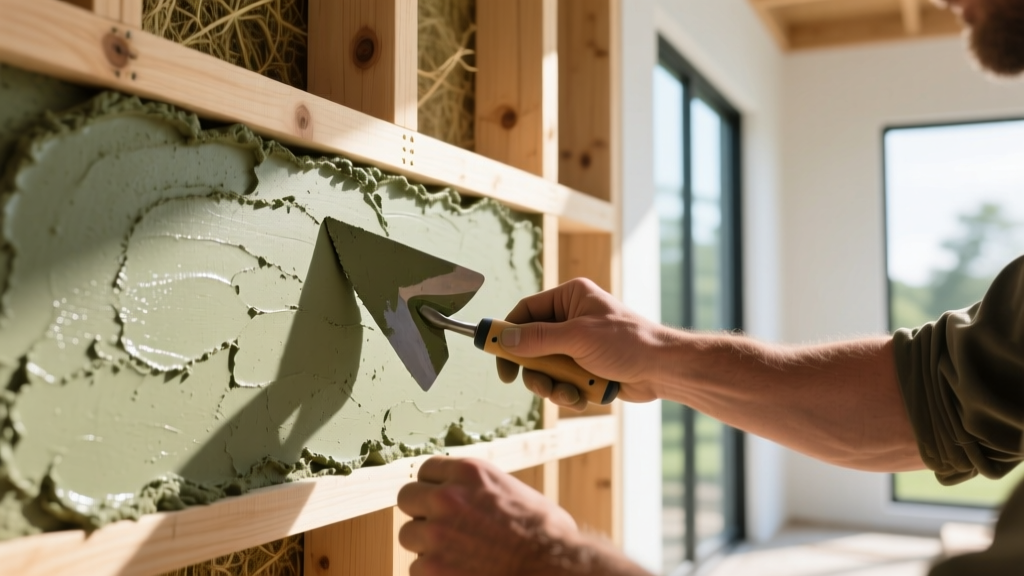
Hempcrete is not a concrete substitute; it is a lightweight, bio-composite insulation and thermal mass material. It consists of the woody core of the hemp plant (the hurd) mixed with a lime-based binder and water. Because it lacks compressive strength (typically 50-100 psi), hempcrete cannot be used in load-bearing applications. It must be cast around a structural frame, such as timber post-and-beam or steel stud.
Exact Mix Ratios and Binder Selection
The performance of hempcrete hinges on the binder-to-hurd ratio and the type of lime used. For exterior walls requiring faster curing and higher weather resistance during the build phase, specify Natural Hydraulic Lime (NHL 3.5). For interior partitions where maximum vapor permeability and carbonation are desired, use Non-Hydraulic Hydrated Lime (CL90).
- Standard Wall Mix (Insulation focus): 1 part NHL 3.5 binder to 1.5 parts hemp hurd (by volume). Yields a density of ~18-22 lbs/cu ft and an R-value of R-2.4 per inch.
- Structural Infill Mix (Higher density): 1 part binder to 1 part hurd. Yields a density of ~35-45 lbs/cu ft and an R-value of R-1.8 per inch, but offers superior mechanical anchoring for exterior plasters.
According to the US Hemp Building Association, a standard 12-inch thick hempcrete wall assembly yields a whole-wall R-value of approximately R-28 to R-30, but its true value lies in its thermal mass and airtightness, which drastically reduces peak heating and cooling loads.
Hemp Insulation Batts: The Drop-In Retrofit Solution
For projects utilizing standard light-frame construction (wood or steel studs), cast-in-place hempcrete is often logistically unfeasible. Hemp insulation batts (often branded as HempWool or similar proprietary names) offer a biogenic alternative to fiberglass and mineral wool. Manufactured from hemp fibers bonded with a proprietary bio-resin or polyester matrix, these batts are designed for friction-fit installation.
Hemp batts typically deliver an R-value of R-3.7 per inch, making them competitive with high-density fiberglass. A standard 3.5-inch batt (designed for 2x4 walls) provides R-13 to R-15. Unlike fiberglass, hemp fibers are naturally hygroscopic; they can absorb and release ambient moisture without losing their thermal resistance or degrading. Furthermore, the dense fiber matrix provides superior acoustic dampening, boasting Sound Transmission Class (STC) ratings 20-30% higher than equivalent mineral wool batts.
2026 Pricing: Expect to pay between $1.75 and $2.20 per square foot for R-15 hemp batts. While this represents a 30-40% premium over commodity fiberglass, the elimination of personal protective equipment (PPE) requirements and the superior acoustic performance often justify the material cost in high-end residential builds.
Hemp Fiberboard: Sheathing and Interior Finishes
Hemp fiberboard is manufactured by compressing hemp hurds and fibers under high heat and pressure, often using lignin-based or formaldehyde-free resins. It serves as a direct replacement for medium-density fiberboard (MDF), oriented strand board (OSB), and gypsum board in specific applications.
- Exterior Sheathing: High-density hemp fiberboard (often treated with natural waxes for water resistance) can be used as exterior sheathing. It provides a shear value comparable to 7/16" OSB while maintaining high vapor permeability, allowing the wall assembly to dry to the exterior.
- Interior Acoustic Panels: Medium-density boards are milled into tongue-and-groove acoustic paneling, offering a warm, natural aesthetic with an NRC (Noise Reduction Coefficient) of 0.80 or higher when mounted with an air gap.
Material Comparison Matrix (2026 Specifications)
| Material Type | R-Value / Inch | Density (pcf) | Vapor Permeable? | Est. Cost (per sq ft) |
|---|---|---|---|---|
| Cast-in-Place Hempcrete (12" wall) | ~2.4 | 18 - 22 | Yes (High) | $4.50 - $6.00* |
| Hemp Insulation Batts (R-15) | ~3.7 | 8 - 10 | Yes (Moderate) | $1.75 - $2.20 |
| Hemp Fiberboard (1/2" Sheathing) | ~1.3 | 45 - 55 | Yes (Moderate) | $1.10 - $1.40 |
*Hempcrete cost reflects material and basic labor for cast-in-place application per square foot of wall area, excluding structural framing and exterior finishes.
Code Compliance and Sourcing Realities
As of 2026, hempcrete and hemp batts are not universally prescriptive in the International Residential Code (IRC). However, they are routinely approved under alternative materials provisions (IRC Section R104.11). Several progressive jurisdictions, particularly in California, Colorado, and parts of the Pacific Northwest, have integrated specific biogenic material appendices. The Department of Energy's Building Technologies Office continues to fund research into the hygrothermal modeling of biogenic walls, which is accelerating code acceptance.
When sourcing, require your supplier to provide a third-party hygrothermal analysis (such as WUFI modeling) specific to your climate zone. Hempcrete performs exceptionally well in mixed-humid and cold climates but requires careful overhang and detailing design in hot-humid zones to prevent exterior plaster degradation from wind-driven rain.
"The biggest mistake architects make with hemp building materials is treating them like conventional insulation. Hempcrete is a dynamic, breathing thermal mass system. If you wrap it in a polyethylene vapor barrier or rigid foam, you have fundamentally broken the building physics and guaranteed a moisture failure."
— Senior Building Scientist, Biogenic Materials Institute
Top 3 Selection Mistakes to Avoid
- Using Hempcrete as a Structural Element: Hempcrete has a compressive strength of roughly 50-100 psi. Standard structural concrete requires 2,500+ psi. Never use hempcrete to support roof loads or as a foundation stem wall.
- Installing Poly Vapor Barriers with Hemp Batts: Hemp fibers regulate moisture by absorbing and releasing water vapor. Installing a Class I vapor retarder (poly sheeting) on the interior winter-warm side traps moisture inside the stud bay. Use a smart vapor retarder (variable-permeability membrane) instead.
- Underestimating Curing Time: A 12-inch hempcrete wall placed in late autumn in a humid climate may take 4 to 6 months to reach the moisture content required (<10%) before interior lime plasters can be applied. Failing to schedule this curing window will result in plaster delamination and mold growth behind the finish.
Written by
Marcus ChenMarcus Chen is a licensed structural engineer (PE) and building materials analyst with over 12 years of experience across residential, commercial, and industrial construction. He holds a Master of Science in Civil Engineering from UC Berkeley and spent six years at Thornton Tomasetti before transitioning to independent consulting and technical writing. Marcus specializes in material selection for seismic-prone regions, concrete reinforcement strategies, and lifecycle cost analysis. His work has been cited by the American Concrete Institute (ACI) and the Structural Engineers Association of California (SEAOC). When he is not on a job site or at his desk, you will find him hiking the Sierra Nevada or restoring a 1920s craftsman bungalow in Oakland, CA.
More from Marcus Chen
View all
Construction Cost
How Much Did the Eiffel Tower Cost to Build?
How much did the Eiffel Tower cost to build in 1889? We adjust for inflation and compare its budget to modern skyscraper construction.
Aug 4, 2026

Fire Resistance
What Is a Fire Resistant Material? Testing & Certification Guide
Discover what is a fire resistant material through ASTM and UL testing. Learn how fire ratings, certifications, and assemblies work in construction.
Aug 4, 2026

Construction Cost
How Much Did the Burj Khalifa Cost to Build?
How much did the Burj Khalifa cost to build? We break down the $1.5B project and extract 5 money-saving strategies for your next build.
Jul 30, 2026