Selecting Pittman's Cantonment Building Materials for Coastal Homes
Expert guide to selecting Pittman's Cantonment building materials for Florida Panhandle projects, covering FBC codes, lumber specs, and roofing.

Navigating the Cantonment Inventory: Core Material Categories
Sourcing materials for construction in Escambia County requires a strategic approach to the local supply chain. Pittman's Cantonment building materials inventory is specifically tailored to the environmental demands of the Florida Panhandle, balancing high-humidity resistance with strict wind-load requirements. Unlike big-box retailers that stock generic national inventories, regional yards like the Cantonment location prioritize Southern Yellow Pine (SYP) framing, specialized moisture barriers, and impact-resistant exterior assemblies. Selecting the right materials from this specific branch requires an understanding of both the Florida Building Code (FBC) and the microclimates of the Gulf Coast.
When pulling framing lumber, roofing, and cladding from the Cantonment yard, contractors must cross-reference product specifications with local wind mitigation standards. The following guide breaks down the exact material specifications you should request when ordering from Pittman's Cantonment for residential and light commercial projects in the Pensacola metro area.
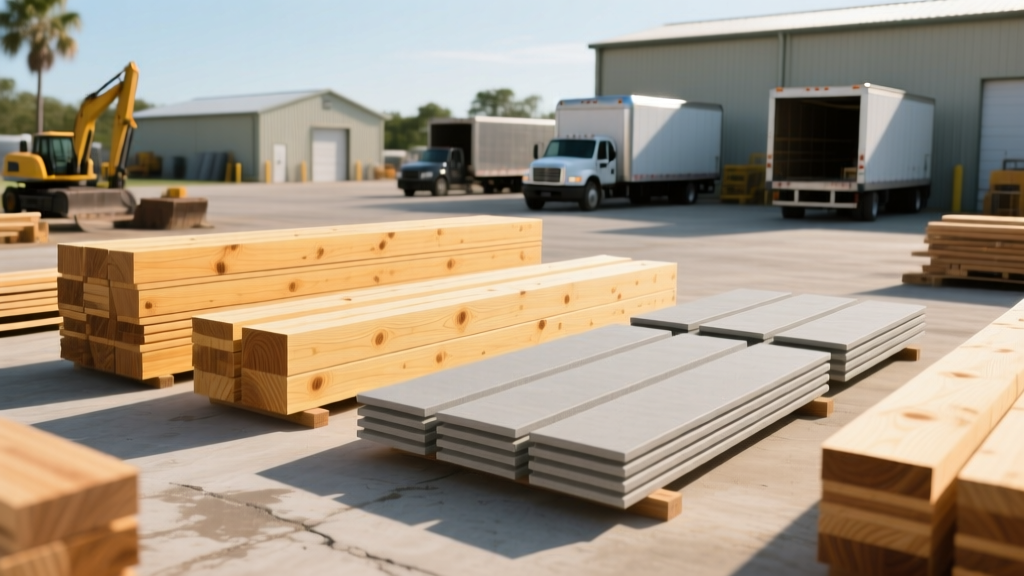
Framing and Lumber: AWPA Standards for the Gulf Coast
The foundation of any Panhandle build is its framing package. Pittman's Cantonment stocks extensive runs of Southern Yellow Pine, prized for its high density and superior nail-holding capacity. However, selecting the correct pressure-treatment retention level is critical to preventing premature rot in Florida's humid environment.
Do not simply order 'treated pine.' Specify the American Wood Protection Association (AWPA) Use Category based on the material's final placement. According to the American Wood Council, using the wrong category is a primary cause of structural decay in coastal builds.
- UC2 (Interior Dry): Use for interior framing, non-load-bearing partitions, and trusses protected from weather.
- UC3A & UC3B (Exterior Above Ground): Required for porch decking, fascia, and exterior wall framing where lumber is exposed to weather but not in contact with the ground. UC3B offers higher retention for severe coastal humidity.
- UC4A (Ground Contact): Mandatory for sill plates, deck posts, and any framing within 6 inches of exposed soil or concrete slabs.
- UC4B (Heavy Ground Contact): Specify this for structural pilings, retaining walls, or permanent wood foundations near the Escambia River or coastal marshlands where salt and moisture saturation are extreme.
When ordering SYP trusses from the Cantonment facility, ensure the design wind speed aligns with Escambia County's current FBC mandate, which typically requires engineering for 150 mph ultimate design wind speeds in non-High-Velocity Hurricane Zone (non-HVHZ) coastal areas.
Roofing Assemblies: Wind Uplift and Impact Resistance
Roofing selections at Pittman's Cantonment heavily feature both architectural asphalt shingles and standing seam metal panels. The decision matrix for roofing should be driven by the project's proximity to the Gulf and the desired Insurance Institute for Business & Home Safety (IBHS) FORTIFIED Home certification level.
Asphalt Shingle Specifications
If selecting architectural shingles, standard 3-tab shingles are virtually obsolete for new Panhandle construction. You must specify shingles that pass ASTM D3161 Class F (110 mph wind resistance) or, preferably, ASTM D7158 Class H (150 mph). Pittman's inventory typically includes premium lines with reinforced sealant strips designed to withstand the cyclic uplift pressures common in tropical storms.
Standing Seam Metal Roofing
For maximum longevity and wind mitigation, 24-gauge or 26-gauge standing seam metal is the superior choice. Avoid 29-gauge panels for primary residences in Cantonment, as the thinner metal is prone to oil-canning and fastener back-out under extreme thermal cycling and wind shear. Specify concealed-fastener systems with a minimum 1.5-inch seam height, and ensure the underlayment is a high-tensile synthetic or self-adhered ice and water shield applied to the entire deck, not just the eaves, to meet FBC secondary water barrier requirements.
Material Selection Matrix for Panhandle Projects
Use this decision matrix when consulting with the pro-desk at Pittman's Cantonment to ensure your material haul matches local code and environmental demands.
| Component | Recommended Material Spec | Code / Performance Rationale |
|---|---|---|
| Wall Framing | 2x6 SYP, 16" O.C., UC3B Treated | Allows for R-19+ cavity insulation; UC3B resists coastal humidity. |
| Roof Decking | 5/8" CDX Plywood or AdvanTech | Superior nail-holding for wind uplift vs. OSB; resists swelling from rain delays. |
| Exterior Cladding | Fiber Cement (HZ10 Zone) | Impervious to termites and woodpeckers; HZ10 formulation handles high UV/humidity. |
| Housewrap | Drainable mesh-backed membrane | Creates a capillary break behind cladding, critical for driving rain events. |
| Windows | Impact-rated, DP 50 minimum | Meets FBC wind-borne debris requirements without needing external shutters. |
Exterior Cladding: Managing the Vapor Drive
The Florida Panhandle experiences a relentless inward vapor drive during the summer months, where hot, humid exterior air meets air-conditioned interior spaces. Selecting the wrong cladding and sheathing combination can lead to catastrophic interstitial condensation.
Pittman's Cantonment stocks both vinyl siding and fiber cement (such as James Hardie). While vinyl is cost-effective, fiber cement is the premier choice for high-end coastal builds due to its dimensional stability and impact resistance. Critical Specification: When ordering fiber cement, ensure you are receiving the HZ10 product line. Manufacturers formulate HZ10 specifically for the southern U.S., featuring enhanced water-resistant coatings and optimized flashing geometries to handle driving rain and intense UV degradation.
When pairing fiber cement or stucco with standard fiberglass batt insulation, do not install a Class I interior vapor retarder (like polyethylene sheeting) on the drywall side. According to building science principles endorsed by the Florida Building Commission, trapping moisture inside the wall cavity in a cooling-dominated climate will cause mold and structural rot. Use a 'smart' vapor retarder or standard latex paint on the interior drywall instead.
Insulation and Moisture Control Strategies
Insulation selection at the Cantonment yard goes beyond basic R-values; it requires managing air and moisture. For exterior walls, closed-cell spray polyurethane foam (ccSPF) is highly recommended for coastal builds. At 2 pounds per cubic foot, ccSPF acts as its own vapor semi-impermeable barrier and adds structural racking strength to the wall assembly—a valuable secondary benefit in high-wind zones.
If budget constraints dictate the use of fiberglass batts, you must pair them with a high-quality, drainable housewrap and meticulously tape all sheathing seams. Pittman's carries specialized fluid-applied flashing and tape systems designed to seal the penetrations around windows and doors, which are the most common failure points for water intrusion during Panhandle squalls.
Sourcing Strategy: Logistics and Delivery in Escambia County
Ordering from Pittman's Cantonment requires understanding local logistics. The Cantonment yard serves as a hub for the northern Pensacola metro, Milton, and Pace. When scheduling delivery, consider the site access constraints.
- Crane Trucks for Trusses: For two-story builds or tight urban infill lots near downtown Pensacola, request a knuckleboom crane truck delivery to safely set roof trusses without requiring a separate mobile crane rental.
- Lumber Staging: Specify 'staged delivery' if your site lacks a dry garage. Pittman's can often coordinate sequential deliveries (e.g., framing first, drywall only after the structure is dried-in) to prevent moisture damage to sensitive materials like MDF trim and gypsum board.
- Will-Call vs. Delivery: For small punch-list items or specialized fasteners (like stainless steel ring-shank nails required for coastal decking), utilizing the Cantonment will-call counter saves on minimum delivery fees and keeps the project moving without waiting for next-day freight.
Frequently Asked Questions
Does Pittman's Cantonment stock FBC-approved impact windows?
Yes, the Cantonment location supplies impact-resistant windows and doors that carry the necessary Florida Product Approval (FPA) numbers. Always request the FPA documentation from the pro-desk to submit with your Escambia County permit application.
Can I open a contractor account for volume pricing?
Regional suppliers like Pittman's offer pro-desk accounts that provide tiered pricing, job-site delivery credits, and extended net-30 terms for licensed contractors operating in the Panhandle.
What is the best fastener for coastal exterior trim?
For any exterior trim installed within 10 miles of the Gulf Coast, specify 304 or 316 stainless steel fasteners. Standard galvanized or ceramic-coated screws will eventually bleed rust stains through fiber cement and wood trim in the salty Panhandle air.
Written by
Priya KapoorPriya Kapoor is a real estate market analyst and construction economics researcher with expertise in housing affordability, development feasibility, and infrastructure investment. She holds a Master of Regional Planning from Cornell University and previously worked as a senior analyst at CBRE's Investment Properties group, where she modeled returns for $4B in mixed-use development pipelines. Priya now runs an independent research practice advising developers, municipalities, and REITs on construction cost forecasting and market timing. She publishes the quarterly "BuildMat Market Pulse" report tracking material price indices across 12 commodity categories. Based in Austin, TX, Priya serves on the board of Habitat for Humanity Austin and is a marathon runner.
More from Priya Kapoor
View all
Construction Cost
Cost to Build a 1600 Sq Ft Home in 2026: Full Breakdown
Accurate 2026 cost to build a 1600 sq ft home—material, labor, and regional pricing breakdowns included. Plan your budget with real-time estimates.
Aug 11, 2026

Wood & Lumber
Name the Types of Wood for Pressure Treatment and Preservation
Learn how to name the types of wood best suited for pressure treatment. Compare species treatability, chemical retention levels, and 2026 preservation costs.
Aug 4, 2026

Stone & Masonry
Stone Veneer Suppliers Lindenhurst: 2026 Cost Analysis
Analyze 2026 stone veneer costs in Lindenhurst, NY. Compare local supplier pricing, delivery fees, and Suffolk County installation labor rates.
Aug 4, 2026