How to Source and Apply Antique Building Materials Safely
Learn how to source, evaluate, and safely install antique building materials. Expert tips on reclaimed wood, historic brick, and mortar matching.

Navigating the Hidden Risks of Salvaged Materials
Integrating antique building materials into modern construction or restoration projects requires navigating a complex matrix of structural compatibility, modern building codes, and hazardous material remediation. Unlike new stock from a lumberyard or masonry supplier, salvaged materials carry a historical footprint that dictates how they must be handled, milled, and fastened. Failure to account for these variables results in catastrophic material failure, such as masonry spalling or severe wood gapping.
Before purchasing any pre-1980 antique materials, mandate a screening for lead and asbestos. According to the EPA's Renovation, Repair and Painting (RRP) Rule, disturbing lead-based paint without certified containment protocols carries severe federal penalties. For antique wood siding or architectural millwork, use X-ray fluorescence (XRF) testing rather than cheap chemical swabs, which frequently yield false negatives on heavily oxidized surfaces. Expect to pay $250–$400 for a professional XRF site inspection.
Evaluating Reclaimed Wood: Density, Moisture, and Milling
The primary appeal of antique timber—specifically Antique Heart Pine (Pinus palustris) and Old-Growth White Oak—lies in its cellular density. Trees harvested in the 18th and 19th centuries grew slowly in dense, unmanaged forests, resulting in tight growth rings (often 15 to 30 rings per inch). This structural density vastly outperforms modern plantation-grown equivalents.
Species Comparison and 2026 Market Pricing
When specifying antique flooring or structural beams, reference the Janka hardness scale and current market rates to ensure the material suits the application's traffic and budget requirements.
| Material | Janka Hardness (lbf) | Target Interior MC | Avg. Cost per Bd Ft (2026) | Best Application |
|---|---|---|---|---|
| Antique Heart Pine | 1,225 | 6% - 8% | $8.50 - $14.00 | High-traffic flooring, exposed beams |
| Reclaimed White Oak | 1,360 | 6% - 8% | $11.00 - $18.50 | Flooring, exterior millwork, cabinetry |
| Old-Growth Douglas Fir | 660 | 8% - 10% | $5.50 - $9.00 | Interior paneling, ceiling treatments |
| Modern Loblolly Pine (Control) | 690 | 8% - 12% | $2.50 - $4.00 | Standard framing, painted trim |
The Acclimatization and Kiln-Drying Mandate
A critical failure point in applying antique wood is improper moisture content (MC). Timber stored in an unconditioned 19th-century barn will equilibrate to an MC of 14%–18%. If installed directly into a modern, climate-controlled home (which typically maintains 30%–40% relative humidity, equating to an equilibrium moisture content of 6%–8%), the wood will violently shrink, causing massive gapping and fastener blowout.
Always specify kiln-drying for interior applications. As of 2026, commercial kiln-drying for reclaimed lumber costs between $1.80 and $2.60 per board foot. This process not only drops the MC to the required 6%–8% range but also sterilizes the wood, eliminating dormant wood-boring insects like powderpost beetles.
Historic Masonry: The Mortar Mismatch Problem
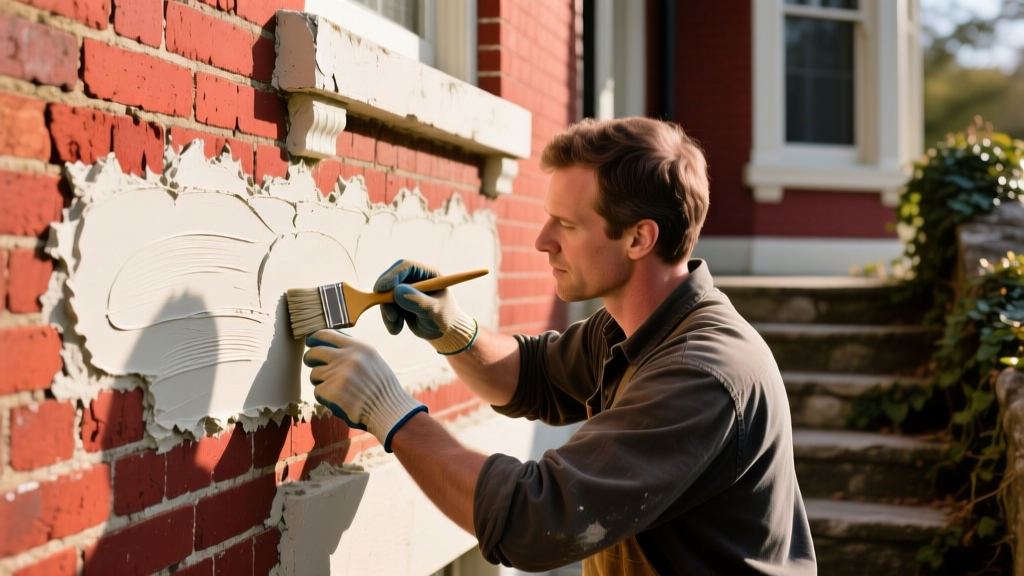
Applying antique brick or stone to a structural facade or interior feature wall requires a fundamental understanding of compressive strength. Modern masonry practices rely on Portland cement-based mortars (Type N or Type S), which boast compressive strengths exceeding 2,500 psi.
However, antique bricks fired in 19th-century clamp kilns are remarkably soft, often testing between 800 and 1,200 psi. If you bind soft historic brick with hard modern Portland cement, the mortar becomes stronger than the masonry unit. During freeze-thaw cycles or minor structural settling, the rigid mortar will not yield, forcing the antique brick to spall, crack, and disintegrate.
"The mortar must always be softer and more permeable than the masonry unit it binds. Repointing historic masonry with hard Portland cement is the single most common cause of irreversible damage to antique brickwork."
— National Park Service, Preservation Brief 2
Formulating High-Lime Mortar for Antique Brick
When laying or tuckpointing antique brick, you must use a high-lime mortar (ASTM Type O) or a Natural Hydraulic Lime (NHL) mixture. Type O mortar offers a compressive strength of roughly 350 psi, allowing it to act as a sacrificial cushion that absorbs thermal expansion and structural movement.
- Type O Mix Ratio (by volume): 1 part Portland cement, 2 parts hydrated lime (Type S), 9 parts washed sharp sand.
- NHL 3.5 Mix Ratio (by volume): 1 part Natural Hydraulic Lime, 2.5 parts sharp sand. (No Portland cement added).
Always perform a "scratch test" on a cured sample of your custom mortar mix after 28 days. You should be able to score the mortar with a flathead screwdriver using moderate hand pressure, but it should not crumble into dust.
Fastening and Hardware Compatibility
Modern fastening techniques frequently fail when applied to antique materials. Driving standard drywall screws or smooth-shank nails into Antique Heart Pine will result in snapped screw heads or severe splitting due to the wood's extreme density and interlocking grain.
Reclaimed barn wood is notorious for hidden metal—square-cut nails, fencing wire, and even embedded bullets. Running this material through a commercial planer without scanning will shatter the cutterhead knives, costing $200–$400 per blade set in replacements and downtime. Pass every board over a high-sensitivity ferrous metal detector (such as a Garrett SuperScanner or a dedicated lumber wand) and extract embedded metal using a nail punch before milling.
For structural fastening of antique timber framing, abandon traditional lag bolts, which require massive pre-drilling and can split aged checks. Instead, utilize modern structural screws designed for high-density timber, such as Simpson Strong-Tie SDWS or GRK RSS structural screws. These feature self-drilling points and aggressive threading that pull dense, aged fibers together without pre-drilling, drastically reducing installation time and split-risk.
Sourcing Strategy: Architectural Salvage vs. Demolition Yards
Where you source your antique building materials dictates the level of remediation required before installation. The Building Materials Reuse Association (BMRA) categorizes sourcing channels into distinct tiers based on material readiness.
- Curated Architectural Salvage Yards: These vendors deconstruct buildings by hand, clean the materials, remove fasteners, and often kiln-dry the wood. You are paying a premium (30%–50% higher) for immediate usability and verified provenance. Best for interior millwork, doors, and finished flooring.
- Raw Demolition Yards: Materials are pulled via heavy machinery or rapid soft-stripping. Expect heavy surface oxidation, embedded nails, and high moisture content. Requires significant in-house milling, metal detection, and kiln-drying. Best for structural beams or exterior siding where a rustic, heavily weathered patina is desired.
- Direct Deconstruction Contracts: Hiring a certified deconstruction crew to dismantle a specific local barn or factory before it is bulldozed. This yields the lowest cost per board foot but requires you to manage the logistics of transport, stacking, stickering, and kiln-drying.
Verifying Provenance and Avoiding Fakes
The premium pricing of antique materials has spawned a market for artificially aged fakes. Unscrupulous suppliers will wire-brush modern plantation pine and stain it to mimic the deep patina of 150-year-old Heart Pine. To verify authenticity, request a cross-section end-grain sample. True Antique Heart Pine will exhibit incredibly tight, dense growth rings (often indistinguishable without a magnifying loupe) and a high ratio of dark, resinous heartwood to pale sapwood. Modern pine will show wide, irregular growth rings and a predominantly pale color profile, regardless of surface staining.
Written by
Marcus ChenMarcus Chen is a licensed structural engineer (PE) and building materials analyst with over 12 years of experience across residential, commercial, and industrial construction. He holds a Master of Science in Civil Engineering from UC Berkeley and spent six years at Thornton Tomasetti before transitioning to independent consulting and technical writing. Marcus specializes in material selection for seismic-prone regions, concrete reinforcement strategies, and lifecycle cost analysis. His work has been cited by the American Concrete Institute (ACI) and the Structural Engineers Association of California (SEAOC). When he is not on a job site or at his desk, you will find him hiking the Sierra Nevada or restoring a 1920s craftsman bungalow in Oakland, CA.
More from Marcus Chen
View all
Construction Cost
How Much Did the Eiffel Tower Cost to Build?
How much did the Eiffel Tower cost to build in 1889? We adjust for inflation and compare its budget to modern skyscraper construction.
Aug 4, 2026

Fire Resistance
What Is a Fire Resistant Material? Testing & Certification Guide
Discover what is a fire resistant material through ASTM and UL testing. Learn how fire ratings, certifications, and assemblies work in construction.
Aug 4, 2026

Construction Cost
How Much Did the Burj Khalifa Cost to Build?
How much did the Burj Khalifa cost to build? We break down the $1.5B project and extract 5 money-saving strategies for your next build.
Jul 30, 2026