Building Materials Tarkov Hideout Items: Real-World Selection & Cost Guide
Discover the real-world construction equivalents of building materials Tarkov players use, including 2026 costs, ASTM codes, and specs.

From Virtual Scavenging to Real-World Job Sites
Searching for building materials tarkov players use to upgrade their hideouts reveals a fascinating crossover between virtual survival mechanics and real-world construction science. In the game, items like a 'corrugated hose,' 'bundle of wires,' or 'metal fuel tank' are generic loot drops. On a real-world job site in 2026, these same items represent highly regulated, code-dependent building materials that require precise specification, budget management, and strict adherence to safety standards.
Whether you are a contractor, a hardcore DIYer, or a gamer looking to understand the physical reality behind your virtual hideout, this selection guide translates in-game loot into real-world construction specifications. We break down the exact ASTM standards, NEC code requirements, and 2026 market pricing for the most critical hideout building materials.
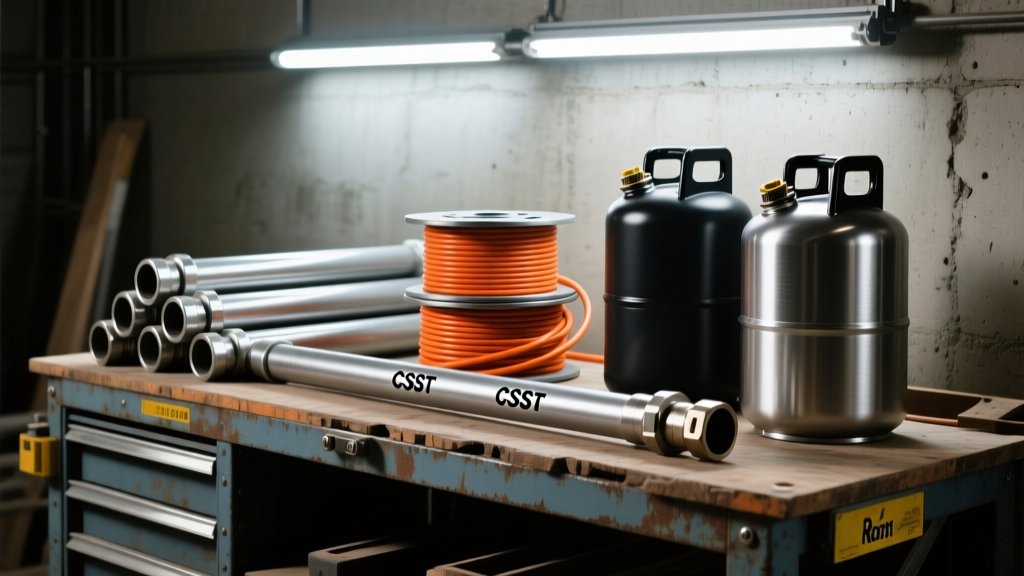
Corrugated Hose: CSST, Flexible Conduit, and Drainage
In-game, a corrugated hose is a catch-all item used for water filtration and ventilation. In modern construction, 'corrugated' refers to three entirely distinct material categories, each governed by different building codes.
1. Corrugated Stainless Steel Tubing (CSST)
Used for natural gas and propane distribution, CSST has largely replaced rigid black iron pipe in residential framing. If you are selecting CSST in 2026, standard yellow-jacketed CSST is being phased out in favor of Arc-Resistant CSST (e.g., Gastite FlashShield or TracPipe CCS).
- Specification: Look for a black polyethylene outer jacket that meets ANSI LC 1 / CSA 6.26 standards.
- Code Requirement: The National Electrical Code (NEC) and NFPA 54 require CSST to be bonded and grounded to prevent lightning-induced arcing, which can puncture standard yellow jackets.
- 2026 Cost: $2.15 to $3.50 per linear foot (1/2-inch diameter), excluding brass fittings.
2. Corrugated HDPE (High-Density Polyethylene)
Used for French drains, foundation perimeter drainage, and stormwater management. Never use this for pressurized water.
- Specification: ASTM F405 for corrugated polyethylene tubing. Ensure you select N12 (smooth interior wall) rather than standard corrugated interior, as smooth walls prevent sediment buildup and maintain flow velocity.
- 2026 Cost: $45.00 per 100-foot coil (4-inch diameter N12).
Bundle of Wires: Ampacity, Gauge, and 2026 Copper Markets
The 'bundle of wires' is essential for hideout comms and electronics. In real-world electrical rough-ins, selecting the wrong wire gauge results in voltage drop, tripped breakers, or catastrophic electrical fires. With copper market volatility continuing into 2026, material selection requires balancing conductivity with cost.
2026 Residential Wiring Selection Matrix
| Tarkov Item | Real-World Spec (Southwire/Cerrowire) | Ampacity & Use Case | 2026 Cost (250ft Spool) |
|---|---|---|---|
| Bundle of Wires | 14/2 NM-B (Romex) | 15A (Lighting/Receptacles) | $112.00 |
| Bundle of Wires | 12/2 NM-B (Romex) | 20A (Kitchen/Bath Appliances) | $148.00 |
| Bundle of Wires | 10/3 UF-B (Underground) | 30A (Outdoor/Generator) | $295.00 |
| Bundle of Wires | 4-4-4-6 AL SER (Aluminum) | 100A (Subpanel Feeder) | $210.00 |
*Note: Due to 2026 copper pricing, many contractors are shifting to Aluminum SER cable for heavy feeders (60A+) to save up to 40% on material costs without sacrificing safety, provided terminals are rated for AL/CU.
Metal Fuel Tank: OSHA Compliance and Flammable Storage
Powering a hideout generator requires fuel. On a real job site, storing diesel, gasoline, or kerosene is heavily regulated to prevent vapor ignition and groundwater contamination. The 'metal fuel tank' translates to job-site approved safety cans and bulk storage solutions.
Steel vs. High-Density Polyethylene (HDPE)
While the game specifies metal, modern job sites frequently use HDPE safety cans (like those from Justrite or Eagle Manufacturing) because they resist denting, will not spark if dropped, and are immune to internal rust caused by ethanol-blended fuels (E15/E85).
- OSHA & NFPA Compliance: According to OSHA flammable liquid guidelines and NFPA 30, any portable fuel container over 1 gallon used on a commercial site must be a DOT-approved safety can with a flash-arresting screen in the spout and a spring-closing lid.
- CARB/EPA Stamps: For residential or contractor use, ensure the tank features a CARB (California Air Resources Board) compliant permeation barrier. Non-CARB metal or plastic tanks will off-gas volatile organic compounds (VOCs) and are illegal to sell or use in several states.
- Color Coding Standard: Red (Gasoline), Yellow (Diesel), Blue (Kerosene), Green (Oils). Never mix these on a job site.
Wooden Ammo Box: Plywood Grading and Sheathing Specs
The 'wooden ammo box' or crate represents raw lumber and manufactured wood products. When contractors select plywood for structural sheathing, concrete formwork, or secure job-site storage crates, they rely on the APA (The Engineered Wood Association) grading stamps.
Decoding the APA Stamp for 2026 Construction
Do not just ask the lumber yard for 'wood.' You must specify the exposure rating and span.
- Exposure 1 vs. Exterior: Exposure 1 panels (like standard CDX sheathing) use exterior-grade glues but are only meant to withstand weather delays during construction. Exterior rated panels must be used for permanent outdoor structures or hideout exteriors.
- Span Rating (e.g., 32/16): The first number (32) indicates the maximum center-to-center spacing for roof rafters. The second (16) is for floor joists. Using a 24/0 rated panel on a roof designed for 32-inch spacing will result in catastrophic sagging under snow loads.
- ACX vs. CDX: CDX has C-grade and D-grade veneers with football-shaped patches; it is strictly for hidden structural sheathing. ACX has one smooth, sanded face (A-grade) suitable for painted job-site crates, exterior siding, or visible architectural elements.
For more on engineered wood grading standards, reference the APA Engineered Wood Association technical bulletins.
Energy-Saving Lamp: Commercial LED Efficacy and CRI
Upgrading hideout lighting requires more than just screwing in a bulb. In 2026, commercial and high-end residential lighting selection is driven by efficacy (lumens per watt) and CRI (Color Rendering Index).
Selection Framework for Job-Site and Workshop Lighting
- DLC Premium Certification: If you are wiring a commercial workshop, only purchase LED high-bay fixtures listed on the DesignLights Consortium (DLC) Premium list. This guarantees an efficacy of >140 lumens/watt and qualifies the project for massive local utility rebates, often cutting fixture costs by 40%.
- CRI > 90: For electrical panels, finish carpentry, and paint booths, a CRI of 80 is insufficient. You must specify CRI 90+ with an R9 value (saturated red) above 50 to accurately see wire insulation colors and wood stain tones.
- Color Temperature: Stick to 4000K (Neutral White) for active job sites. 5000K+ (Daylight) causes severe glare off metallic surfaces and safety glasses, increasing eye fatigue during long shifts.
Summary: Building the Real-World Hideout
Translating building materials tarkov mechanics into real-world procurement requires a shift from generic scavenging to code-compliant specification. Whether you are pulling 12/2 NM-B wire, installing arc-resistant CSST, or setting up CARB-compliant fuel storage, the materials you select dictate the safety, longevity, and legality of your build. Always verify APA stamps, NEC ampacity tables, and local utility rebate lists before finalizing your 2026 material orders.
Written by
Priya KapoorPriya Kapoor is a real estate market analyst and construction economics researcher with expertise in housing affordability, development feasibility, and infrastructure investment. She holds a Master of Regional Planning from Cornell University and previously worked as a senior analyst at CBRE's Investment Properties group, where she modeled returns for $4B in mixed-use development pipelines. Priya now runs an independent research practice advising developers, municipalities, and REITs on construction cost forecasting and market timing. She publishes the quarterly "BuildMat Market Pulse" report tracking material price indices across 12 commodity categories. Based in Austin, TX, Priya serves on the board of Habitat for Humanity Austin and is a marathon runner.
More from Priya Kapoor
View all
Construction Cost
Cost to Build a 1600 Sq Ft Home in 2026: Full Breakdown
Accurate 2026 cost to build a 1600 sq ft home—material, labor, and regional pricing breakdowns included. Plan your budget with real-time estimates.
Aug 11, 2026

Wood & Lumber
Name the Types of Wood for Pressure Treatment and Preservation
Learn how to name the types of wood best suited for pressure treatment. Compare species treatability, chemical retention levels, and 2026 preservation costs.
Aug 4, 2026

Stone & Masonry
Stone Veneer Suppliers Lindenhurst: 2026 Cost Analysis
Analyze 2026 stone veneer costs in Lindenhurst, NY. Compare local supplier pricing, delivery fees, and Suffolk County installation labor rates.
Aug 4, 2026