PMC Building Materials Cost Analysis & 2026 Pricing Guide
Comprehensive 2026 cost analysis of PMC building materials. Compare polymer modified concrete pricing, lifecycle ROI, and installation costs.
Defining the PMC Premium: Material vs. Installed Costs
When evaluating advanced construction materials, Polymer Modified Concrete (PMC) and broader Polymer Matrix Composites represent a significant upgrade over traditional Portland cement concrete (PCC). By integrating organic polymers—such as Styrene Butadiene Rubber (SBR), polyvinyl acetate (PVA), or acrylic emulsions—into the cementitious matrix, PMC achieves superior tensile strength, reduced permeability, and enhanced chemical resistance. However, this performance comes with a distinct cost profile that requires careful analysis beyond simple per-yard pricing.
In 2026, the upfront material cost for PMC building materials typically ranges from 40% to 150% higher than standard PCC, depending on the polymer type and dosage rate. Yet, focusing solely on the batch ticket price ignores the installed cost and lifecycle savings. Below is a detailed breakdown of current material costs for common concrete and PMC variants.
| Material Type | Polymer Dosage | Avg. Cost per Cubic Yard (2026) | Avg. Cost per Sq. Ft. (Overlay) |
|---|---|---|---|
| Standard PCC (4,000 PSI) | 0% | $135 - $165 | $4.50 - $6.00 |
| SBR-Modified Concrete | 5% - 10% by weight | $190 - $240 | $7.00 - $9.50 |
| Acrylic-Modified Concrete | 10% - 15% by weight | $260 - $320 | $9.00 - $12.00 |
| Epoxy Polymer Concrete | 100% polymer binder | $650 - $850 | $14.00 - $22.00 |
According to guidelines published by the American Concrete Institute (ACI) Committee 548 on Polymers in Concrete, the optimal dosage for SBR latex in bridge deck overlays and industrial flooring is typically between 7% and 12% of the cement weight. Pushing beyond this threshold yields diminishing returns on compressive strength while exponentially driving up material costs.
Lifecycle Cost Analysis: The 20-Year ROI
The true financial advantage of PMC building materials emerges during the operational lifecycle of the structure. Traditional concrete is highly susceptible to chloride ion penetration, freeze-thaw degradation, and shrinkage cracking. Repairing these failure modes—via epoxy injection, cathodic protection, or full-depth patching—costs between $8.00 and $15.00 per square foot in 2026.
ROI Highlight: Industrial Flooring
For a 10,000 sq. ft. heavy-duty warehouse floor, standard PCC requires joint resealing and crack routing every 5 to 7 years. Over a 20-year period, maintenance costs average $3.20 per sq. ft. An acrylic-modified PMC floor, which exhibits 60% less drying shrinkage (per ASTM C157 testing) and eliminates the need for traditional control joints in many designs, reduces 20-year maintenance costs to $0.85 per sq. ft. The initial 45% material premium is recovered in year 8.
Furthermore, PMC's drastically reduced permeability protects embedded steel reinforcement from corrosion. The Federal Highway Administration (FHWA) heavily advocates for polymer-modified and latex-modified concrete overlays in bridge preservation, noting that PMC decks routinely achieve 30 to 40-year service lives without major structural intervention, compared to 15 to 20 years for standard concrete decks exposed to de-icing salts.
Application-Specific Cost Breakdowns
The financial viability of PMC depends heavily on the specific application and the environmental stressors the material will face.
1. Marine and Chemical Exposure Environments
In wastewater treatment plants, chemical processing facilities, and coastal infrastructure, standard PCC degrades rapidly due to sulfuric acid attack and chloride ingress. Specifying epoxy polymer concrete or high-dosage acrylic PMC in these zones is not just a performance choice; it is a financial necessity. While epoxy polymer concrete costs upwards of $750 per cubic yard, its resistance to pH levels as low as 2.0 prevents the catastrophic structural failures that would require complete element replacement. In chemical containment zones, the cost of a secondary spill event or environmental remediation dwarfs the initial PMC premium.
2. Fast-Track Overlays and Resurfacing
For commercial retail spaces or active logistics hubs, downtime is the most expensive variable. Standard concrete requires 7 to 28 days to reach sufficient strength for heavy forklift traffic. PMC formulations utilizing rapid-set cements combined with SBR polymers can achieve 3,000 PSI compressive strength and open to heavy traffic in 24 to 48 hours. When factoring in lost revenue at $5,000 to $10,000 per day for a shuttered loading dock, the $100 per cubic yard premium for fast-track PMC is instantly justified.
Hidden Cost Variables in 2026 Procurement
When budgeting for PMC building materials, estimators must account for several hidden variables that affect the final installed cost:
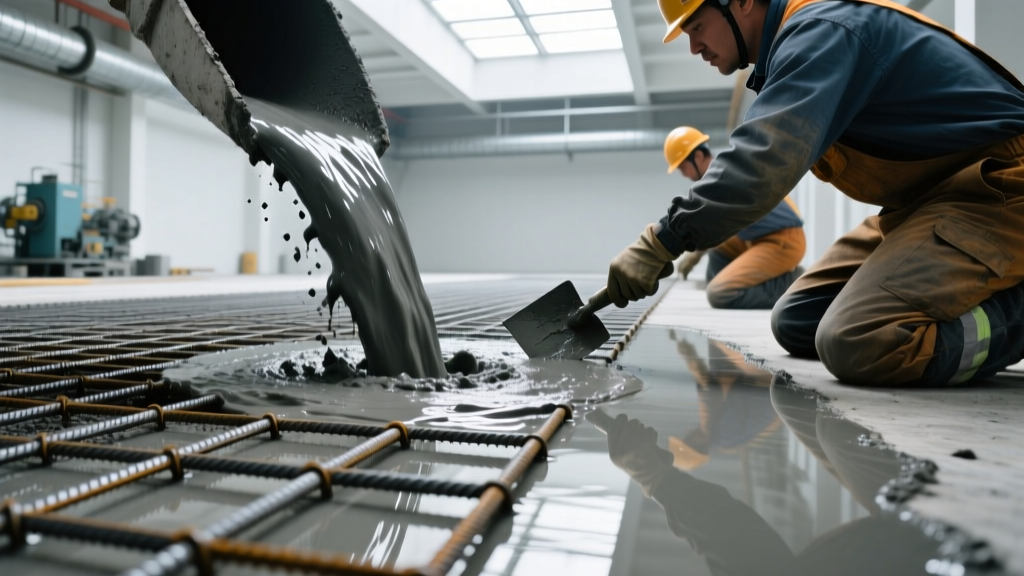
- Labor Efficiency and Finishing: PMC mixes are inherently more cohesive and 'sticky' due to the polymer films. While this improves bond strength, it requires skilled finishers. Expect finishing labor rates to be 10% to 15% higher, as the material demands precise timing and specialized troweling techniques to avoid burning the surface.
- Curing Protocol Changes: Polymers alter the hydration process. PMC requires immediate and continuous wet curing or the application of specialized curing compounds to prevent plastic shrinkage. Failure to implement strict curing protocols within 30 minutes of finishing will result in micro-cracking, negating the material's primary benefits.
- Admixture Incompatibility: Standard air-entraining admixtures (AEAs) often react unpredictably with polymer emulsions, leading to rapid slump loss or excessive air content. Procurement teams must source polymer-compatible AEAs, which carry a 20% price premium over standard surfactants.
- Supply Chain Consolidation: As of 2026, specialized acrylic and SBR emulsions for construction are heavily consolidated among a few major chemical manufacturers. Lead times for bulk liquid polymer totes can reach 4 to 6 weeks, requiring earlier procurement integration than standard cementitious materials.
Decision Matrix: When to Specify PMC
Use the following framework to determine if the PMC premium is justified for your specific project parameters.
| Project Scenario | Standard PCC Viability | PMC Recommendation | Financial Justification |
|---|---|---|---|
| Interior residential slabs | High | Not Recommended | Low environmental stress; premium cannot be recouped. |
| Exterior parking structures | Medium | SBR-Modified Overlay | Prevents chloride ingress; extends deck life by 15+ years. |
| Food & Beverage processing floors | Low | Epoxy/Acrylic PMC | Withstands thermal shock and lactic acid; prevents costly facility shutdowns. |
| Standard highway paving | High | Not Recommended | Scale of project makes polymer cost prohibitive; use standard air-entrained PCC. |
Expert Verdict: Maximizing Your PMC Investment
PMC building materials are not a universal replacement for traditional concrete, nor should they be viewed merely as an expensive upgrade. They are highly engineered solutions designed to solve specific durability, chemical, and scheduling challenges. To maximize ROI in 2026, specifiers must shift from evaluating the cost per cubic yard to evaluating the cost per year of service life. By targeting PMC applications strictly to high-wear, chemically aggressive, or fast-track environments, project owners can leverage the material's superior tensile strength and impermeability to drive down long-term operational expenditures significantly.
Written by
Marcus ChenMarcus Chen is a licensed structural engineer (PE) and building materials analyst with over 12 years of experience across residential, commercial, and industrial construction. He holds a Master of Science in Civil Engineering from UC Berkeley and spent six years at Thornton Tomasetti before transitioning to independent consulting and technical writing. Marcus specializes in material selection for seismic-prone regions, concrete reinforcement strategies, and lifecycle cost analysis. His work has been cited by the American Concrete Institute (ACI) and the Structural Engineers Association of California (SEAOC). When he is not on a job site or at his desk, you will find him hiking the Sierra Nevada or restoring a 1920s craftsman bungalow in Oakland, CA.
More from Marcus Chen
View all
Construction Cost
How Much Did the Eiffel Tower Cost to Build?
How much did the Eiffel Tower cost to build in 1889? We adjust for inflation and compare its budget to modern skyscraper construction.
Aug 4, 2026

Fire Resistance
What Is a Fire Resistant Material? Testing & Certification Guide
Discover what is a fire resistant material through ASTM and UL testing. Learn how fire ratings, certifications, and assemblies work in construction.
Aug 4, 2026

Construction Cost
How Much Did the Burj Khalifa Cost to Build?
How much did the Burj Khalifa cost to build? We break down the $1.5B project and extract 5 money-saving strategies for your next build.
Jul 30, 2026