Achieving Product Visibility for Building Materials: A Selection Guide
Learn how to achieve product visibility for building materials using EPDs, HPDs, and Declare labels to meet LEED, WELL, and LBC transparency credits.
The Mandate for Material Transparency in Modern Construction
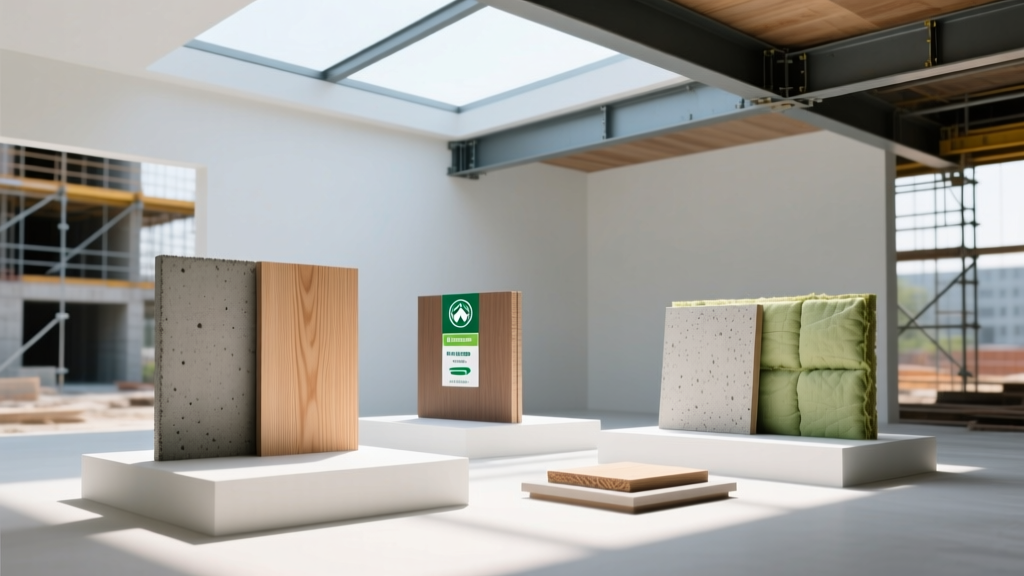
In the contemporary construction ecosystem, the term product visibility for building materials no longer refers to retail merchandising or showroom placement. Instead, it defines the degree of supply chain transparency, ingredient disclosure, and lifecycle impact data available to specifiers and owners. As green building frameworks like LEED v5, WELL v2, and the Living Building Challenge (LBC) tighten their requirements, general contractors and architects face a critical procurement challenge: sourcing materials that offer total verifiable visibility from raw extraction to installation.
Selecting materials with high product visibility mitigates risk, ensures regulatory compliance, and future-proofs assets against impending embodied carbon mandates. This guide provides a technical framework for evaluating, specifying, and procuring building materials based on verified transparency metrics, moving beyond superficial greenwashing to rely on standardized, third-party data.

Decoding the Pillars of Product Visibility
To achieve genuine product visibility, procurement teams must require specific third-party certifications. Relying on manufacturer-authored sustainability reports is insufficient for modern compliance. The industry relies on three primary disclosure instruments, each serving a distinct function in the material selection process.
| Disclosure Tool | Governing Standard | Primary Focus | Best Use Case |
|---|---|---|---|
| EPD (Environmental Product Declaration) | ISO 14025 / EN 15804 | Quantifies environmental impacts (GWP, ODP, AP, EP) across the lifecycle. | LEED v4.1/v5 MR Credits, embodied carbon tracking, structural material selection (concrete, steel). |
| HPD (Health Product Declaration) | HPD Open Standard | Discloses chemical ingredients and associated health hazards down to 1000 ppm (or 100 ppm). | WELL Building Standard, interior finishes, sealants, adhesives, and flooring. |
| Declare Label | Living Future Institute | Acts as a 'nutrition label' identifying Red List chemicals and end-of-life recyclability. | Living Building Challenge (LBC), high-performance healthcare, and educational facilities. |
According to the Health Product Declaration Collaborative, the demand for HPDs has surged as owners prioritize indoor air quality and occupant health, making chemical transparency a non-negotiable aspect of product visibility for interior building materials.
Selection Framework: Matching Materials to Certification Targets
Specifiers must align material visibility requirements with the specific certification track of the project. Over-specifying transparency can inflate procurement costs and delay submittal approvals, while under-specifying jeopardizes certification points.
Targeting LEED v5 (Embodied Carbon Focus)
If your project is pursuing LEED v5, product visibility must center on Environmental Product Declarations. You must prioritize structural and envelope materials with Type III EPDs.
- Actionable Spec: Require cradle-to-gate EPDs for all concrete mixes and structural steel. Ensure the EPD is less than five years old and verified by an approved program operator (e.g., ASTM, UL, NSF).
- Material Example: Specify concrete mixes utilizing calcined clay or slag cement replacements, backed by plant-specific EPDs showing a Global Warming Potential (GWP) at least 20% below the industry baseline.
Targeting WELL v2 (Occupant Health Focus)
WELL prioritizes the chemical makeup of interior environments. Here, product visibility means knowing exactly what volatile organic compounds (VOCs) and semi-volatile organic compounds (SVOCs) are present.
- Actionable Spec: Mandate HPDs or Declare Labels for all materials applied within the waterproofing membrane and interior paint layers. Cross-reference disclosed ingredients against the WELL Restricted Materials list.
- Material Example: Select acoustic ceiling tiles (e.g., Armstrong Ultima) that hold both UL GREENGUARD Gold certification and a fully disclosed HPD showing zero intentional addition of formaldehyde or halogenated flame retardants.
Targeting Living Building Challenge (Total Transparency)
The LBC is the most rigorous framework, requiring total product visibility via the Red List. The Living Future Institute's Declare program is practically mandatory here.
- Actionable Spec: Require 'Red List Free' Declare labels for 90% of interior materials by cost. Accept no 'Red List Approved' (which allows minor exceptions) for primary finishes.
Cost Analysis: The Premium for Verified Visibility
Achieving high product visibility for building materials often carries an upfront cost premium. Manufacturers must invest heavily in lifecycle assessments (LCAs) and third-party auditing to publish EPDs and HPDs. Below is a realistic cost breakdown comparing standard opaque materials with high-visibility, fully documented alternatives based on 2026 market pricing.
| Material Category | Standard Product (Low Visibility) | High-Visibility Alternative | Cost Premium |
|---|---|---|---|
| 1/2" Type X Gypsum Board | $0.48 / sq. ft. (Generic) | $0.88 / sq. ft. (CertainTeed AirRenew w/ EPD & HPD) | +83% |
| R-15 Mineral Wool Insulation | $1.15 / sq. ft. (Generic Kraft-faced) | $1.32 / sq. ft. (ROCKWOOL Safe'n'Sound w/ EPD) | +14% |
| Commercial Carpet Tile | $2.10 / sq. ft. (Standard VCT/LVT) | $4.50 / sq. ft. (Interface Embodied Beauty w/ Declare) | +114% |
| Structural Glazing Sealant | $12.50 / tube (Standard Silicone) | $16.00 / tube (Tremco Spectrum w/ full HPD) | +28% |
Note: While interior finishes carry high premiums for chemical transparency, commodity structural materials like mineral wool only carry a marginal premium for EPD documentation, making them high-value targets for LEED compliance.
Contractors frequently encounter 'self-declared' environmental claims in subcontractor submittal packages. A manufacturer's internal PDF stating a product is '100% recyclable' or 'low carbon' without an accompanying ISO-compliant EPD or verifiable HPD is worthless for U.S. Green Building Council (USGBC) compliance. Always reject submittals that lack direct links to the program operator's public registry (e.g., the UL SPOT database or the Declare database).
Step-by-Step Procurement Workflow for Transparency
To enforce product visibility without stalling the construction schedule, integrate transparency requirements directly into the bidding and procurement lifecycle.
- Division 01 Integration: Embed transparency requirements in Division 01 (General Requirements) of your project manual. Explicitly state that EPDs and HPDs are required submittal documents, not optional alternatives, for specified material categories.
- Bid Qualification: Require subcontractors to submit a preliminary 'Transparency Log' with their bids, listing the proposed manufacturers and the specific third-party labels (EPD, HPD, Declare) each product holds. Disqualify bids that rely on generic, undocumented substitutions.
- Submittal Filtering: Utilize digital submittal management software (e.g., Procore, PlanGrid) to create mandatory metadata tags for sustainability documents. If a subcontractor uploads a product data sheet without the corresponding EPD/HPD attachment, the system should automatically route it back as 'Revise and Resubmit'.
- Closeout Documentation: Compile all verified EPDs and HPDs into the final digital O&M (Operations and Maintenance) manual. This centralized database is critical for facility managers pursuing ongoing WELL recertification or future LEED O+M audits.
Future-Proofing Your Material Library
As municipal building codes begin to adopt embodied carbon limits—mirroring the trajectory of energy codes over the last two decades—product visibility for building materials will transition from a 'green building' niche to a baseline code requirement. Firms that build internal material libraries pre-vetted for EPD and HPD compliance today will drastically reduce specification time and procurement friction on tomorrow's projects. Prioritize manufacturers that publish plant-specific EPDs over industry-average EPDs, as plant-specific data provides the granular visibility necessary to optimize structural carbon models and win competitive bids in an increasingly regulated market.
Written by
Marcus ChenMarcus Chen is a licensed structural engineer (PE) and building materials analyst with over 12 years of experience across residential, commercial, and industrial construction. He holds a Master of Science in Civil Engineering from UC Berkeley and spent six years at Thornton Tomasetti before transitioning to independent consulting and technical writing. Marcus specializes in material selection for seismic-prone regions, concrete reinforcement strategies, and lifecycle cost analysis. His work has been cited by the American Concrete Institute (ACI) and the Structural Engineers Association of California (SEAOC). When he is not on a job site or at his desk, you will find him hiking the Sierra Nevada or restoring a 1920s craftsman bungalow in Oakland, CA.
More from Marcus Chen
View all
Construction Cost
How Much Did the Eiffel Tower Cost to Build?
How much did the Eiffel Tower cost to build in 1889? We adjust for inflation and compare its budget to modern skyscraper construction.
Aug 4, 2026

Fire Resistance
What Is a Fire Resistant Material? Testing & Certification Guide
Discover what is a fire resistant material through ASTM and UL testing. Learn how fire ratings, certifications, and assemblies work in construction.
Aug 4, 2026

Construction Cost
How Much Did the Burj Khalifa Cost to Build?
How much did the Burj Khalifa cost to build? We break down the $1.5B project and extract 5 money-saving strategies for your next build.
Jul 30, 2026