Comparing Core Building Materials Categories for Construction
Compare core building materials categories by cost allocation, lifespan, and procurement lead times to optimize structural, envelope, and finish selections.
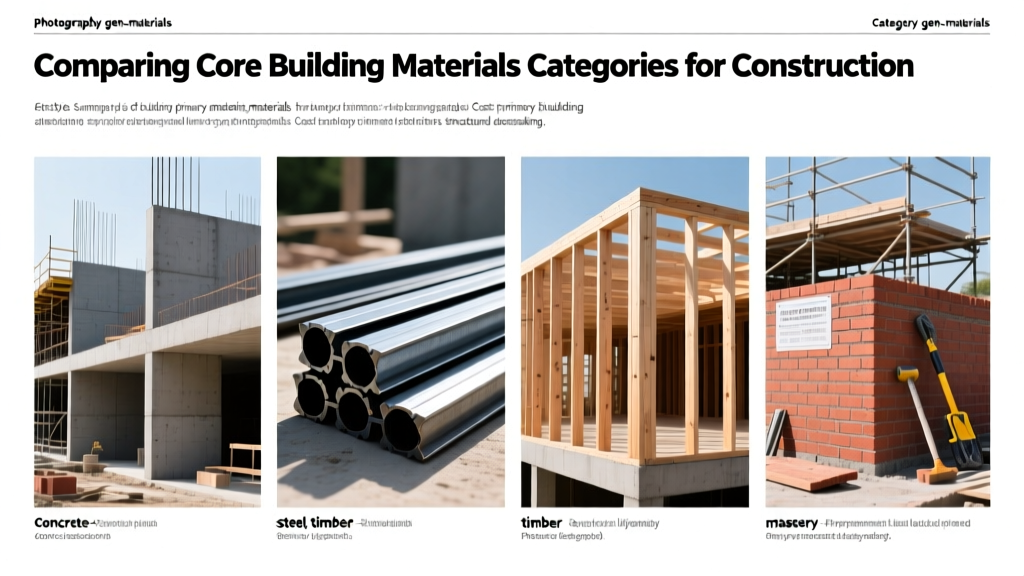
The Four Pillars: A Matrix of Building Materials Categories
Construction estimating, value engineering, and lifecycle planning require a granular understanding of how different building materials categories interact. Rather than viewing a project as a monolithic expense, breaking it down into distinct functional categories reveals specific cost drivers, lifespans, and supply chain vulnerabilities. The Construction Specifications Institute (CSI) organizes these materials into standardized divisions, but for practical project management, they are best grouped into four macro-categories: Structural, Enclosure, Interior Finishes, and MEP (Mechanical, Electrical, Plumbing).
| Category | Primary CSI Divisions | Cost Allocation (% of Total) | Expected Lifespan | Procurement Lead Time |
|---|---|---|---|---|
| Structural | Div 3, 4, 5, 6 | 25% - 32% | 50 - 100+ Years | 8 - 16 Weeks |
| Enclosure / Envelope | Div 7, 8 | 18% - 25% | 25 - 50 Years | 10 - 20 Weeks |
| Interior Finishes | Div 9, 10, 11, 12 | 20% - 28% | 10 - 25 Years | 4 - 12 Weeks |
| MEP Rough-In & Trim | Div 21, 22, 23, 26, 27, 28 | 22% - 30% | 15 - 40 Years | 6 - 14 Weeks |
Structural Materials: Load-Bearing Foundations and Framing
The structural category forms the permanent skeleton of any build. Material selection here dictates not only the initial budget but the long-term adaptability and carbon footprint of the asset.
Concrete and Masonry
Cast-in-place concrete remains the dominant material for commercial foundations and mid-to-high-rise cores. Standard Portland cement (ASTM C150 Type I/II) typically costs between $120 and $145 per cubic yard, but specialized mixes incorporating fly ash or slag (SCMs) to lower embodied carbon can add a 5% to 12% premium. For elevated decks, expect structural concrete framing to range from $18 to $28 per square foot, heavily dependent on rebar density and post-tensioning requirements.
Structural Steel vs. Mass Timber
Structural steel (ASTM A992 W-shapes) offers high strength-to-weight ratios and rapid erection times, though it requires expensive intumescent fireproofing to achieve 1-hour or 2-hour fire ratings. Conversely, Cross-Laminated Timber (CLT) and Glulam are rapidly gaining market share in the mid-rise sector. According to APA – The Engineered Wood Association, mass timber can reduce structural framing time by up to 25% compared to concrete, while inherently providing the necessary fire resistance through predictable char rates (typically 1.5 inches per hour). However, CLT procurement currently demands 12 to 16 weeks of lead time, requiring much earlier design freezes than structural steel.
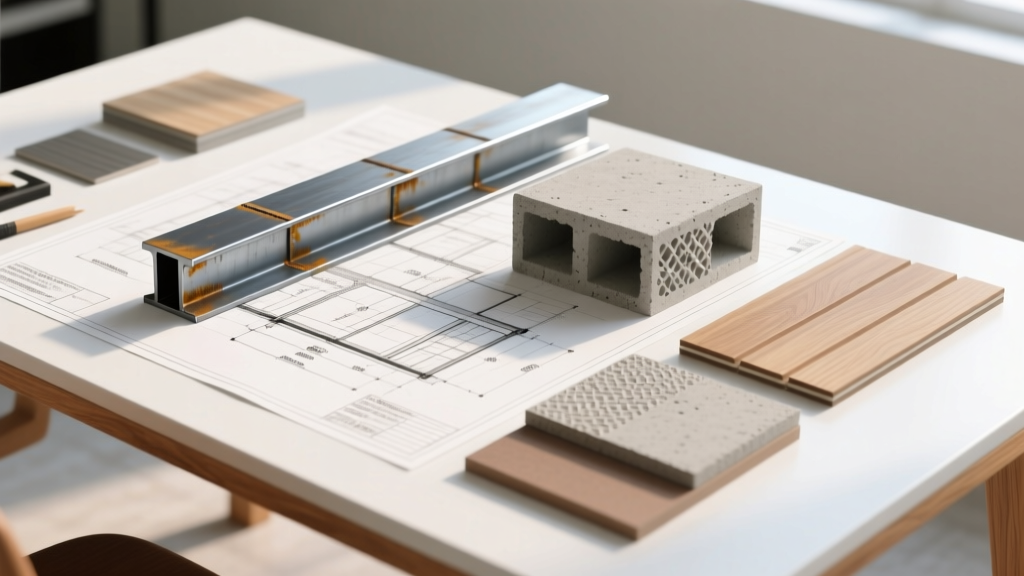
Enclosure and Envelope: Weatherproofing and Thermal Control
The building envelope separates the conditioned interior from the exterior environment. Modern energy codes (such as IECC 2024 and local equivalents) mandate rigorous continuous insulation (ci) and air barrier systems, making this category a primary target for both energy savings and aesthetic expression.
Insulation Systems
Polyisocyanurate (polyiso) rigid board remains the standard for commercial roof and wall continuous insulation, offering an R-value of approximately R-6.5 per inch. However, polyiso experiences thermal drift in extreme cold. For projects in climate zones 6 and above, mineral wool board (R-4.2 per inch) is increasingly specified despite its lower R-value per inch. Mineral wool is non-combustible, vapor-permeable, and maintains its thermal resistance at sub-zero temperatures, making it the superior choice for high-performance, fire-resilient enclosures.
Cladding and Fenestration
Exterior cladding choices drastically alter the maintenance lifecycle of a building. Fiber cement siding (e.g., James Hardie panels) offers a 50-year lifespan with moderate upfront costs ($6 to $11 per sq. ft. installed) but requires periodic caulking and painting. Aluminum Composite Material (ACM) panels provide a modern, low-maintenance aesthetic with a 30 to 40-year lifespan, but installed costs range from $25 to $45 per sq. ft. Fenestration (windows and curtain walls) represents the highest cost-per-square-foot element in the enclosure category. Triple-glazed, thermally broken aluminum frames with argon gas fills are now standard for commercial projects targeting net-zero energy, pushing window package costs to $65 to $110 per sq. ft. of rough opening.
Interior Finishes: Aesthetics, Acoustics, and Durability
Interior finishes endure the highest frequency of physical contact and are the first materials to be replaced during tenant improvements. Strategic selection here balances initial capital expenditure against lifecycle maintenance.
Wall and Ceiling Assemblies
Standard 1/2-inch gypsum board (ASTM C1396) is the baseline for interior partitions, costing roughly $1.50 to $2.25 per sq. ft. for material. However, for commercial corridors, elevator shafts, and multi-family demising walls, 5/8-inch Type X or Type C gypsum board is mandatory to achieve 1-hour or 2-hour fire-resistance ratings. Type C boards incorporate advanced glass-fiber reinforcements that prevent core shrinkage during a fire, offering superior structural integrity under thermal stress without increasing the physical thickness of the wall assembly.
Commercial Flooring
Luxury Vinyl Tile (LVT) with a minimum 20-mil wear layer dominates commercial interiors due to its $4 to $8 per sq. ft. installed cost and high resistance to moisture. In high-traffic retail or institutional settings, polished concrete (utilizing lithium silicate densifiers and diamond-impregnated pads) offers a virtually maintenance-free, 30-year lifecycle, though the initial grinding and polishing process costs $7 to $14 per sq. ft. and requires strict scheduling to avoid damage from subsequent trades.
MEP Rough-In Materials: The Hidden Cost Drivers
Mechanical, Electrical, and Plumbing materials are concealed behind walls and above ceilings, yet they account for nearly a third of total project costs. The Environmental Protection Agency (EPA) notes that optimizing MEP material selection not only reduces initial construction waste but drastically lowers operational resource consumption.
Piping and Conduit
For domestic water supply, Type L copper has historically been the gold standard, offering a 50-year lifespan and natural biostatic properties. However, with copper prices subject to extreme global market volatility, PEX-A (cross-linked polyethylene manufactured via the Engel method) has become the dominant alternative. PEX-A resists kinking, expands to accommodate freezing without bursting, and installs 40% faster than soldered copper, reducing labor costs by thousands of dollars on mid-sized commercial builds.
HVAC Ductwork
Galvanized sheet metal ductwork remains mandatory for main trunk lines and fire-rated shaft enclosures due to its rigidity and non-combustible nature. However, for branch runs in commercial offices, insulated flexible ductwork (flex duct) with a fiberglass core and foil-scrim-kraft (FSK) vapor barrier reduces installation time and dampens acoustic noise transfer from air handling units to occupied spaces.
Decision Framework: How to Allocate Budget Across Categories
Value engineering is not simply about cutting costs; it is about shifting capital between building materials categories to maximize long-term ROI. Use this decision framework when balancing your project budget:
- Shift from MEP to Enclosure: If the HVAC budget is overblown, invest an additional 3% of total project costs into high-performance envelope materials (triple-pane glazing, continuous mineral wool). This reduces the heating and cooling load, allowing you to downsize chillers, boilers, and ductwork, often resulting in a net-zero initial cost increase but a 20% reduction in operational energy costs.
- Shift from Finishes to Structure: In multi-family or hospitality builds, exposed structural concrete ceilings eliminate the need for suspended acoustic ceiling grids, drywall furring, and paint. The savings in the Finishes category can be reallocated to higher-quality structural formwork to ensure a flawless architectural concrete finish.
- Standardize MEP Rough-In: Avoid custom or proprietary MEP fixtures. Standardizing on readily available PEX-A manifolds, standard galvanized duct dimensions, and off-the-shelf electrical switchgear prevents 12-to-16-week procurement delays that routinely stall certificate of occupancy (CO) approvals.
Understanding the distinct financial and physical characteristics of these building materials categories allows project teams to design structures that are not only code-compliant and aesthetically pleasing, but fundamentally optimized for long-term durability and operational efficiency.
Written by
Marcus ChenMarcus Chen is a licensed structural engineer (PE) and building materials analyst with over 12 years of experience across residential, commercial, and industrial construction. He holds a Master of Science in Civil Engineering from UC Berkeley and spent six years at Thornton Tomasetti before transitioning to independent consulting and technical writing. Marcus specializes in material selection for seismic-prone regions, concrete reinforcement strategies, and lifecycle cost analysis. His work has been cited by the American Concrete Institute (ACI) and the Structural Engineers Association of California (SEAOC). When he is not on a job site or at his desk, you will find him hiking the Sierra Nevada or restoring a 1920s craftsman bungalow in Oakland, CA.
More from Marcus Chen
View all
Construction Cost
How Much Did the Eiffel Tower Cost to Build?
How much did the Eiffel Tower cost to build in 1889? We adjust for inflation and compare its budget to modern skyscraper construction.
Aug 4, 2026

Fire Resistance
What Is a Fire Resistant Material? Testing & Certification Guide
Discover what is a fire resistant material through ASTM and UL testing. Learn how fire ratings, certifications, and assemblies work in construction.
Aug 4, 2026

Construction Cost
How Much Did the Burj Khalifa Cost to Build?
How much did the Burj Khalifa cost to build? We break down the $1.5B project and extract 5 money-saving strategies for your next build.
Jul 30, 2026