What Is the Purpose of Asbestos in Building Materials?
Discover what the purpose of asbestos in building materials was, where it hides in older structures, and how to safely identify and replace it today.

The Mineralogy Behind the Applications
The purpose of asbestos in building materials was fundamentally rooted in its unique silicate mineral structure. Unlike synthetic fibers, asbestos occurs naturally as long, thin, flexible crystalline fibers that possess extraordinary physical and chemical properties. Throughout the 20th century, builders and manufacturers integrated these fibers into thousands of construction products because they offered a combination of benefits that no single alternative material could match at the time.
Specifically, asbestos provided high tensile strength (exceeding that of steel wire of the same diameter), exceptional thermal insulation, acoustic dampening, and near-total chemical inertness. When mixed with Portland cement, gypsum, or vinyl binders, the microscopic fibers created a reinforcing matrix that prevented cracking, resisted fire, and degraded incredibly slowly. According to the U.S. Environmental Protection Agency (EPA), these properties made it a ubiquitous component in residential, commercial, and industrial construction from the 1930s through the late 1970s.
Application Matrix: Where Asbestos Hides in Legacy Structures
To understand the purpose of asbestos in building materials, one must examine the specific mineral variants used. Chrysotile (white asbestos) accounted for roughly 90-95% of all commercial applications due to its flexibility. Amosite (brown) and Crocidolite (blue) were reserved for high-temperature and high-acid environments. The table below maps common legacy building components to their specific asbestos applications.
| Building Component | Primary Asbestos Type | Binder Matrix | Functional Purpose |
|---|---|---|---|
| Thermal System Insulation (TSI) | Amosite / Chrysotile | Calcium Silicate / Magnesia | Prevent heat loss on boilers and steam pipes |
| Vinyl Floor Tiles (9x9 inch) | Chrysotile | Polyvinyl Chloride (PVC) | Increase tensile strength and wear resistance |
| Transite Roofing & Siding | Chrysotile / Amosite | Portland Cement | Provide fireproof, weather-resistant exterior cladding |
| Spray-Applied Fireproofing | Amosite / Crocidolite | Gypsum / Portland Cement | Protect structural steel from thermal collapse |
| Drywall Joint Compound | Chrysotile | Calcium Carbonate / Talc | Prevent shrinkage and cracking during curing |
Friable vs. Non-Friable: The Risk Assessment Framework
The original purpose of the material dictates its current risk profile. Building inspectors and industrial hygienists categorize ACMs into two distinct classifications based on their physical state and the likelihood of fiber release.
Friable Asbestos-Containing Materials
Friable materials can be crumbled, pulverized, or reduced to powder by hand pressure when dry. Because the binder matrix is weak or degraded, the asbestos fibers are easily liberated into the ambient air. Examples include spray-applied acoustic ceiling textures (popcorn ceilings), pipe lagging, and loose-fill attic insulation (such as vermiculite contaminated with tremolite). Friable ACMs pose the highest immediate hazard and generally mandate professional abatement if disturbed or deteriorating.
Non-Friable (Matrix-Bound) Materials
In non-friable applications, the asbestos fibers are tightly locked within a rigid binder, such as cement, vinyl, or epoxy. Transite cement boards, asphalt roofing shingles, and vinyl floor tiles fall into this category. Under normal conditions, these materials do not release fibers. However, if subjected to aggressive mechanical forces—such as sanding, power-sawing, or heavy demolition—the matrix fractures, converting the non-friable material into a friable hazard.
Modern Material Equivalents and Replacements
Following the phase-out of asbestos in the 1980s and subsequent bans by the Consumer Product Safety Commission (CPSC) and EPA, the construction industry engineered modern alternatives to fulfill the original purposes of asbestos without the associated health risks. When replacing legacy ACMs, specify the following modern equivalents:
- Fiber Cement Siding & Roofing: Replaces transite boards. Modern fiber cement (e.g., JamesHardie or CertainTeed) utilizes a matrix of Portland cement, silica sand, and cellulose or polyvinyl alcohol (PVA) fibers for tensile reinforcement.
- Mineral Wool Insulation: Replaces asbestos pipe lagging and fireproofing. Rockwool and slag wool provide identical thermal resistance (R-values) and fire-stopping capabilities (withstanding temperatures up to 2,150°F) using spun basalt or steel slag.
- Aramid and PTFE Gaskets: Replaces asbestos rope and gaskets in high-temperature plumbing and HVAC systems. Kevlar (aramid) and Teflon (PTFE) offer superior chemical resistance and thermal stability.
- Cellulose and Fiberglass Joint Compounds: Replaces asbestos-containing drywall mud. Modern compounds use finely ground limestone and cellulose ethers for shrinkage control.
Identification and Abatement Decision Protocols
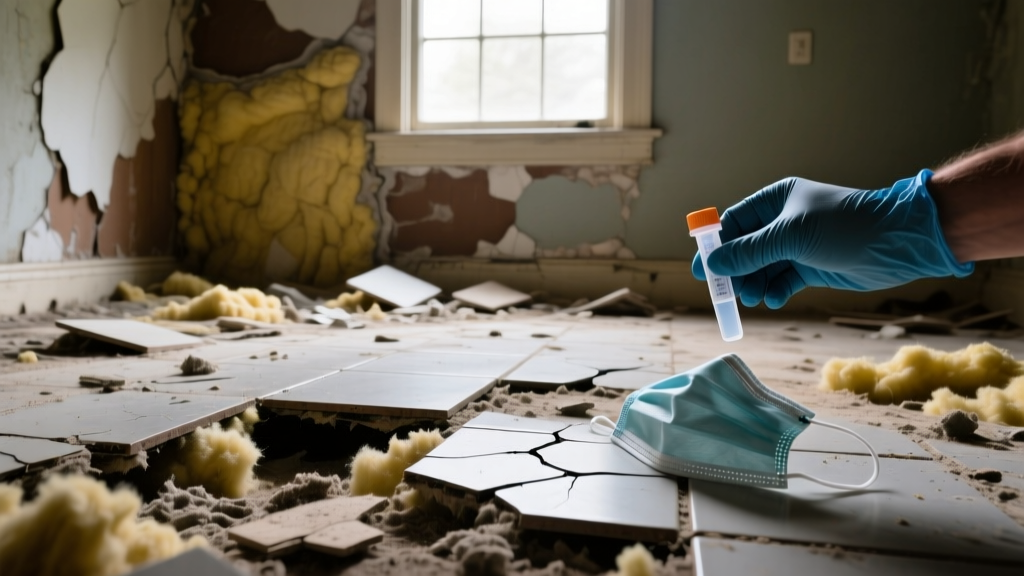
Visual identification of asbestos is impossible; the fibers are microscopic (typically 0.1 to 10 micrometers in length). If you suspect a material contains asbestos based on the application matrix above, follow this strict decision framework:
- Isolate and Halt Work: Immediately cease any drilling, cutting, or sanding. Seal the area with 6-mil polyethylene sheeting and negative air pressure if a breach has occurred.
- Engage a Certified Inspector: Hire an EPA-accredited or state-licensed asbestos building inspector. They will safely extract bulk samples using wet-method sampling and HEPA-filtered tools.
- Laboratory Analysis: Samples must be analyzed using Polarized Light Microscopy (PLM) to determine the percentage and type of asbestos. If the concentration is 1% or greater, the material is legally classified as an ACM. For air monitoring post-abatement, Transmission Electron Microscopy (TEM) is required to detect sub-micron fibers.
- Select an Abatement Strategy:
- Encapsulation: Applying a penetrating or bridging sealant (e.g., epoxy or polyurethane coatings) to bind fibers in place. Cost: $2 to $6 per square foot. Best for intact, non-friable materials that will not be impacted by future renovations.
- Enclosure: Building an airtight barrier around the ACM, such as framing a new wall over asbestos pipe insulation. Cost: $4 to $10 per square foot.
- Removal: Complete extraction by licensed abatement contractors using negative pressure enclosures and HEPA filtration. Cost: $10 to $25+ per square foot for friable materials, scaling up based on accessibility and hazardous waste disposal fees.
Understanding the historical purpose of asbestos in building materials is critical for modern contractors, facility managers, and homeowners. By recognizing where these materials were deployed and why, professionals can accurately assess structural risks, budget for appropriate modern replacements, and execute safe abatement protocols that protect both building occupants and construction crews.
Written by
James ThorntonJames Thornton is a construction industry veteran with 25 years of hands-on experience in wood framing, lumber grading, and residential building codes. He started as a framing carpenter in rural Oregon, earned his ICC Residential Building Inspector certification, and eventually became a senior plan reviewer for the City of Portland Bureau of Development Services. James holds a B.S. in Wood Science & Technology from Oregon State University and is a certified lumber grader through the West Coast Lumber Inspection Bureau (WCLIB). He has inspected over 3,000 residential construction sites and authored the city's internal guide on advanced framing techniques (2x6 at 24" O.C.). James lives in Bend, OR, where he builds custom timber-frame cabins and competes in lumberjack sports.
More from James Thornton
View all
Insulation
Best Home Insulation Materials: Complete 2026 Guide
Compare top home insulation materials for 2026. Find R-values, installed costs per square foot, and best uses for fiberglass, spray foam, and mineral wool.
Aug 4, 2026

Sustainable Building
Certify Your Green Building Material for LEED and WELL
Step-by-step guide to certifying a green building material for LEED v5 and WELL v2. Master EPDs, HPDs, and VOC limits for 2026 project specifications.
Aug 4, 2026

Stone & Masonry
Veneer Stacked Stone Panels: Interior Design & Style Showcase
Discover how veneer stacked stone panels transform interiors. Explore modern design profiles, material pairings, and technical installation specs.
Aug 4, 2026