Bio-Construction: The Basic Building Material of All the Body's Cells
Discover how protein structures—the basic building material of all the body's cells—are applied in modern bio-bricks, soy adhesives, and eco-construction.

The Biological Blueprint: From Cellular Biology to the Job Site
When structural engineers and architects look to the future of sustainable construction, they are increasingly looking inward—specifically, to biology. Proteins and amino acids, universally recognized as the basic building material of all the body's cells, are now being synthesized and harnessed to replace toxic petrochemical resins and energy-intensive mineral wools. By leveraging the natural binding properties of cellular proteins and chitin networks, the construction industry is scaling two revolutionary material categories: soy-protein engineered timber adhesives and mycelium-based bio-composites.
Application 1: Soy-Protein Binders in Engineered Hardwood
For decades, the engineered wood industry relied on urea-formaldehyde (UF) and phenol-formaldehyde (PF) resins. Today, soy-based protein adhesives dominate the premium interior plywood and mass timber market. By isolating the basic building material of all the body's cells from soybeans and cross-linking it with polyamidoamine-epichlorohydrin (PAE), manufacturers create a waterproof, structural-grade bond that emits zero volatile organic compounds (VOCs).
Technical Specifications and Press Parameters
When sourcing soy-protein bonded panels (such as Columbia Forest Products' PureBond line or Ashland's SOYAD resin systems) for commercial millwork or structural sheathing, fabricators must adjust their hot-press parameters. Unlike traditional UF resins that cure rapidly at lower temperatures, soy-protein matrices require specific thermal activation to unfold and cross-link.
- Optimal Moisture Content: Wood veneers must be conditioned to 6% - 8% moisture content. Exceeding 10% prevents the protein matrix from fully cross-linking, leading to delamination under ASTM D1037 cyclic testing.
- Press Temperature: Platens must be maintained between 285°F and 310°F (140°C - 154°C).
- Cure Time: Requires 45 to 60 seconds per millimeter of panel thickness, approximately 20% longer than standard UF resins.
- Spread Rate: 35 to 45 lbs per 1,000 square feet of single glue line (MSGL).
Application 2: Mycelium-Chitin Thermal and Acoustic Insulation
Mycelium—the vegetative root structure of fungi—is composed of chitin and structural proteins. When introduced to agricultural waste like hemp hurds or corn stover, the mycelium digests the lignin and binds the substrate into a dense, fire-resistant cellular matrix. Once the desired shape is achieved, the composite is baked at 180°F to halt biological activity, resulting in a stable, inert bio-brick or insulation batt.
Performance Matrix: Bio-Composites vs. Traditional Insulation
| Material Property | Mycelium Bio-Board | Fiberglass Batt (Standard) | Mineral Wool |
|---|---|---|---|
| Thermal Resistance (R-Value) | R-3.8 per inch | R-3.1 to R-3.4 per inch | R-4.2 per inch |
| Acoustic Absorption (NRC) | 0.75 - 0.85 (Excellent) | 0.50 - 0.60 | 0.80 - 0.95 |
| Density | 8 - 12 lbs/ft³ | 0.5 - 1.2 lbs/ft³ | 4 - 8 lbs/ft³ |
| Fire Rating (ASTM E84) | Class A (Self-extinguishing) | Class A | Class A |
| Embodied Carbon | Carbon Negative | High (Energy Intensive) | Very High |
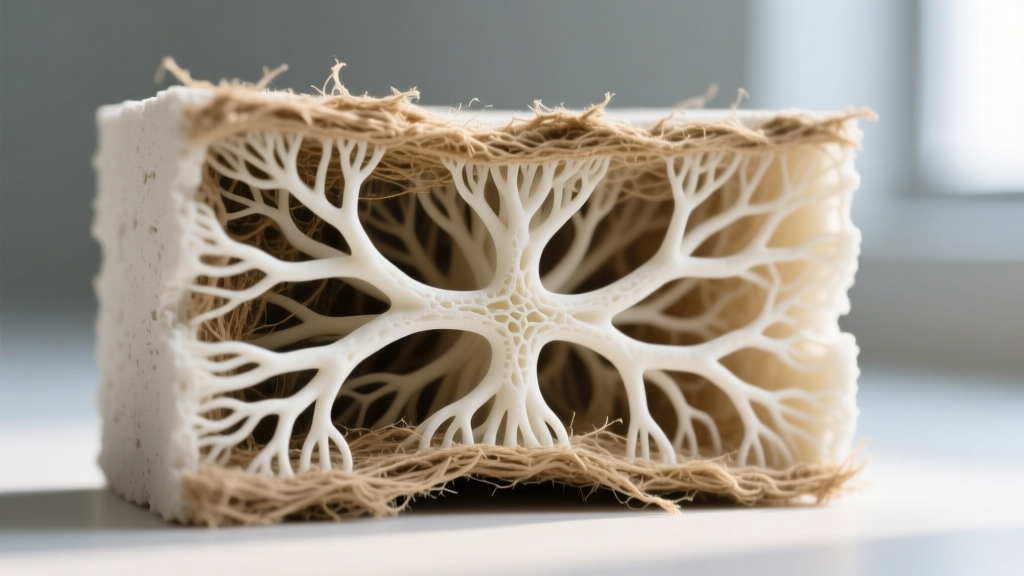
Step-by-Step Installation: Mycelium Acoustic Wall Panels
Installing cellular bio-boards for interior acoustic treatment requires specific handling to preserve the organic integrity of the material while ensuring structural adhesion to drywall or masonry substrates.
- Substrate Preparation: Ensure the wall surface is free of efflorescence and has a moisture content below 12%. Mycelium composites are naturally hydrophobic but prolonged exposure to liquid water can compromise the cellular protein bonds.
- Cutting and Shaping: Do not use standard utility knives. Use a fine-tooth carbide-tipped panel saw (minimum 60 teeth) to cut the bio-board. The dense chitin network will tear if cut with coarse blades.
- Adhesive Application: Apply a high-grab, VOC-free polyurethane construction adhesive (such as Loctite PL Premium) in a continuous serpentine pattern on the back of the panel. Avoid water-based acrylic adhesives, as the moisture can temporarily reactivate dormant fungal spores.
- Mounting and Bracing: Press the panel firmly against the substrate and brace with T-pins or temporary mechanical fasteners for 45 minutes while the adhesive achieves initial tack.
- Edge Sealing: Seal all exposed cut edges with a plant-based penetrating oil or beeswax emulsion to prevent localized moisture ingress and maintain the panel's Class A fire rating.
Code Compliance and LEED v4.1 Credits
Integrating bio-based materials into commercial projects directly impacts green building certifications. Under the USGBC LEED v4.1 framework, specifying soy-protein bonded timber and mycelium insulation contributes heavily to the Materials and Resources (MR) credit category, specifically the Environmental Product Declarations (EPD) and Sourcing of Raw Materials credits. Furthermore, these materials align perfectly with the principles outlined by the EPA Green Chemistry program, which prioritizes the elimination of hazardous chemical syntheses in favor of renewable, biological feedstocks. Always verify that your specific bio-composite carries an active EPD and a valid UL Environment certification for VOC emissions before submitting for LEED documentation.
Sourcing and Cost Breakdown (2026 Market Outlook)
As bio-fabrication scales, the cost premium for cellular protein materials has narrowed significantly. In 2026, mycelium acoustic panels average $8.50 to $12.00 per square foot, positioning them as a premium but accessible alternative to high-end mineral wool or synthetic PET baffles. Soy-protein engineered plywood carries a mere 4% to 6% price premium over standard UF-bonded equivalents, a cost easily offset by the elimination of specialized HVAC ventilation requirements during interior fabrication and installation.
Frequently Asked Questions
Can mycelium bio-bricks be used for exterior load-bearing walls?
No. While the compressive strength of high-density mycelium composites can reach up to 60 PSI, they are not rated for structural load-bearing applications or prolonged exterior weather exposure. They are strictly classified as non-structural thermal/acoustic infill and interior cladding.
Do soy-protein adhesives attract pests or rodents?
Once cured and cross-linked with PAE, the soy protein undergoes a denaturation process that renders it unrecognizable and indigestible to pests. The resulting polymer matrix is as resistant to biological degradation as traditional synthetic epoxies.
Written by
David NakamuraDavid Nakamura is a licensed architect (AIA) and construction technology writer focused on sustainable building methods, mass timber engineering, and high-performance building envelopes. He holds a Master of Architecture from the University of Washington and is a certified Passive House Consultant (CPHC). David spent eight years at the Seattle firm Mithun, where he led the design of three LEED Platinum projects, before founding his own practice specializing in net-zero residential design. He serves on the editorial advisory board of GreenBuilder Magazine and has authored peer-reviewed papers on cross-laminated timber (CLT) connections for the Journal of Structural Engineering. In his spare time, David teaches woodworking at Pratt Fine Arts Center and kayaks the Puget Sound.
More from David Nakamura
View all
Construction Cost
Labor Cost to Build a Deck Per Sq Ft: 2026 Installation Guide
Discover the exact labor cost to build a deck per sq ft in 2026. This installation guide breaks down contractor rates, complexity factors, and hidden fees.
Aug 4, 2026

Construction Cost
How Much Does It Cost to Build a 3 Bedroom House? Financing Guide
Learn exactly how much it costs to build a 3 bedroom house and explore 2026 financing options, construction loan types, and budget frameworks for your build.
Aug 4, 2026

Construction Cost
Cost to Build a Tennis Court: 2026 Guide
How much does it cost to build a tennis court in 2026? Breakdowns for asphalt, concrete, and synthetic surfaces plus fencing and lighting.
Jul 30, 2026