Building Materials Exchange Lisbon Maine vs Big Box Retailers
Compare the building materials exchange in Lisbon, Maine against big-box retailers. Discover pricing, inventory, and logistics for your next project.

The Sourcing Dilemma in Androscoggin County
For contractors and homeowners tackling renovations in the Lisbon, Maine area, sourcing materials usually presents a binary choice: navigate the local building materials exchange and salvage networks, or drive ten minutes down Route 196 to the big-box retail corridor in Auburn. While conventional wisdom suggests that new materials from major retailers guarantee consistency and speed, the economic and environmental realities of 2026 construction tell a more nuanced story. The Lisbon-area building materials exchange—comprising local architectural salvage yards, deconstruction reclaimers, and regional reuse networks—offers distinct advantages for specific project phases, provided you understand the logistical trade-offs. This comparison review breaks down exact pricing, inventory constraints, and hidden costs to help you decide where to allocate your procurement budget.
The Contenders: Local Exchange vs. Retail Giants
Before comparing line items, it is critical to define the operational models of both sourcing channels. The 'exchange' model in the Lisbon and greater Lewiston-Auburn (L/A) area relies on deconstruction rather than demolition. Materials are carefully stripped from 19th-century New England farmhouses and mid-century Cape Cods, then processed, tested, and resold. Conversely, the big-box retailers on Center Street in Auburn operate on a high-volume, just-in-time supply chain, offering uniform, newly manufactured building components with standardized warranties.
Procurement Profile Summary
Building Materials Exchange (Lisbon/Salvage Network): High variability, massive cost savings on premium materials, zero manufacturer warranties, requires flexible design parameters and DIY transport.
Big-Box Retailers (Auburn Corridor): High consistency, premium pricing on solid wood and architectural elements, full manufacturer warranties, flat-rate delivery available.
Head-to-Head Pricing Breakdown
The most immediate draw of the building materials exchange is the price delta on high-value finishes and structural lumber. Below is a comparative pricing matrix based on current 2026 market rates in the Androscoggin County region. Note that exchange prices reflect 'as-is' condition, meaning buyers must factor in the labor required for cleaning, de-nailing, or minor refinishing.
| Material Category | Exchange / Salvage Price | Big-Box Retail Price | Estimated Savings |
|---|---|---|---|
| Dimensional Lumber (2x4x8 SPF Stud) | $2.15 | $3.98 | 46% |
| Vinyl Double-Hung Window (36x54) | $45.00 | $189.00 | 76% |
| Solid Wood Shaker Cabinets (Linear Ft) | $65.00 | $140.00 | 53% |
| Reclaimed Maple Flooring (Sq Ft) | $4.25 | $8.50 (New Engineered) | 50% |
| Cast Iron Clawfoot Tub (Standard 60') | $350.00 | $1,200.00 (New Reproduction) | 70% |
While dimensional lumber savings are moderate, the true financial benefit of the exchange emerges in architectural finishes. Sourcing solid maple flooring or custom cabinetry through the exchange allows a mid-tier renovation budget to accommodate premium, old-growth materials that would otherwise be cost-prohibitive at retail.
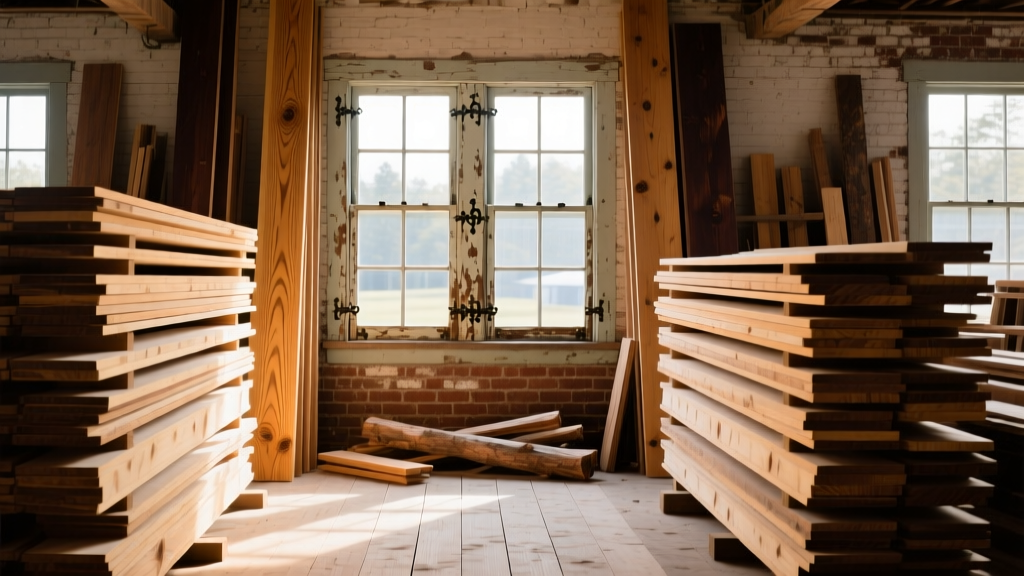
Inventory Realities: The Treasure Hunt vs. The Catalog
Where the Lisbon Exchange Excels
The exchange network is unparalleled for historical restorations and character-driven builds. If you are repairing a 1920s Lisbon Falls home and need to match existing 5-inch baseboards with a specific ogee profile, a big-box store will offer you nothing but modern MDF approximations. The exchange, however, frequently stocks period-accurate millwork, solid brass hardware, and old-growth timber that possesses a tightness of grain impossible to find in modern plantation pine. According to industry experts at BuildingGreen, specifying salvaged materials not only preserves regional architectural heritage but significantly elevates the perceived value of the finished property.
Where Big-Box Retailers Win
Consistency and volume. If your project requires 40 identical interior doors, 2,000 square feet of uniform drywall, and 50 gallons of a specific paint color matched to the exact decimal, the exchange model will fail you. Salvage yards cannot guarantee volume uniformity. For framing, rough-in plumbing (PEX/Copper), and electrical components, big-box retailers remain the mandatory choice due to strict modern building codes and the necessity for UL-listed, warrantied components.
Logistics, Transport, and Hidden Costs
The sticker price at the register is only half the procurement equation. Transporting materials from a Lisbon exchange yard introduces logistical friction that retail delivery services eliminate.
Contractor Insight: Big-box retailers in Auburn typically offer flat-rate job-site delivery for $79 to $99, dropping palletized materials directly onto your driveway. The exchange model is almost exclusively 'cash and carry.' If you do not own a heavy-duty truck, you must rent a cargo van or flatbed. Factoring in a $19.95 base rental plus $0.79 per mile from a Lewiston rental hub, plus the cost of your own loading labor, can erase the savings on lower-ticket items like drywall or insulation.
To maximize the exchange model, batch your purchases. Rent a truck once, map out a loading strategy, and secure heavy items like cast iron tubs and reclaimed flooring in a single trip. Reserve retail delivery for high-volume, lightweight, or fragile items like insulation batts and drywall sheets.
Environmental Impact and Code Compliance
Building material reuse is a cornerstone of sustainable construction. The Environmental Protection Agency (EPA) notes that millions of tons of construction and demolition (C&D) debris are generated annually, with wood, drywall, and metals making up the bulk of landfill-bound waste. By sourcing from the Lisbon exchange, you directly divert high-embodied-carbon materials from the waste stream.
However, code compliance requires vigilance. When sourcing reclaimed materials, specifically windows and painted wood, you must navigate modern energy and health codes.
Critical Safety Protocol for Pre-1978 Salvage
Any salvaged painted wood, vintage doors, or original windows sourced from pre-1978 structures in Maine must be tested for lead-based paint before interior installation. Use an EPA-recognized lead swab test kit. If lead is present on friction surfaces (like window sashes), the components must be professionally encapsulated or stripped, which adds $15 to $30 per linear foot in remediation labor. Never sand untested vintage millwork on-site.
Furthermore, while vintage single-pane windows are aesthetically superior, Maine's stringent residential energy codes often mandate double-pane, Low-E glazing for new envelope penetrations. Use exchange windows for interior applications, historical non-conditioned spaces, or as decorative storm-window layers over modern, code-compliant primary units.
Final Verdict: The Hybrid Procurement Strategy
The most successful contractors and homeowners in the Lisbon area do not choose one supplier over the other; they deploy a hybrid procurement strategy based on the specific phase of construction.
- Use the Building Materials Exchange for: Finish carpentry, hardwood flooring, architectural hardware, vintage lighting fixtures, landscaping timbers, and unique focal-point elements (e.g., reclaimed barn wood for accent walls). The cost savings on these high-margin items justify the time spent hunting and hauling.
- Use Big-Box Retailers for: Structural framing, roofing shingles, rough-in MEP (mechanical, electrical, plumbing) supplies, drywall, insulation, and any component requiring a continuous manufacturer warranty or strict adherence to modern energy codes.
By treating the Lisbon building materials exchange as a specialized finish and architectural supplier rather than a wholesale replacement for modern hardware stores, you can reduce your overall finish budget by 30% to 40% while injecting authentic, irreplaceable character into your build.
Written by
Marcus ChenMarcus Chen is a licensed structural engineer (PE) and building materials analyst with over 12 years of experience across residential, commercial, and industrial construction. He holds a Master of Science in Civil Engineering from UC Berkeley and spent six years at Thornton Tomasetti before transitioning to independent consulting and technical writing. Marcus specializes in material selection for seismic-prone regions, concrete reinforcement strategies, and lifecycle cost analysis. His work has been cited by the American Concrete Institute (ACI) and the Structural Engineers Association of California (SEAOC). When he is not on a job site or at his desk, you will find him hiking the Sierra Nevada or restoring a 1920s craftsman bungalow in Oakland, CA.
More from Marcus Chen
View all
Construction Cost
How Much Did the Eiffel Tower Cost to Build?
How much did the Eiffel Tower cost to build in 1889? We adjust for inflation and compare its budget to modern skyscraper construction.
Aug 4, 2026

Fire Resistance
What Is a Fire Resistant Material? Testing & Certification Guide
Discover what is a fire resistant material through ASTM and UL testing. Learn how fire ratings, certifications, and assemblies work in construction.
Aug 4, 2026

Construction Cost
How Much Did the Burj Khalifa Cost to Build?
How much did the Burj Khalifa cost to build? We break down the $1.5B project and extract 5 money-saving strategies for your next build.
Jul 30, 2026