Munoz Building Materials LLC: 2026 Cost Analysis & Pricing Guide
Analyze 2026 procurement costs, volume discounts, and freight rates when sourcing masonry and structural supplies through Munoz Building Materials LLC.

The Economics of Regional Material Distribution
When evaluating construction procurement strategies in 2026, general contractors and developers must look beyond the base unit price of commodities. Sourcing through regional suppliers like Munoz Building Materials LLC shifts the financial calculus from simple material cost to Total Landed Cost (TLC). While national big-box retailers or direct-to-mill purchases might offer marginally lower sticker prices on individual SKUs, regional distributors provide critical value through mixed-load freight consolidation, local staging, and flexible reverse logistics.
According to data tracked by the Bureau of Labor Statistics Producer Price Index (PPI), construction material volatility remains a primary risk factor for project margins. Regional LLCs absorb localized supply chain shocks by maintaining deep regional inventory buffers, effectively acting as a financial hedge for mid-sized contractors who cannot afford the warehousing overhead of direct-mill bulk purchasing.
Munoz Building Materials LLC: Core Product Pricing Matrix
To understand the true cost of sourcing through a regional distributor, we must compare the direct-mill or national wholesale cost against the regional distributor price. The following matrix analyzes five core general building materials, highlighting the premium paid for regional availability and the specific value-add that justifies the spread.
| Material (Specification) | Unit | Direct Mill / National Cost | Munoz LLC Regional Cost | Value-Add Justification |
|---|---|---|---|---|
| Type S Mortar (ASTM C270) | 80lb Bag | $6.85 | $7.45 | Climate-controlled storage preventing premature hydration; mixed-pallet delivery. |
| 5/8" Firecode X Drywall (ASTM C1392) | 4x12 Sheet | $21.50 | $23.10 | Boom truck placement directly to upper-floor staging; edge-protection packaging. |
| 2x6 SPF Lumber (Grade Stamp #2 & Btr) | 8ft Stud | $5.90 | $6.35 | Kiln-dried (KD) acclimatization; cull-rate guarantees under 4%. |
| 6000 PSI Redi-Mix (3/4" Aggregate) | Per Cubic Yard | $165.00 | $178.50 | Guaranteed 90-minute slump retention; small-load fee waivers for under 4 yards. |
| 1/2" OSB Sheathing (Exposure 1) | 4x8 Sheet | $38.00 | $41.25 | Weather-wrapped pallets; just-in-time (JIT) delivery to tight urban sites. |
As illustrated by the National Association of Home Builders (NAHB) material pricing reports, a 6% to 9% premium on base materials is standard for regional distributors. However, this premium is routinely offset by the elimination of third-party freight brokers and specialized unloading equipment rentals.
Freight, Logistics, and Hidden Sourcing Costs
The most significant cost advantage of utilizing Munoz Building Materials LLC lies in freight consolidation. When purchasing direct from multiple mills (e.g., a lumber mill in the Pacific Northwest and a masonry plant in the Southeast), contractors are forced to manage multiple Less-Than-Truckload (LTL) shipments. LTL freight rates in 2026 average $3.50 to $4.20 per hundredweight (cwt), and carriers frequently apply accessorial fees for residential delivery, liftgate requirements, and inside delivery.
The Mixed-Load Advantage
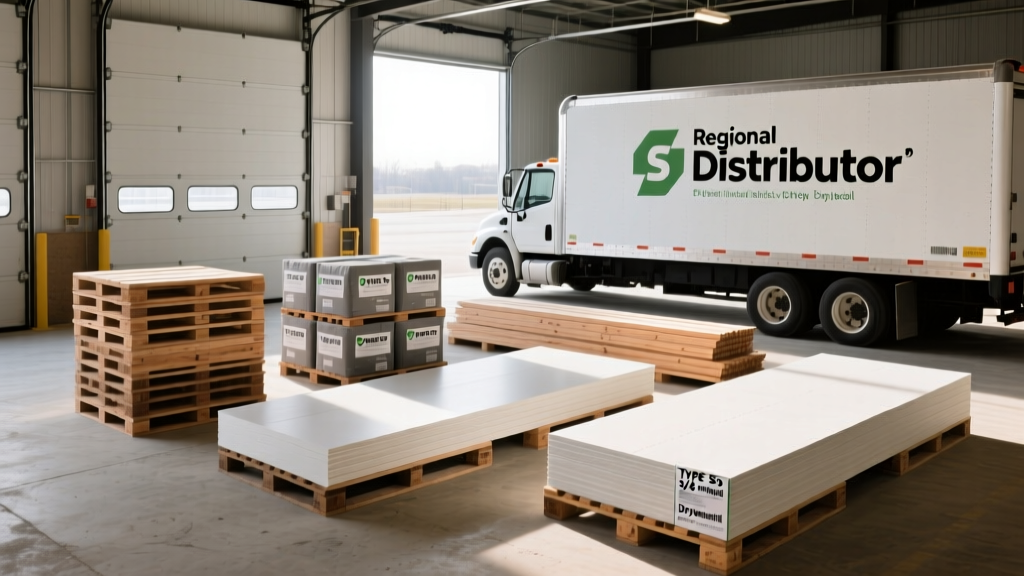
Regional distributors operate a hub-and-spoke model. By consolidating heavy masonry products with lightweight framing lumber and drywall into a single Full-Truckload (FTL) or dedicated local route, Munoz Building Materials LLC effectively subsidizes the freight cost of heavier items.
- Direct Sourcing Freight Penalty: Ordering 10 pallets of concrete block direct requires a dedicated flatbed, often incurring a $450+ short-haul minimum freight charge.
- Distributor Freight Efficiency: Those same 10 pallets are combined with drywall and insulation on a single route truck, reducing the allocated freight cost to roughly $125 per pallet.
Pallet Deposits and Reverse Logistics
A frequently overlooked line item in construction cost analysis is pallet and dunnage management. National big-box stores and direct mills often utilize CHEP or PECO rental pallets, which require strict return logistics to avoid $25 to $35 per-pallet unreturned fees. Furthermore, mills often ship masonry and drywall on heavy-duty hardwood stringer pallets that require the contractor to pay for disposal or storage.
Munoz Building Materials LLC typically utilizes a closed-loop pallet return system. For a mid-sized commercial project requiring 400 pallets of mixed materials, the reverse logistics savings are substantial:
- Deposit Avoidance: No upfront capital tied up in CHEP deposits (saving ~$8,000 in cash flow).
- Disposal Fees: Eliminates the need to rent 30-yard roll-off dumpsters specifically for broken pallets and dunnage, saving approximately $600 per haul.
- Site Clearance: The distributor's next delivery truck removes the empty pallets, maintaining OSHA-compliant site egress without requiring dedicated labor hours for staging and breaking down wood waste.
Volume Tier Discounts and Credit Terms
Cash flow management is just as critical as material pricing. Direct mills typically require prepayment or strict Net-30 terms with severe late penalties, and they rarely offer early payment discounts to mid-tier contractors. Regional suppliers like Munoz Building Materials LLC offer more flexible credit architectures tailored to local construction draw schedules.
Typical 2026 Regional Distributor Credit Structures
| Account Tier | Annual Volume | Standard Terms | Early Pay Discount | Rebate Structure |
|---|---|---|---|---|
| Standard Contractor | Under $250k | Net-30 | None | None |
| Preferred Builder | $250k - $1M | Net-45 | 1.5% / 10 Days | 2% EOY Volume Rebate |
| Enterprise Developer | Over $1M | Net-60 (Draw Aligned) | 2% / 15 Days | 4% EOY + Co-op Marketing |
For a contractor operating on tight margins, the 1.5% early payment discount on a $500,000 annual spend yields $7,500 in pure bottom-line savings, effectively neutralizing the base price premium on items like OSB and dimensional lumber.
Strategic Procurement Framework for 2026
Deciding when to utilize Munoz Building Materials LLC versus bypassing them for direct procurement requires a scenario-based decision matrix. Use the following framework to optimize your purchasing strategy:
When to Use the Regional Distributor
- Urban Infill Projects: Sites with zero laydown area require just-in-time (JIT) delivery and boom-truck staging. The distributor's logistics network is essential here.
- Mixed-Material Phases: During rough-in phases where framing, plumbing supplies, and drywall are needed simultaneously. Consolidated delivery prevents site congestion.
- High-Cull Materials: When purchasing natural stone veneer or specialty brick where color blending and breakage replacement are necessary. Regional yards allow for immediate, small-quantity replenishment without triggering mill minimum-order quantities (MOQs).
When to Bypass and Go Direct-to-Mill
- Commodity Framing Packages: For large-scale tract housing or massive commercial shells requiring 50,000+ board feet of identical engineered lumber (LVL/LSL). The volume justifies direct mill pricing and dedicated FTL shipping.
- Specialty Roofing Systems: High-end standing seam metal roofing or specialized TPO membranes are best sourced directly from the manufacturer to ensure warranty compliance and factory-certified accessory matching.
By treating regional suppliers as strategic logistics partners rather than mere commodity vendors, contractors can leverage the infrastructure of companies like Munoz Building Materials LLC to reduce soft costs, minimize site downtime, and protect project margins against the unpredictable freight and disposal fees that plague direct-sourcing models.
Written by
James ThorntonJames Thornton is a construction industry veteran with 25 years of hands-on experience in wood framing, lumber grading, and residential building codes. He started as a framing carpenter in rural Oregon, earned his ICC Residential Building Inspector certification, and eventually became a senior plan reviewer for the City of Portland Bureau of Development Services. James holds a B.S. in Wood Science & Technology from Oregon State University and is a certified lumber grader through the West Coast Lumber Inspection Bureau (WCLIB). He has inspected over 3,000 residential construction sites and authored the city's internal guide on advanced framing techniques (2x6 at 24" O.C.). James lives in Bend, OR, where he builds custom timber-frame cabins and competes in lumberjack sports.
More from James Thornton
View all
Insulation
Best Home Insulation Materials: Complete 2026 Guide
Compare top home insulation materials for 2026. Find R-values, installed costs per square foot, and best uses for fiberglass, spray foam, and mineral wool.
Aug 4, 2026

Sustainable Building
Certify Your Green Building Material for LEED and WELL
Step-by-step guide to certifying a green building material for LEED v5 and WELL v2. Master EPDs, HPDs, and VOC limits for 2026 project specifications.
Aug 4, 2026

Stone & Masonry
Veneer Stacked Stone Panels: Interior Design & Style Showcase
Discover how veneer stacked stone panels transform interiors. Explore modern design profiles, material pairings, and technical installation specs.
Aug 4, 2026