R Value of Building Materials: Cost vs Insulation ROI
Compare the r value of building materials against installation costs. Discover which insulation offers the best ROI and lowest cost per R-value in 2026.
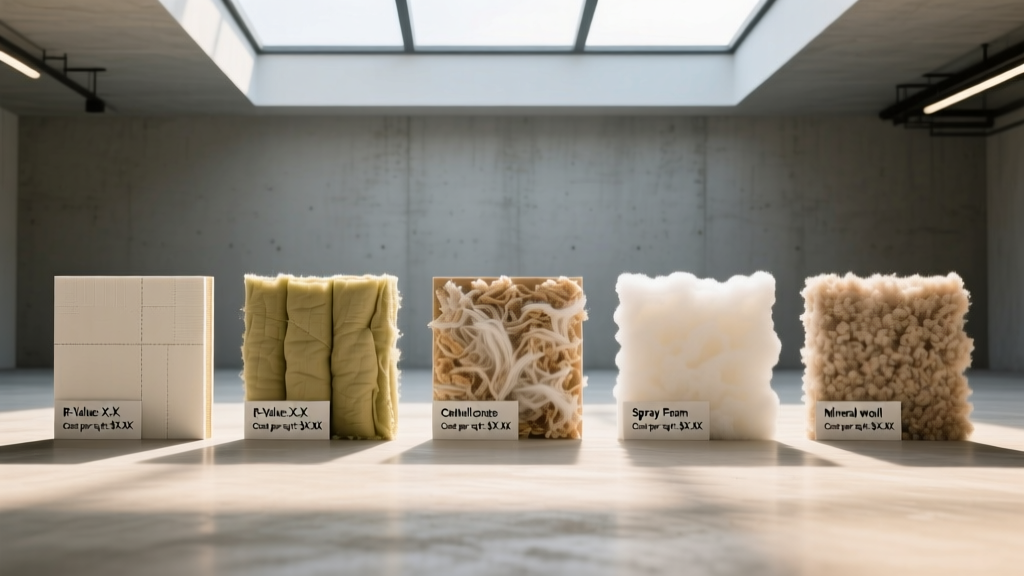
The Economics of Thermal Resistance
When evaluating the r value of building materials, contractors and homeowners often make the mistake of looking solely at the upfront material cost or the R-value per inch in isolation. Neither metric provides a complete financial picture. The true measure of insulation efficiency is the Installed Cost per R-Value ($/R). This metric accounts for the material price, the labor required to achieve a specific thermal resistance, and the physical space constraints of the building assembly.
Formula: (Material Cost per Sq Ft + Labor Cost per Sq Ft) ÷ Total Assembly R-Value. This reveals exactly how many dollars you are spending for each unit of thermal resistance, allowing for an apples-to-apples financial comparison between vastly different material chemistries.
In 2026, with energy codes adopting stricter IECC 2024 baselines (pushing attic requirements to R-49 or R-60 in many climate zones), optimizing this $/R metric is critical for maintaining project margins while ensuring long-term energy ROI. According to the U.S. Department of Energy, proper insulation and air sealing can save an average of 15% on heating and cooling costs, but the payback period varies wildly depending on the material chosen.
Material Breakdown: Cost Per R-Value Matrix
The table below analyzes the most common insulation materials available in 2026. Pricing reflects national averages for both material and professional installation, standardized to an R-20 assembly where possible. Note that materials with higher R-values per inch (like closed-cell spray foam) command a premium that is only justified in space-constrained assemblies.
| Material Type | R-Value / Inch | Material Cost (per sq ft / inch) | Installed Cost (R-20 Assembly) | Cost per R-Value ($/R) |
|---|---|---|---|---|
| Fiberglass Batts (Standard) | 3.2 - 3.8 | $0.35 - $0.45 | $2.80 - $3.20 | $0.14 - $0.16 |
| Blown-in Cellulose (Dense Pack) | 3.5 - 3.8 | $0.50 - $0.65 | $3.50 - $4.10 | $0.17 - $0.20 |
| Mineral Wool (ROCKWOOL type) | 4.0 - 4.3 | $0.75 - $0.95 | $5.20 - $6.00 | $0.26 - $0.30 |
| EPS (Expanded Polystyrene) | 3.6 - 4.2 | $0.45 - $0.60 | $3.80 - $4.50 | $0.19 - $0.22 |
| XPS (Extruded Polystyrene) | 5.0 | $0.80 - $1.10 | $5.50 - $6.50 | $0.27 - $0.32 |
| Polyiso (Faced Rigid Board) | 5.6 - 6.5* | $0.90 - $1.20 | $6.00 - $7.20 | $0.30 - $0.36 |
| Open-Cell Spray Foam | 3.5 - 3.8 | $1.20 - $1.50 | $4.80 - $5.50 | $0.24 - $0.27 |
| Closed-Cell Spray Foam | 6.0 - 7.0 | $2.00 - $2.60 | $9.50 - $11.50 | $0.47 - $0.57 |
*Polyiso R-value is rated at 75°F; see thermal drift section below for cold-weather performance adjustments.
As the North American Insulation Manufacturers Association (NAIMA) highlights, fiber-based insulations like fiberglass and mineral wool remain the undisputed leaders in cost-effectiveness for open-cavity applications. However, they require meticulous air sealing on the interior plane to perform to their rated R-value, which can add $0.50 to $1.00 per square foot in labor and membrane materials.
The Cold-Weather Trap: Thermal Drift and Blowing Agents
A critical failure mode in cost analysis is ignoring how the r value of building materials shifts under extreme temperatures. Rigid foam boards are not created equal, and their chemical composition dictates their real-world performance.
Polyisocyanurate (Polyiso) boasts the highest R-value per inch (up to R-6.5) at room temperature. However, the blowing agents trapped in its cells condense in freezing temperatures. In Climate Zones 5 and above, when exterior temperatures drop below 25°F, the effective R-value of Polyiso can plummet by 20% to 25%, dropping to an effective R-4.5 per inch. If you are calculating payback periods for exterior continuous insulation in cold climates, you must use the cold-weather R-value, not the labeled 75°F value.
Conversely, Expanded Polystyrene (EPS) actually increases in R-value as temperatures drop, making it highly cost-effective for below-grade and cold-climate exterior applications. Furthermore, the 2026 market landscape for Extruded Polystyrene (XPS) has been heavily impacted by the AIM Act's HFC phase-down. Manufacturers have transitioned to next-generation HFO blowing agents. While this drastically reduces the Global Warming Potential (GWP) of XPS, it has permanently elevated the material cost by roughly 15% compared to pre-2024 levels, widening the cost gap between XPS and EPS.
Calculating Your Payback Period: A Real-World Scenario
To determine the true ROI, we must calculate the Simple Payback Period (SPP). Let's analyze an attic upgrade in Climate Zone 5 (e.g., Chicago, IL), moving from an existing R-19 fiberglass batt assembly to an R-49 blown-in cellulose assembly.
Step 1: Establish the Upgrade Cost
- Area: 1,500 sq ft attic floor.
- Existing R-Value: R-19 (degraded, effectively R-15).
- Target R-Value: R-49 (Requires adding R-34).
- Material & Labor Cost: Blown-in cellulose at $0.60/sq ft per inch. Achieving R-34 requires ~9.7 inches. Cost per sq ft = $5.82. Total Upgrade Cost = $8,730.
Step 2: Calculate Annual Energy Savings
Using the DOE's energy savings parameters for Zone 5, upgrading from an effective R-15 to R-49 reduces attic heat loss by approximately 65%. For a home with an annual heating/cooling bill of $3,200, where the attic accounts for 30% of the thermal load ($960), a 65% reduction yields an annual savings of $624.
Step 3: Determine Simple Payback Period
$8,730 (Total Cost) ÷ $624 (Annual Savings) = 13.9 Years.
While a 13.9-year payback might seem lengthy, this calculation ignores utility rate inflation (averaging 4-6% annually) and local utility rebates. Furthermore, if the homeowner utilizes closed-cell spray foam to achieve the same R-49 in a space-constrained cathedral ceiling, the upfront cost triples, pushing the payback period well beyond 35 years—proving that high-tech materials are rarely justified by energy savings alone.
High-Performance vs. Budget: When to Spend More
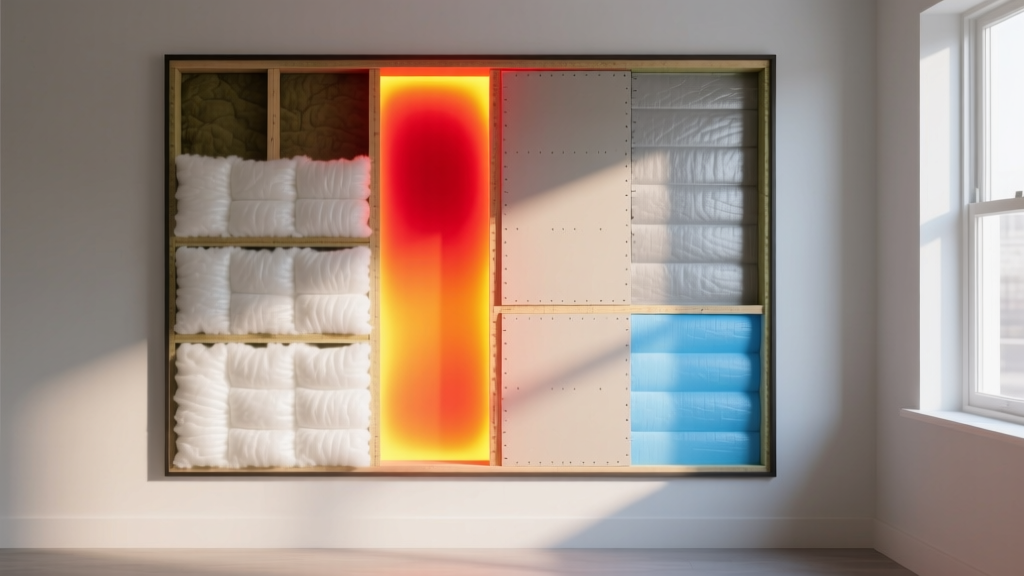
When does it make financial sense to choose materials with a higher $/R cost? The decision hinges on spatial constraints and moisture management.
- Choose Closed-Cell Spray Foam ($0.50/R) when: You are insulating a cathedral ceiling with 2x6 rafters where maximizing R-value per inch is the only way to meet code minimums, or when the material must act as a Class II vapor retarder and structural racking component.
- Choose Mineral Wool ($0.28/R) when: Fire resistance and acoustic dampening are secondary requirements alongside thermal performance. It is non-combustible and maintains its dimensional stability in high-humidity environments where fiberglass would sag.
- Choose EPS ($0.20/R) when: Installing exterior continuous insulation (ci) over wall sheathing. It provides excellent moisture tolerance, does not suffer from thermal drift, and costs significantly less than XPS or Polyiso.
Building Code Minimums and Assembly Performance
As jurisdictions adopt the 2024 IECC (with widespread enforcement in 2026), the focus has shifted from prescriptive cavity R-values to overall Whole-Wall U-Factor requirements. This accounts for thermal bridging through wood or steel studs. A wall framed with 2x4s at 16 inches on center loses nearly 25% of its thermal resistance through the wood studs. Therefore, adding exterior continuous insulation (like EPS or mineral wool boards) is no longer optional in many zones; it is required to break the thermal bridge. When calculating material costs, factor in the furring strips, longer fasteners, and specialized window bucks required to accommodate 1 to 2 inches of exterior rigid insulation.
Frequently Asked Questions
Does doubling the thickness of the insulation double the R-value?
For most materials, yes. Two layers of R-15 fiberglass batts will yield an R-30 assembly. However, this assumes perfect installation without compression. Compressing a 6-inch R-19 batt into a 3.5-inch 2x4 wall cavity does not yield R-19; it drops the effective R-value to roughly R-13 while increasing the density. Always match the material's designated thickness to the cavity depth.
What is the most cost-effective insulation for existing closed walls?
For retrofitting existing walls without removing drywall, dense-pack cellulose or low-density open-cell spray foam injected through drilled holes are the standard choices. Cellulose offers a significantly lower $/R (around $0.20/R installed) and provides excellent air-sealing properties due to its density. Open-cell foam costs roughly 40% more but offers superior air-sealing in highly irregular cavities with complex wiring and plumbing obstructions.
Written by
Sarah WhitfieldSarah Whitfield is a chartered quantity surveyor (MRICS) and construction cost analyst with 15 years of experience in material pricing, procurement strategy, and project budgeting. She earned her degree in Construction Management from the University of Reading (UK) and has worked on projects ranging from $2M custom homes to $180M mixed-use developments across North America and Europe. Sarah currently leads cost estimating for BuildMat Insight, maintaining a proprietary database of 4,000+ material price points updated quarterly. She is a frequent contributor to RSMeans cost data panels and has presented at the International Cost Engineering Council (ICEC) congress. Based in Denver, CO, Sarah is an avid trail runner and volunteer mentor for Women in Construction.
More from Sarah Whitfield
View all
Wood & Lumber
What Are the Different Types of Wood? A Builder's Guide
Compare structural softwoods, finish hardwoods, and engineered lumber. Analyze Janka ratings, MOE values, and 2026 pricing for construction.
Aug 4, 2026

Walls & Panels
Steel Framing vs Wood Framing: Corrosion and Moisture Defense
Compare steel framing vs wood framing for moisture resistance. Learn about galvanized coatings, condensation risks, and corrosion protection strategies.
Jul 21, 2026

Stone & Masonry
How to Cut Stone Veneer: Wet Saw vs Grinder Comparison
Compare the best tools for cutting stone veneer. We review wet saws, angle grinders, and chop saws to help you achieve clean, chip-free cuts.
Jul 21, 2026