HVAC Classification & Construction Building Materials Cost Analysis
Analyze how HVAC company engineering classifications impact construction building material selection, procurement strategies, and overall project costs.

The Financial Impact of HVAC Engineering Classifications
General contractors frequently evaluate mechanical bids as a single aggregated line item, obscuring the massive cost variances driven by the contractor's operational tier. The relationship between HVAC company classification, engineering capabilities, and construction building materials is the primary driver of mechanical budget overruns in commercial projects. A Design-Build MEP firm specifies entirely different material grades, tolerances, and assembly methods than a standard commercial installation contractor. In 2026, with sustained volatility in raw material pricing and specialized labor shortages, misaligning your HVAC partner's classification with your project's material specifications guarantees margin erosion.
This analysis breaks down how HVAC engineering classifications dictate material procurement, providing exact cost matrices and specification frameworks to optimize your mechanical budget.
Tier Breakdown: How HVAC Classifications Dictate Material Specs
HVAC contractors are broadly categorized into three engineering and execution tiers. Each tier possesses distinct procurement channels, vendor relationships, and material handling capabilities that directly impact your bottom line.
- Tier 1: MEP Design-Build & Engineering Firms. These companies employ in-house mechanical engineers (PEs) and BIM coordinators. They specify high-efficiency, custom-fabricated, and heavily integrated materials (e.g., pre-insulated phenolic ductwork, magnetic bearing chillers, and proprietary building automation systems). They leverage national bulk-purchasing agreements, often reducing unit costs on premium materials by 8-12%.
- Tier 2: Commercial Specialty Contractors. These firms execute engineered designs but rarely perform in-house engineering. They rely on standard commercial specifications (e.g., galvanized spiral duct, standard VAV boxes, and brazed copper piping). Their material procurement is highly regionalized, making them sensitive to local supply chain fluctuations.
- Tier 3: Light Commercial / Standard Installers. Focused on split systems, RTUs, and flex-duct distributions. They lack the engineering bandwidth to manage complex material submittals or specialized rigging requirements for heavy central plant equipment.
2026 Material Cost Matrix by HVAC Contractor Tier
The following matrix illustrates the divergence in material costs and specifications for a standard 50,000-square-foot mid-rise commercial office build, comparing the three primary HVAC classifications.
| Material Category | Tier 1 (MEP Design-Build) | Tier 2 (Commercial Specialty) | Tier 3 (Light Commercial) |
|---|---|---|---|
| Air Distribution | Pre-insulated Phenolic Spiral ($26/lf) | Galvanized Rectangular + Fiberglass ($22/lf) | Flex Duct & Standard Round ($14/lf) |
| Chilled Water Piping | Grooved Carbon Steel w/ Victaulic ($34/lf) | Threaded Black Iron / Type L Copper ($28/lf) | N/A (DX Systems Only) |
| Control Valves | Belimo Characterized 2-Way ($850/ea) | Standard Globe Valves w/ Actuators ($420/ea) | Manual Balancing Valves ($110/ea) |
| Acoustic Insulation | 2" Elastomeric Closed-Cell ($4.80/bd ft) | 1.5" Fiberglass Board ($1.90/bd ft) | Standard Duct Wrap ($0.85/bd ft) |
| Estimated Total Material Cost | $415,000 - $440,000 | $320,000 - $350,000 | $210,000 - $230,000 |
Deep Dive: High-Cost Material Divergences
To accurately forecast construction building materials costs, estimators must understand the specific engineering requirements that trigger premium material selections.
Ductwork and Acoustic Liners
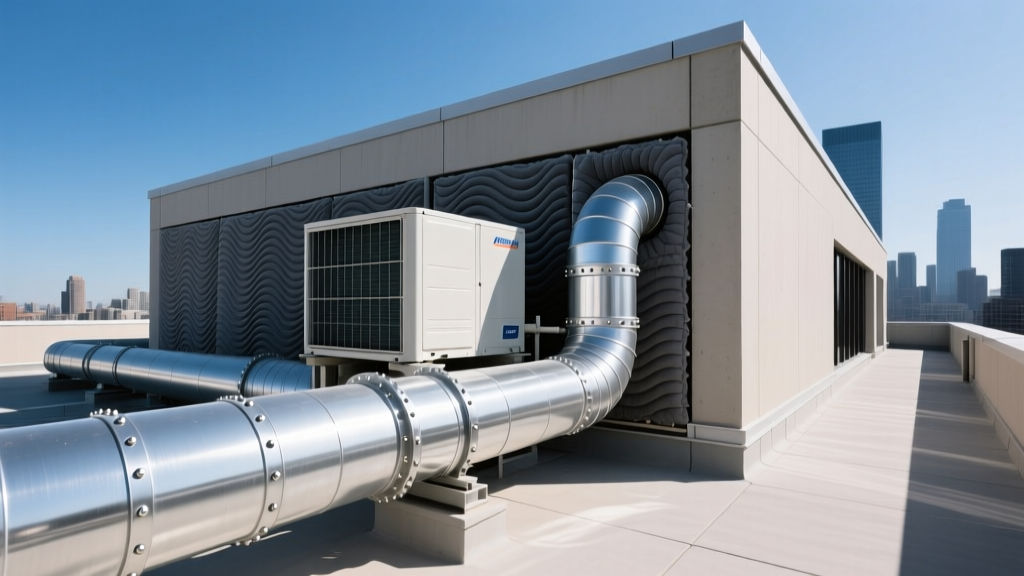
Ductwork represents the highest volume of material in commercial HVAC. According to the Sheet Metal and Air Conditioning Contractors' National Association (SMACNA), duct construction standards vary wildly based on pressure classes. Tier 1 engineering firms designing for high-velocity, low-noise environments (like Class-A office space or healthcare) will specify 2-inch phenolic board insulation (ASTM C1126) or specialized elastomeric liners. At $4.80 per board foot, this is a 150% premium over the 1.5-inch fiberglass board (ASTM C553) typically installed by Tier 2 contractors. Furthermore, Tier 1 firms often mandate factory-applied acoustic liners to mitigate field-installation errors, adding $3.50 to $5.00 per linear foot to the base duct cost but eliminating $12,000+ in field labor and reducing acoustic commissioning failures.
Chilled Water Piping and Valve Assemblies
For central plant projects, piping material selection is heavily influenced by the HVAC company's engineering classification. Tier 1 MEP firms almost exclusively specify grooved carbon steel piping utilizing mechanical couplings (e.g., Victaulic). While the raw material cost of carbon steel is lower than Type L copper, the engineered couplings and specialized gaskets push the installed material cost to roughly $34 per linear foot. Tier 2 contractors often value-engineer this down to threaded black iron or brazed copper. However, the American Society of Heating, Refrigerating and Air-Conditioning Engineers (ASHRAE) notes that mechanical grooved systems significantly reduce long-term maintenance costs and allow for modular prefabrication, a capability unique to Tier 1 and advanced Tier 2 contractors.
General contractors frequently attempt to force Tier 1 material specifications (like pre-fabricated modular piping racks or specialized phenolic ductwork) onto Tier 2 or Tier 3 contractors to save on the initial bid. This results in a 15-22% increase in change orders. Lower-tier contractors lack the specialized tooling, BIM coordination software, and vendor relationships to procure these materials efficiently, leading to massive field-fabrication waste and schedule delays.
Strategic Procurement for General Contractors
Aligning your material procurement strategy with your HVAC partner's classification is critical for protecting project margins in 2026. Implement the following framework during the preconstruction phase:
- Audit the Subcontractor's Procurement Channel: Before finalizing the mechanical scope, request a list of the HVAC company's primary material vendors. If a Tier 2 contractor is bidding a project that specifies high-end Tier 1 materials (e.g., Daikin magnetic bearing chillers or specialized Nailor VAV boxes), verify they have an established credit line and volume discount with those specific manufacturers.
- Standardize the Control Valves: Control valves and actuators carry the highest markup variance. Allow your HVAC engineering partner to specify a single manufacturer (e.g., Belimo or Taco) for all hydronic and air-side controls. This consolidates the procurement volume, typically unlocking an additional 8-10% discount from the local representative.
- Leverage Department of Energy (DOE) Rebates for High-Efficiency Materials: Tier 1 engineering firms are best equipped to specify and document materials that qualify for 2026 federal and state energy efficiency rebates (such as ASHRAE 90.1-2022 compliant envelope and mechanical integrations). Factor these rebates into your net material cost analysis.
"The lowest mechanical bid is rarely the lowest final cost. When a contractor's engineering classification does not match the complexity of the specified construction building materials, the general contractor absorbs the cost of field coordination, material waste, and commissioning delays."
Frequently Asked Questions
What is the standard material markup for HVAC contractors?
Material markups vary strictly by classification. Tier 1 MEP firms typically apply a 5-8% markup on major equipment and 10-12% on bulk piping/ductwork, as their profit is heavily weighted toward engineering and design fees. Tier 2 and Tier 3 contractors, relying almost entirely on installation margins, typically apply a 15-20% markup on all construction building materials to cover overhead and field risk.
Can a GC purchase HVAC materials directly to save money?
While owner-furnished or GC-furnished equipment (like rooftop units or chillers) is common, GCs should never procure distributed materials (ductwork, piping, insulation). HVAC warranties are voided if the installing contractor does not procure the distributed materials, as they cannot guarantee the chain of custody, storage conditions, or material integrity prior to installation.
How do supply chain delays affect different HVAC tiers?
Tier 1 firms mitigate 2026 supply chain volatility through national master service agreements (MSAs) with manufacturers, securing priority allocation for critical path items like custom air handling units and specialized valves. Tier 2 and 3 contractors rely on local wholesale distributors, making them highly vulnerable to regional stockouts, which can delay mechanical rough-in by 4 to 8 weeks.
Written by
Marcus ChenMarcus Chen is a licensed structural engineer (PE) and building materials analyst with over 12 years of experience across residential, commercial, and industrial construction. He holds a Master of Science in Civil Engineering from UC Berkeley and spent six years at Thornton Tomasetti before transitioning to independent consulting and technical writing. Marcus specializes in material selection for seismic-prone regions, concrete reinforcement strategies, and lifecycle cost analysis. His work has been cited by the American Concrete Institute (ACI) and the Structural Engineers Association of California (SEAOC). When he is not on a job site or at his desk, you will find him hiking the Sierra Nevada or restoring a 1920s craftsman bungalow in Oakland, CA.
More from Marcus Chen
View all
Construction Cost
How Much Did the Eiffel Tower Cost to Build?
How much did the Eiffel Tower cost to build in 1889? We adjust for inflation and compare its budget to modern skyscraper construction.
Aug 4, 2026

Fire Resistance
What Is a Fire Resistant Material? Testing & Certification Guide
Discover what is a fire resistant material through ASTM and UL testing. Learn how fire ratings, certifications, and assemblies work in construction.
Aug 4, 2026

Construction Cost
How Much Did the Burj Khalifa Cost to Build?
How much did the Burj Khalifa cost to build? We break down the $1.5B project and extract 5 money-saving strategies for your next build.
Jul 30, 2026