Ryan Building Materials Southfield Michigan: 2026 Supply Trends
Analyze 2026 construction supply trends through the lens of Ryan Building Materials in Southfield, Michigan, focusing on commercial retrofits and pricing.

The Southfield Commercial Retrofit Boom and Material Demand
Southfield, Michigan, has historically been recognized as a premier suburban commercial hub in Oakland County, characterized by its iconic high-rise office towers. However, the 2026 real estate landscape has shifted dramatically. With the acceleration of office-to-residential and mixed-use conversions, regional distributors like Ryan Building Materials in Southfield are fundamentally altering their inventory profiles. The days of stocking primarily standard commercial drop-ceiling grids and bulk fiberglass insulation are over. Today, the metro Detroit supply chain is heavily indexed toward specialized retrofit materials, acoustic treatments, and fire-rated shaft wall assemblies required for adaptive reuse projects.
When converting legacy Class B and Class C office spaces into multi-family residential units, contractors face strict International Building Code (IBC) requirements for sound transmission and fire separation. A local supplier operating near the M-10 and I-696 corridors must now maintain deep stock of specialized products. For instance, shaft wall liner panels—such as the USG Sheetrock Brand 1-inch Shaft Wall Liner Panels—are critical for enclosing elevator shafts and mechanical chases in newly carved residential corridors. Similarly, sound attenuation fire blankets (SAFB), like Owens Corning Thermafiber SAFB mineral wool batts, are now moving in high volume to meet the STC (Sound Transmission Class) 50+ ratings mandated between newly constructed demising walls.
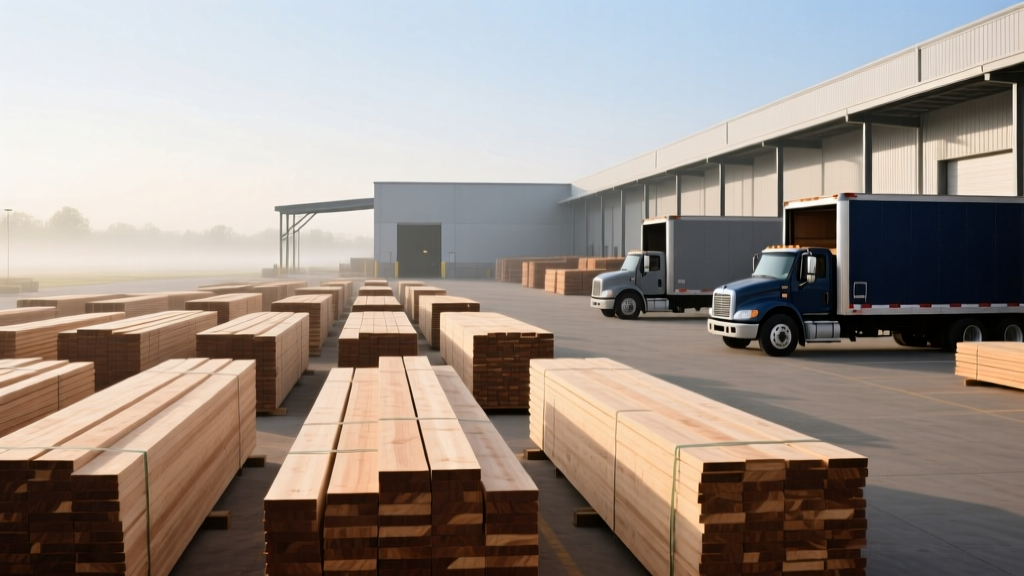
Hyper-Local Supply Chain Buffering in Metro Detroit
The macroeconomic lessons of the early 2020s solidified into permanent operational strategies by 2026. Global just-in-time delivery models have been largely abandoned in favor of regional buffering. For a distributor situated in Southfield, this means leveraging Oakland County’s robust industrial warehousing footprint to maintain a 45- to 60-day supply of critical path materials, insulating local contractors from international shipping disruptions.
This hyper-local approach is particularly evident in the procurement of structural steel and heavy timber required for podium decks in mixed-use developments. Instead of relying on overseas steel imports subject to volatile tariff schedules and port delays, Southfield-based suppliers are increasingly sourcing from regional mini-mills in the Great Lakes corridor. According to data tracked by the U.S. Census Bureau on construction spending, regional material manufacturing has seen sustained capital investment, allowing local yards to offer more predictable lead times. A contractor ordering W-shape steel beams or glulam columns for a Southfield mixed-use project can now expect a 3-week lead time from a localized distributor, compared to the 8- to 12-week delays common when relying on coastal import hubs.
Logistics and Last-Mile Delivery Optimization
Distributing heavy building materials through the dense, traffic-congested corridors of Metro Detroit requires precise logistical execution. Modern supply yards in the region have integrated GPS-tracked flatbed routing and automated dispatch software. This ensures that deliveries of fragile materials—like large-format porcelain architectural panels or pallets of 5/8-inch Type X gypsum board—arrive exactly when the crane or forklift is ready, eliminating costly on-site staging and reducing the risk of weather-related damage.
2026 Material Pricing Dynamics: Metro Detroit Market
Understanding localized pricing is critical for accurate project estimating. While national indices provide a baseline, the actual invoice prices at a Southfield lumber yard reflect regional freight costs, local union labor rates for loading, and state-specific environmental compliance fees. Below is a snapshot of core material costs for the Southeast Michigan market in 2026.
| Material Category | 2024 Metro Detroit Avg. | 2026 Metro Detroit Avg. | Primary Market Driver |
|---|---|---|---|
| SPF Dimensional Lumber (2x4x8) | $3.45 / unit | $3.95 / unit | Canadian softwood tariffs & regional rail freight |
| Ready-Mix Concrete (4,000 PSI) | $135 / cu yd | $158 / cu yd | Cement kiln decarbonization capital costs |
| Polyiso Insulation (1-inch) | $0.85 / sq ft | $0.94 / sq ft | Petrochemical feedstock volatility |
| Type X Gypsum Board (5/8") | $18.50 / sheet | $19.20 / sheet | Stable domestic mining, slight logistics bump |
| 60-mil TPO Roofing Membrane | $1.65 / sq ft | $1.82 / sq ft | Increased commercial flat-roof retrofit demand |
The most notable inflationary pressure in the 2026 table is ready-mix concrete. The jump to $158 per cubic yard is directly tied to the capital expenditures required by Michigan cement producers to upgrade kilns for lower-carbon clinker production. While this increases upfront material costs, it aligns with the state's aggressive environmental targets.
Sustainability Mandates and Green Procurement
Michigan’s evolving building codes and the push for LEED v5 certification have forced material suppliers to become experts in environmental compliance. It is no longer sufficient to simply sell insulation; distributors must provide comprehensive Environmental Product Declarations (EPDs) and Health Product Declarations (HPDs) for the materials they supply. The Environmental Protection Agency's green building guidelines emphasize the importance of lifecycle assessments, pushing commercial developers in Southfield to demand materials with verified low embodied carbon.
For a supplier like Ryan Building Materials, this means curating a specific 'green catalog.' When bidding on a municipal project or a corporate headquarters retrofit in Oakland County, contractors require documentation proving that the structural steel contains a minimum of 85% recycled content, or that the specified acoustic ceiling tiles are manufactured with bio-based binders rather than formaldehyde. Furthermore, the National Institute of Standards and Technology (NIST) continues to refine its building material databases, providing the exact lifecycle data that local distributors use to help architects meet stringent energy codes.
The Rise of Low-Carbon Concrete Mixes
One of the most significant shifts in the local yard is the availability of low-carbon concrete mixes. By substituting traditional Portland cement with high volumes of fly ash, slag cement, and calcined clays (LC3), local batch plants are supplying mixes that reduce embodied carbon by up to 40% without sacrificing the 4,000 PSI compressive strength required for commercial foundations and podium decks. Educating local contractors on the curing times and finishing characteristics of these supplementary cementitious materials (SCMs) has become a core value-added service for Southfield suppliers.
Tech Integration at the Yard Level
The modern building material supply yard is a highly digitized environment. To maintain the inventory accuracy required for just-in-sequence commercial deliveries, regional distributors have adopted RFID (Radio Frequency Identification) tagging on high-value pallets. When a forklift moves a pallet of Huber ZIP System sheathing or a crate of commercial-grade HVAC diffusers, the inventory management system updates in real-time. This eliminates the 'ghost inventory' problem where a contractor's online portal shows an item in stock, but the physical yard cannot locate it.
"The contractors who win bids in 2026 are the ones who integrate their procurement software directly with their local supplier's API. Real-time stock visibility prevents project delays caused by material stockouts, which currently cost Metro Detroit commercial projects an average of $4,500 per day in idle labor."
Strategic Takeaways for Metro Detroit Contractors
Sourcing materials in Southfield and the broader Oakland County area requires a strategic approach tailored to the 2026 market realities. Contractors should prioritize the following actions:
- Audit for Adaptive Reuse Compatibility: Ensure your supplier stocks specialized shaft wall and acoustic separation materials, as standard commercial partitions will fail residential conversion inspections.
- Lock in Low-Carbon Mix Designs Early: Coordinate with your local batch plant and supplier to finalize SCM-heavy concrete mix designs at least 60 days before the pour date to ensure admixture availability.
- Require EPDs at the Bid Stage: Do not wait until the submittal phase to gather sustainability documentation. Partner with distributors who provide automated EPD downloads directly from their digital catalogs.
- Leverage Local Buffering: Shift away from national big-box procurement for critical-path structural items. Utilize regional yards that maintain 45-day localized stock to insulate your project timeline from global freight disruptions.
By understanding the specific material demands, pricing dynamics, and technological advancements of regional hubs like Ryan Building Materials in Southfield, Michigan, construction professionals can navigate the complexities of the 2026 building environment with precision and profitability.
Written by
Marcus ChenMarcus Chen is a licensed structural engineer (PE) and building materials analyst with over 12 years of experience across residential, commercial, and industrial construction. He holds a Master of Science in Civil Engineering from UC Berkeley and spent six years at Thornton Tomasetti before transitioning to independent consulting and technical writing. Marcus specializes in material selection for seismic-prone regions, concrete reinforcement strategies, and lifecycle cost analysis. His work has been cited by the American Concrete Institute (ACI) and the Structural Engineers Association of California (SEAOC). When he is not on a job site or at his desk, you will find him hiking the Sierra Nevada or restoring a 1920s craftsman bungalow in Oakland, CA.
More from Marcus Chen
View all
Construction Cost
How Much Did the Eiffel Tower Cost to Build?
How much did the Eiffel Tower cost to build in 1889? We adjust for inflation and compare its budget to modern skyscraper construction.
Aug 4, 2026

Fire Resistance
What Is a Fire Resistant Material? Testing & Certification Guide
Discover what is a fire resistant material through ASTM and UL testing. Learn how fire ratings, certifications, and assemblies work in construction.
Aug 4, 2026

Construction Cost
How Much Did the Burj Khalifa Cost to Build?
How much did the Burj Khalifa cost to build? We break down the $1.5B project and extract 5 money-saving strategies for your next build.
Jul 30, 2026