Silver Mason Supply & Building Material: 2026 Trends
Explore 2026 industry trends at Silver Mason Supply & building material distributors, covering carbon-cured CMUs, polymer mortars, and supply chain shifts.

The Shift in Regional Masonry Distribution
The masonry and hardscape distribution sector has undergone a radical transformation over the last 36 months. Regional networks like Silver Mason Supply & building material distributors are no longer functioning merely as brick-and-block staging yards. In 2026, these suppliers have evolved into advanced building science hubs, driven by stringent updates to the International Energy Conservation Code (IECC) and a massive surge in demand for low-embodied-carbon construction assemblies. Contractors relying on legacy supply chains are finding themselves outbid by peers who leverage next-generation masonry inventories.
Top 4 Material Categories Driving 2026 Inventory
To maintain competitive margins and meet modern architectural specifications, leading suppliers have completely overhauled their core stock keeping units (SKUs). Here is a deep dive into the specific materials dominating the supply yard this year.
1. Carbon-Sequestering Masonry Units
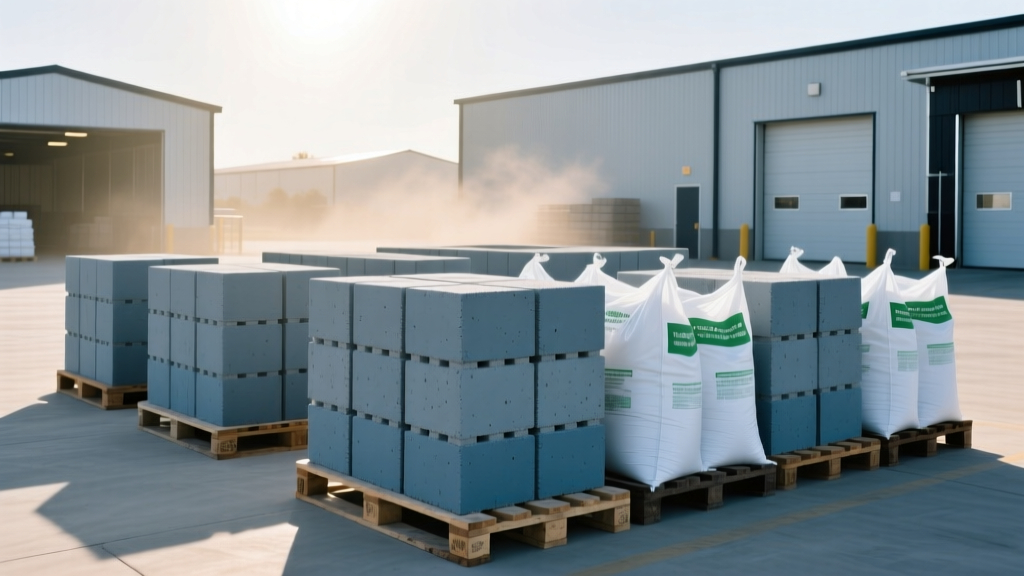
Standard concrete masonry units (CMUs) are being rapidly supplemented by carbon-injected alternatives. Utilizing carbon mineralization technology during the curing process, these blocks permanently trap CO2 while actually increasing compressive strength. Modern carbon-cured CMUs routinely exceed the ASTM C90 requirement of 2,800 psi, often testing at 3,200 psi or higher. For contractors, this means fewer rejected loads and higher structural reliability. Supply yards are now stocking these in standard 8x8x16 configurations, with a 2026 wholesale premium of roughly $0.85 to $1.10 per block over traditional gray CMU.
2. High-Performance Polymer-Modified Mortars
Traditional Type S and Type N mortars (governed by ASTM C270) are still present, but polymer-modified variants now occupy prime shelf space. These pre-blended mortars include redispersible polymer powders that drastically improve flexural bond strength and water retention. In freeze-thaw climates, this translates to a 60% reduction in efflorescence and spalling over a 10-year lifecycle. An 80 lb bag of advanced polymer-modified mortar currently retails between $18.50 and $24.00 at regional suppliers, compared to $9.00 for standard Portland-lime mixes.
3. Ultra-Lightweight Engineered Stone Veneers
Natural stone veneer is heavy, requiring extensive structural backing and increasing freight costs. The 2026 supply yard solution is ultra-lightweight engineered veneer, manufactured under ASTM C1670 standards. These panels weigh between 8.5 and 11 lbs per square foot—less than a third of the weight of natural limestone or fieldstone. Crucially, modern manufacturing uses 3D-printed molds derived from actual quarried stone, eliminating the repetitive visual patterns that plagued early engineered veneers.
4. Thermal-Break Masonry Ties and Anchors
With continuous insulation (ci) mandates now strictly enforced in most commercial building envelopes, traditional steel masonry ties are creating unacceptable thermal bridges. Suppliers are heavily stocking basalt fiber and composite thermal ties. These ties possess a thermal conductivity of roughly 0.04 W/m·K (compared to 50 W/m·K for stainless steel), effectively eliminating condensation risks within the wall cavity while maintaining the necessary tensile strength to anchor heavy wythes of brick.
Traditional vs. Next-Gen Materials: A 2026 Comparison
Understanding the exact performance deltas between legacy materials and modern inventory is critical for accurate project estimating and value engineering.
| Material Category | Legacy Standard (Pre-2024) | 2026 Next-Gen Supplier Stock | Primary Contractor Benefit |
|---|---|---|---|
| CMU Blocks | Standard Gray (2,800 psi) | Carbon-Cured (3,200+ psi) | Lower embodied carbon, higher yield |
| Mortar Mix | Type S Portland-Lime | Polymer-Modified Pre-Blend | Eliminates on-site admixtures, reduces callbacks |
| Wall Ties | Corrugated Stainless Steel | Basalt Fiber Composite | Zero thermal bridging, code-compliant ci |
| Stone Veneer | Natural Quarry Cut (35+ lbs/sq ft) | Engineered Ultra-Light (9 lbs/sq ft) | No structural steel reinforcement required |
Supply Chain & Logistics: The Modern Distributor Approach
The logistics of moving heavy, brittle materials have been optimized through digital integration. According to industry analyses tracked by Masonry Magazine, top-tier distributors have implemented several key logistical upgrades to protect contractor timelines:
- RFID Pallet Tracking: Every pallet of CMU and veneer is now tagged with passive RFID, allowing contractors to track their exact material location from the manufacturer to the job site via mobile apps.
- Micro-Fulfillment Yards: Instead of relying on a single massive distribution center, suppliers are utilizing 15,000 sq ft micro-yards located within 20 miles of major metro construction zones, cutting last-mile delivery times by 40%.
- Automated Boom Trucks: Delivery fleets are increasingly equipped with remote-controlled articulating boom cranes, allowing a single driver to place pallets directly onto scaffolding or second-floor decks without requiring a site forklift.
"The contractors who are winning bids in 2026 aren't just buying cheaper block; they are partnering with suppliers who provide the Environmental Product Declarations (EPDs) and structural testing data required by modern architectural firms." — Director of Procurement, Regional Masonry Alliance
Cost Implications and ROI for Contractors
While next-generation materials carry a higher upfront unit cost, the total installed cost often favors the modern materials due to labor savings. For example, laying ultra-lightweight engineered veneer allows a two-person crew to install up to 120 square feet per day, compared to just 60 square feet with natural stone. At an average mason labor rate of $65 per hour, the labor savings on a 2,000 sq ft commercial facade easily exceeds $8,500, completely absorbing the $3.50 per square foot material premium. The National Concrete Masonry Association (NCMA) frequently publishes case studies demonstrating how optimized masonry assemblies reduce overall project schedules by 12% to 18%.
Sourcing Strategy: How to Leverage Your Local Supplier
To maximize the value of your relationship with a modern distributor, follow this precise procurement workflow for your next project:
- Audit Assembly Requirements Early: Before requesting quotes, cross-reference the project's continuous insulation (ci) requirements with the supplier's thermal tie catalog to ensure the specific cavity width is supported.
- Request EPDs and HPDs: For commercial projects targeting LEED v5 or WELL certification, require your supplier to provide Environmental Product Declarations for all CMU and mortar. Top distributors have these documents pre-packaged in digital folders.
- Negotiate Volumetric Mortar Silos: For projects exceeding 10,000 square feet of masonry, bypass 80 lb bags entirely. Request a 3,000 lb returnable steel silo of polymer-modified mortar delivered to the site. This eliminates packaging waste, reduces mixing time by 70%, and guarantees consistent water-to-cement ratios.
- Lock in Weather-Adjusted Admixtures: If pouring or laying in extreme temperatures, ensure your supplier includes the exact ASTM C1384-compliant accelerators or retarders matched to the specific pre-blended mortar SKU, rather than relying on generic field-added chemicals.
Frequently Asked Questions
What is the standard lead time for carbon-cured CMUs in 2026?
Unlike traditional gray block which is often stocked in massive quantities, carbon-cured units are frequently produced in targeted runs. Expect a 14 to 21-day lead time from the point of order to the local supply yard. Always secure your production slot during the design development phase.
Do polymer-modified mortars require special cleaning acids?
Yes. Because the polymer additives create a denser, less porous matrix, standard muriatic acid solutions are often ineffective and can stain the masonry. Suppliers recommend specialized, non-acidic masonry cleaners formulated specifically for polymer-modified joints to remove efflorescence and mortar smears.
Can basalt fiber wall ties be cut on-site?
Basalt fiber ties should not be cut with standard abrasive masonry saws, as this frays the composite fibers and compromises the structural anchor point. They must be ordered in exact lengths corresponding to your cavity width, or cut using specialized shears provided by the manufacturer.
Written by
Marcus ChenMarcus Chen is a licensed structural engineer (PE) and building materials analyst with over 12 years of experience across residential, commercial, and industrial construction. He holds a Master of Science in Civil Engineering from UC Berkeley and spent six years at Thornton Tomasetti before transitioning to independent consulting and technical writing. Marcus specializes in material selection for seismic-prone regions, concrete reinforcement strategies, and lifecycle cost analysis. His work has been cited by the American Concrete Institute (ACI) and the Structural Engineers Association of California (SEAOC). When he is not on a job site or at his desk, you will find him hiking the Sierra Nevada or restoring a 1920s craftsman bungalow in Oakland, CA.
More from Marcus Chen
View all
Construction Cost
How Much Did the Eiffel Tower Cost to Build?
How much did the Eiffel Tower cost to build in 1889? We adjust for inflation and compare its budget to modern skyscraper construction.
Aug 4, 2026

Fire Resistance
What Is a Fire Resistant Material? Testing & Certification Guide
Discover what is a fire resistant material through ASTM and UL testing. Learn how fire ratings, certifications, and assemblies work in construction.
Aug 4, 2026

Construction Cost
How Much Did the Burj Khalifa Cost to Build?
How much did the Burj Khalifa cost to build? We break down the $1.5B project and extract 5 money-saving strategies for your next build.
Jul 30, 2026