Parthenon Building Material Analysis: Pentelic Marble & Stone
An expert overview of the Parthenon building material, analyzing Pentelic marble properties, ancient iron clamps, and modern titanium restoration.

The Core Parthenon Building Material: Pentelic Marble
When evaluating the structural longevity of classical antiquity, the primary Parthenon building material—Pentelic marble—stands as a masterclass in geological selection. Quarried from Mount Pentelicus, approximately 16 kilometers northeast of the Acropolis, this specific stone was chosen not merely for its brilliant white appearance, but for its unique mineralogical profile and workability.
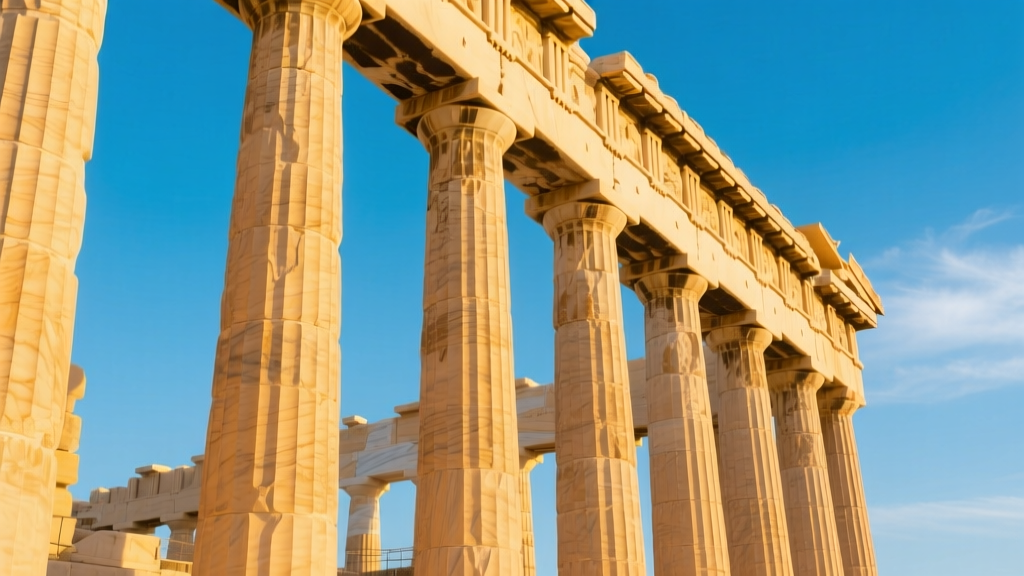
Pentelic marble is a metamorphic rock composed primarily of calcite (calcium carbonate), but its defining characteristic is the presence of trace iron oxides, specifically limonite and hematite. Upon exposure to atmospheric oxygen and sunlight over centuries, these iron impurities oxidize, producing the distinct, warm golden patina that defines the Parthenon today. From a structural engineering perspective, the stone offers a compressive strength ranging between 100 and 120 MPa, with a density of approximately 2,700 kg/m³. This high density allowed ancient stonemasons to carve the precise 20 flutes of the Doric columns without the stone micro-fracturing under the chisel.
Material Data Highlight: Pentelic Marble
- Geological Classification: Calcitic marble with dolomitic traces
- Compressive Strength: 100 - 120 MPa
- Porosity: 0.4% - 0.8% (highly resistant to water ingress)
- Thermal Expansion Coefficient: ~6.5 x 10⁻⁶ /°C
- Primary Quarry Distance: 16 km from the Acropolis site
Secondary Structural Materials: Limestone and Timber
While Pentelic marble represents the visible splendor of the structure, an accurate material overview must account for the hidden load-bearing and roofing components. The foundational crepidoma (the stepped platform upon which the columns rest) utilizes Piraeus limestone. This porous, shell-bearing sedimentary rock was significantly cheaper and easier to extract in massive blocks, making it the pragmatic choice for the unseen substructure that distributes the immense 20,000-ton dead load of the temple into the bedrock.
For the roof trusses and ceiling coffers, the architects Iktinos and Kallikrates utilized timber, primarily Lebanese cedar and cypress. These woods were selected for their high strength-to-weight ratios and natural resistance to rot and insect degradation due to their high resin content. Unfortunately, the organic nature of the timber meant it was lost to fires and subsequent historical alterations, leaving only the marble and limestone shell intact.
Ancient Engineering: The Iron Clamp and Lead Pour System
The most critical, yet entirely invisible, Parthenon building material system is the dry-joint masonry connector network. The Greeks did not use mortar to bind the massive marble blocks. Instead, they relied on a sophisticated system of iron clamps and dowels encased in molten lead.
Masons carved precise I-shaped or T-shaped recesses into the adjacent marble blocks. Wrought iron clamps were inserted into these channels, and molten lead (melting point 327°C) was poured into the cavity to seal the metal entirely. This technique provided three distinct engineering advantages:
- Corrosion Prevention: The lead casing created an anaerobic environment, preventing the iron from oxidizing, rusting, and expanding—which would otherwise shatter the surrounding marble.
- Seismic Flexibility: Lead is highly malleable. During seismic events, the lead acted as a shock absorber, allowing the marble blocks to shift slightly and dissipate kinetic energy without fracturing the rigid stone.
- Sacrificial Anode: In the event that moisture breached the joint, the lead would act as a sacrificial anode, corroding preferentially to protect the structural iron.
"The use of lead-encased iron clamps in classical Greek architecture represents an early understanding of seismic base isolation and galvanic corrosion, predating modern structural dampening concepts by over two millennia."
Comparative Matrix: Ancient Materials vs. Modern Equivalents
Understanding how the original Parthenon building materials map to contemporary construction supplies provides valuable context for modern architects studying classical durability.
| Ancient Material | Primary Application | Modern 2026 Equivalent | Performance Comparison |
|---|---|---|---|
| Pentelic Marble | Columns, architraves, pediments | High-density Calcitic Marble / UHPC | Modern UHPC offers higher tensile strength but lacks the natural thermal mass and aesthetic weathering of Pentelic stone. |
| Piraeus Limestone | Hidden foundation core (crepidoma) | Mass concrete / Compacted aggregate | Modern concrete provides superior compressive load distribution and faster curing times. |
| Lead-encased Iron | Dry-joint masonry clamps | Grade 2 Titanium / Epoxy anchors | Titanium matches marble's thermal expansion perfectly and eliminates the need for lead encapsulation. |
| Cedar Timber | Roof trusses and ceiling beams | Glulam / Structural Steel | Glulam offers similar warmth with engineered predictability; steel provides non-combustible spans. |
Weathering, Pollution, and 21st-Century Conservation
While the original material selection was flawless for the 5th century BCE, the industrial era introduced unprecedented threats to the Pentelic marble. Sulfur dioxide (SO2) emissions from mid-20th-century Athens traffic reacted with atmospheric moisture to form sulfuric acid. This acid rain reacted with the calcium carbonate in the marble, converting it into gypsum (calcium sulfate). Gypsum is highly soluble and easily washed away by rain, leading to the severe loss of surface detail on the metopes and friezes.
The Shift to Titanium in Modern Restoration
During the 2026 phase of the ongoing Acropolis restoration efforts, conservators face the challenge of repairing blocks shattered by previous, flawed restoration attempts. In the late 19th and early 20th centuries, restorers used exposed iron and steel clamps. As these metals rusted, they expanded up to seven times their original volume, cracking the priceless marble from the inside out.
Today, the Acropolis Restoration Service (YSMA) exclusively uses Grade 2 Titanium (ASTM B265) for structural clamps and dowels. Titanium is selected for two highly specific material reasons:
- Thermal Compatibility: Titanium's coefficient of thermal expansion (8.6 x 10⁻⁶ /°C) is remarkably close to that of Pentelic marble. This ensures that during the extreme temperature fluctuations of Athenian summers, the metal and stone expand and contract at nearly identical rates, preventing internal shear stress.
- Passivation Layer: Titanium instantly forms a stable, inert oxide layer when exposed to air, rendering it completely immune to atmospheric corrosion without the need for toxic lead encapsulation.
For a deeper look into the architectural significance and historical context of the site, the UNESCO World Heritage Centre provides extensive documentation on the structural evolution of the Acropolis. Furthermore, the Acropolis Museum houses the original surviving marble fragments, allowing material scientists and architects to study the tooling marks and crystalline structure of the original Pentelic blocks up close.
Frequently Asked Questions
Why didn't the builders use mortar between the marble blocks?
Mortar creates a rigid, brittle joint that is highly susceptible to shear failure during earthquakes. By using dry-joint masonry with lead-encased iron clamps, the Parthenon was designed as a flexible, interlocking puzzle. This allows the structure to absorb and dissipate seismic waves, which is the primary reason it has survived numerous severe earthquakes over 2,500 years.
Is Pentelic marble still quarried today for modern construction?
Yes, Mount Pentelicus is still actively quarried, though modern extraction is heavily regulated to preserve the mountain's geological and historical integrity. Contemporary architects can source authentic Pentelic marble for high-end cladding and restoration projects, though it commands a premium price compared to imported Carrara or Calacatta marbles due to its specific mineral composition and limited extraction quotas.
How heavy is a single Parthenon column drum?
The column drums vary in weight depending on their position in the tapering shaft, but an average lower drum measures roughly 1.9 meters in diameter and 1.5 meters in height. Given the 2,700 kg/m³ density of Pentelic marble, a single drum weighs approximately 11 to 12 metric tons. The heaviest architrave blocks lifted to the top of the columns exceeded 20 metric tons, requiring massive timber cranes and complex pulley systems.
Written by
Priya KapoorPriya Kapoor is a real estate market analyst and construction economics researcher with expertise in housing affordability, development feasibility, and infrastructure investment. She holds a Master of Regional Planning from Cornell University and previously worked as a senior analyst at CBRE's Investment Properties group, where she modeled returns for $4B in mixed-use development pipelines. Priya now runs an independent research practice advising developers, municipalities, and REITs on construction cost forecasting and market timing. She publishes the quarterly "BuildMat Market Pulse" report tracking material price indices across 12 commodity categories. Based in Austin, TX, Priya serves on the board of Habitat for Humanity Austin and is a marathon runner.
More from Priya Kapoor
View all
Construction Cost
Cost to Build a 1600 Sq Ft Home in 2026: Full Breakdown
Accurate 2026 cost to build a 1600 sq ft home—material, labor, and regional pricing breakdowns included. Plan your budget with real-time estimates.
Aug 11, 2026

Wood & Lumber
Name the Types of Wood for Pressure Treatment and Preservation
Learn how to name the types of wood best suited for pressure treatment. Compare species treatability, chemical retention levels, and 2026 preservation costs.
Aug 4, 2026

Stone & Masonry
Stone Veneer Suppliers Lindenhurst: 2026 Cost Analysis
Analyze 2026 stone veneer costs in Lindenhurst, NY. Compare local supplier pricing, delivery fees, and Suffolk County installation labor rates.
Aug 4, 2026