Same Day Delivery Building Materials: 2026 Cost Analysis & Hidden Fees
Analyze the true cost of same day delivery building materials in 2026. Uncover hidden fees, per-mile surcharges, and cost-saving strategies for contractors.

The Premium of Speed: Understanding Base Delivery Rates
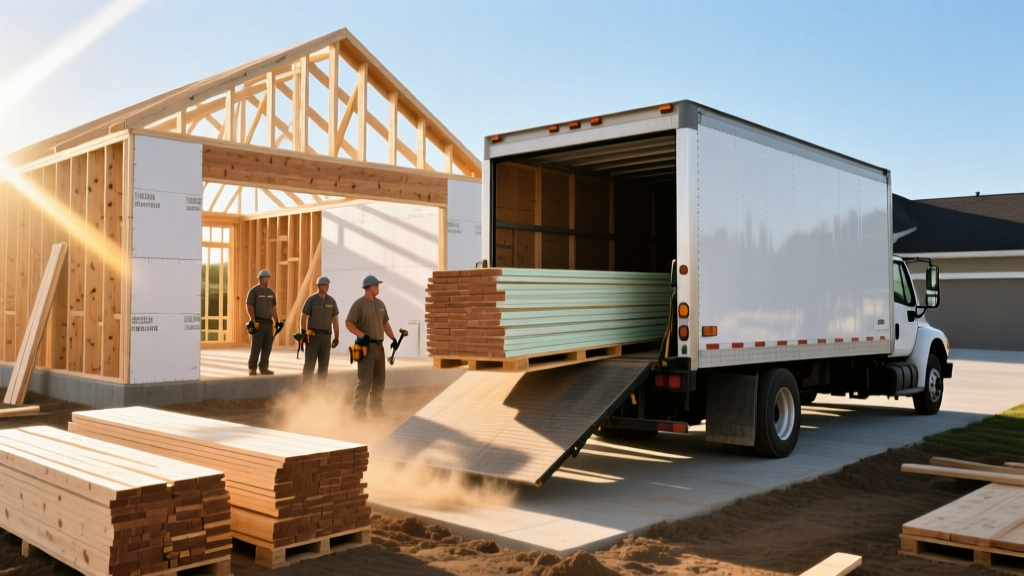
When a critical path item is missing from the job site, the immediate reflex for most project managers is to expedite freight. However, ordering same day delivery building materials is rarely as simple as paying a flat premium. The logistics of moving heavy, oversized, or fragile construction supplies on short notice involve a complex web of base rates, equipment surcharges, and mileage fees. As of 2026, with localized freight capacity remaining tight in many metropolitan markets, understanding the exact anatomy of an expedited delivery invoice is essential for protecting project margins.
Base rates for same-day service are dictated primarily by the equipment required to transport and unload the materials. A standard box truck delivering finish hardware or plumbing rough-ins operates on a completely different pricing tier than a flatbed hauling dimensional lumber or a boom truck dropping engineered trusses.
2026 Average Base Rates for Same-Day Expedited Freight
- Box Truck (Under 24ft): $149 - $275 base fee (typically includes first 10-15 miles)
- Standard Flatbed (Lumber/Plywood): $350 - $550 base fee
- Boom/Crane Truck (Masonry/Trusses): $650 - $950 base fee
- Hot Shot Truck (Pickup + Gooseneck): $225 - $400 base fee (highly dependent on regional owner-operator availability)
Deconstructing the Invoice: Where the Hidden Fees Lurk
The base rate is merely the entry fee. According to Construction Dive's ongoing supply chain reporting, logistics bottlenecks and last-mile delivery complications are primary drivers of budget overruns in residential and commercial builds. When you request same-day service, suppliers and third-party logistics (3PL) providers pass on the operational friction via accessorial fees.
| Accessorial Fee | Average Cost (2026) | Trigger Condition |
|---|---|---|
| Liftgate Service | $85 - $145 | Required if the job site lacks a forklift or loading dock to unload palletized goods (e.g., drywall, mortar). |
| Inside Delivery | $150 - $350+ | Driver is required to move materials past the curbside/property line into a specific room or garage. |
| Demurrage / Waiting Time | $85 - $125 / hour | Charged when the driver is kept on-site waiting to unload beyond the standard 15-minute grace period. |
| Out-of-Route / Mileage Surcharge | $3.50 - $6.00 / mile | Applied for every mile beyond the supplier's standard localized delivery radius (usually 15-20 miles). |
| Residential / Job Site Drop Fee | $75 - $150 | Applied to compensate for the difficulty of navigating heavy trucks through unfinished residential streets. |
Contractor Warning: Never assume 'curbside delivery' means the driver will pull onto your unpaved job site. Many flatbed operators will refuse to leave the paved public right-of-way without a signed liability waiver or an additional 'off-road drop' fee, which can add $200 to the invoice.
The Break-Even Analysis: Downtime vs. Delivery Premium
To justify the cost of same day delivery building materials, you must weigh the freight premium against the cost of crew downtime. This is where many estimators fail, as they underestimate the fully burdened labor rate of their crews.
Calculating the True Cost of Standing Around
Assume you have a four-person framing crew waiting on a missing beam or specialized hardware. The average hourly wage might be $32/hour, but the fully burdened rate (including workers' comp, liability insurance, payroll taxes, and equipment overhead) is typically 1.4x to 1.6x the base wage. Let us use a conservative burdened rate of $48/hour per worker.
- Crew Size: 4 workers
- Burdened Rate: $48/hour each
- Total Hourly Burn: $192/hour
If a missing material delays the crew for just three hours while you wait for a standard next-day or scheduled delivery to be expedited, you have lost $576 in unproductive labor. In this scenario, paying a $425 same-day flatbed delivery fee yields a net positive ROI of $151, not including the prevention of cascading schedule delays that could trigger liquidated damages on commercial contracts. The National Association of Home Builders (NAHB) consistently highlights that material delays are a top driver of schedule slippage, making expedited freight a necessary insurance policy for critical path items.
Material-Specific Expedited Freight Matrix
Not all materials are created equal when it comes to same-day logistics. The physical properties of the materials dictate the equipment needed, which in turn dictates the availability and cost of expedited service.
Lumber and Framing Packages
Dimensional lumber, LVLs, and I-joists are the easiest materials to source for same-day delivery. Most local lumber yards and big-box pro desks maintain a fleet of flatbeds and Moffett forklifts. Cost Gotcha: If you order treated lumber for same-day delivery, ensure it is kiln-dried after treatment (KDAT). Standard wet treated lumber is incredibly heavy and can exceed the weight limits of a standard box truck, forcing the supplier to upgrade you to a flatbed at a 40% premium.
Drywall and Masonry (Heavy Freight)
Expedited delivery for drywall and concrete masonry units (CMUs) is notoriously expensive. These materials require heavy-duty flatbeds with boom cranes or specialized forklifts. Cost Gotcha: If your site does not have a telehandler or forklift to unload a boom truck, the driver will use the truck-mounted Moffett. However, Moffetts cannot easily navigate muddy or uneven terrain. If the driver has to manually break down pallets and use a pallet jack over rough ground, expect maximum demurrage fees to apply.
Finish Materials, Windows, and HVAC
While finish materials like trim, doors, and HVAC units can easily fit in a box truck for a low base rate, they carry a high risk of damage during rushed, same-day loading. Cost Gotcha: Expedited warehouse pickers are under immense time pressure. Windows and pre-hung doors ordered for same-day delivery suffer a 12-15% higher damage rate in transit compared to scheduled, carefully staged freight. Always mandate 'air-ride suspension' box trucks for same-day window deliveries, which adds roughly $75 to the fee but prevents thousands in replacement costs.
3 Strategies to Mitigate Expedited Freight Costs
While same-day delivery is sometimes unavoidable, you can structure your procurement strategy to minimize the financial impact.
- Negotiate Pro-Tier Logistics SLAs: Do not rely on walk-in rates. Establish a Service Level Agreement (SLA) with your primary suppliers. Many regional suppliers will cap same-day mileage surcharges or waive liftgate fees for accounts that maintain a minimum monthly volume (typically $25,000+). According to market data analyzed by FMI Corporation, contractors who formalize vendor logistics agreements reduce overall supply chain costs by up to 8% annually.
- Implement 'Will-Call' Staging with Runner Trucks: Instead of paying a supplier $400 for a same-day flatbed delivery, have the supplier stage the materials at their will-call dock. Dispatch your own company's half-ton pickup or small dump truck with a driver to pick up the critical path items. The internal cost of fuel and a runner's time is usually a fraction of a 3PL expedited freight invoice.
- Consolidate 'Emergency' Runs: Institute a strict site policy where emergency material requests are batched. Instead of calling in three separate same-day box truck deliveries for plumbing, electrical, and hardware (costing $200 each), consolidate the requests into a single multi-stop box truck route, reducing the per-drop cost significantly.
Frequently Asked Questions
Can I get same-day delivery for custom-mixed concrete or mortar?
Generally, no. Ready-mix concrete operates on strict scheduled batching routes due to the chemical curing clock. While you can sometimes pay a premium for a 'short-load' emergency concrete truck, it is rarely same-day unless you are already on a batching plant's active daily route. Mortar and stucco in dry-bulk bags, however, can easily be delivered same-day via flatbed or box truck.
Do big-box stores charge the same as local lumber yards for same-day delivery?
Big-box stores (like Home Depot Pro or Lowe's) often utilize third-party logistics networks (like Roadie or localized freight partners) for same-day box truck deliveries, which can result in highly variable, surge-priced rates depending on the time of day. Local, independent lumber yards typically use their own W-2 employees and fleet, offering more predictable, flat-rate same-day pricing for established contractor accounts.
What happens if my same-day delivery arrives damaged?
Because same-day deliveries bypass standard quality-control staging, damage is more common. You must inspect the materials before the driver leaves the site. If you sign the proof of delivery (POD) without noting 'Subject to inspection for concealed damage' or taking photos of compromised packaging, the supplier's claims department will likely deny the replacement request, forcing you to order and pay for a second expedited delivery.
Written by
Sarah WhitfieldSarah Whitfield is a chartered quantity surveyor (MRICS) and construction cost analyst with 15 years of experience in material pricing, procurement strategy, and project budgeting. She earned her degree in Construction Management from the University of Reading (UK) and has worked on projects ranging from $2M custom homes to $180M mixed-use developments across North America and Europe. Sarah currently leads cost estimating for BuildMat Insight, maintaining a proprietary database of 4,000+ material price points updated quarterly. She is a frequent contributor to RSMeans cost data panels and has presented at the International Cost Engineering Council (ICEC) congress. Based in Denver, CO, Sarah is an avid trail runner and volunteer mentor for Women in Construction.
More from Sarah Whitfield
View all
Wood & Lumber
What Are the Different Types of Wood? A Builder's Guide
Compare structural softwoods, finish hardwoods, and engineered lumber. Analyze Janka ratings, MOE values, and 2026 pricing for construction.
Aug 4, 2026

Walls & Panels
Steel Framing vs Wood Framing: Corrosion and Moisture Defense
Compare steel framing vs wood framing for moisture resistance. Learn about galvanized coatings, condensation risks, and corrosion protection strategies.
Jul 21, 2026

Stone & Masonry
How to Cut Stone Veneer: Wet Saw vs Grinder Comparison
Compare the best tools for cutting stone veneer. We review wet saws, angle grinders, and chop saws to help you achieve clean, chip-free cuts.
Jul 21, 2026