Tarkov Building Materials: Real-World Survival Shelter Equivalents
Discover real-world construction equivalents to Tarkov building materials. Learn how to build survival shelters using concrete, steel, and scavenged wood.

The Hideout Concept: Translating Game Mechanics to Real-World Survival
While the hideout upgrade mechanics in the tactical shooter Escape from Tarkov are designed for video game progression, analyzing Tarkov building materials through a real-world construction lens reveals critical insights into bunker building, shelter fortification, and off-grid utility management. For preppers, off-grid builders, and survivalists, the game's resource requirements inadvertently map to actual structural engineering and survival architecture. Transitioning from digital scavenging to physical construction requires understanding building codes, material science, and modern 2026 supply chain realities. This guide translates in-game hideout materials into code-compliant, real-world equivalents for constructing resilient survival shelters.
Core Structural Materials: From Scavenged Loot to Code-Compliant Lumber and Steel
Wooden Planks and Corrugated Metal (The Early Game)
In the early stages of hideout development, the game requires basic wooden planks and corrugated metal panels. In real-world survival construction, relying on literal scavenged planks is a structural liability. Instead, modern off-grid shelters utilize specific grades of engineered wood and coated steel to resist moisture, rot, and wind uplift.
For framing and sheathing, standard rough-sawn lumber is insufficient for long-term subterranean or high-moisture environments. Builders should specify Southern Yellow Pine (SYP) pressure-treated lumber, specifically rated UC4A (for ground contact) or UC4B (for freshwater immersion or heavy ground contact). For sheathing, 5/8-inch CDX plywood remains the industry standard, offering structural rigidity and moisture resistance during the construction phase. In 2026, CDX plywood sheets average $55 to $75 depending on regional supply.
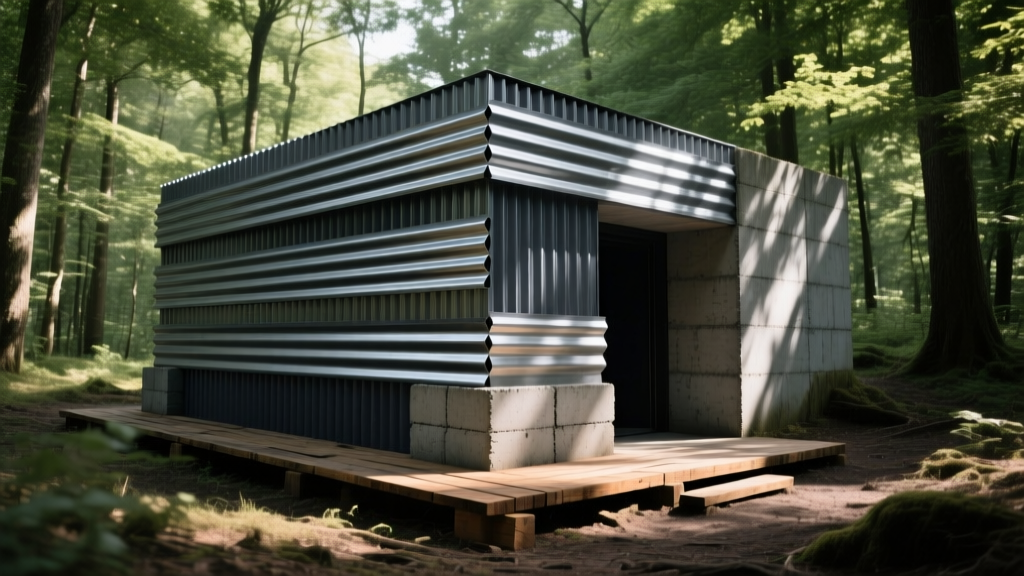
For roofing and exterior cladding, the real-world equivalent to the game's generic corrugated metal is 29-gauge Galvalume (AZ50 coating) R-Panel. Galvalume combines aluminum and zinc to provide superior corrosion resistance compared to standard galvanized steel. When installing these panels in high-wind or off-grid scenarios, fasteners are critical. Never use nails; instead, use #10 x 1-inch hex-head steel screws with neoprene washers, driven into the flat of the panel to prevent water intrusion and withstand wind uplift forces up to 150 mph.
Reinforced Concrete and Rebar (The Late Game)
Upgrading a hideout to its highest tiers demands reinforced concrete and metal pipes. In real-world bunker and safe room construction, concrete is the undisputed king of ballistic resistance and structural longevity. According to FEMA's Safe Room guidelines, poured concrete walls provide the highest level of protection against both extreme weather events and ballistic threats.
A survival shelter requires a minimum 4,000 PSI concrete mix with a low water-to-cement ratio (0.45 or lower) to ensure high compressive strength and low permeability. For freeze-thaw durability, the mix must include 5% to 7% entrained air. Reinforcement is non-negotiable: a grid of #4 (1/2-inch) or #5 (5/8-inch) Grade 60 rebar spaced at 12 inches on center (both horizontally and vertically) provides the tensile strength necessary to prevent catastrophic cracking under earth-load or blast pressures. The Portland Cement Association's durability standards emphasize that proper curing—maintaining moisture and temperature for at least 7 days post-pour—is what ultimately dictates the concrete's lifespan and structural integrity.
Material Translation Matrix: Game Items vs. Real-World Specs
The following matrix maps common in-game hideout requirements to their professional construction equivalents, including estimated 2026 material costs and primary applications.
| Game Item | Real-World Equivalent | 2026 Est. Cost | Primary Application |
|---|---|---|---|
| Wooden Plank | UC4A Pressure-Treated SYP / CDX Plywood | $8.50 / linear ft (2x6) | Subfloor framing, earth-sheltered retaining walls |
| Corrugated Metal | 29-Ga Galvalume AZ50 R-Panel | $3.25 - $4.00 / sq ft | Roofing, exterior cladding, blast-deflection |
| Reinforced Concrete | 4,000 PSI Mix with #4 Rebar Grid | $160 - $190 / cubic yard | Monolithic foundation, ballistic wall cores |
| Metal Fuel Tank | UL-142 / UL-2085 Double-Wall Steel Tank | $2,800 - $4,500 (500 gal) | Long-term diesel/kerosene storage, fire-resistant |
| Water Filter | Reverse Osmosis + UV Sterilization System | $800 - $1,500 (System) | Potable water purification, pathogen removal |
Off-Grid Utilities: Water, Power, and Air Filtration Systems
The most complex hideout modules involve water collection, air filtering, and power generation. Translating these to real-world off-grid survival requires moving beyond consumer-grade camping gear into resilient, redundant utility systems.
Water Collection and Purification
Relying solely on groundwater is risky due to contamination. A robust survival shelter integrates a rainwater catchment system utilizing a food-grade polyethylene cistern (minimum 2,500 gallons) buried below the frost line. The water must pass through a first-flush diverter to eliminate initial roof debris, followed by a multi-stage filtration setup: a 5-micron sediment filter, a carbon block filter for VOCs, and finally a UV-C sterilization chamber to neutralize biological pathogens. The CDC emergency water protocols mandate that any water sourced from unverified external environments must be treated with both physical filtration and chemical/UV disinfection before consumption.
Air Filtration and Subterranean Ventilation
Standard HVAC systems are useless in a sealed bunker environment. Real-world equivalents to the game's air filtering unit require an NBC (Nuclear, Biological, Chemical) air filtration system. These units utilize a pre-filter for large particulates, a MERV-17 or true HEPA filter for biological agents, and a massive activated carbon bed to adsorb chemical gases and radioactive iodine. Furthermore, the shelter must be equipped with manual blast valves to seal the intake and exhaust pipes in the event of an overpressure wave.
When sealing a shelter for extended periods, carbon dioxide exhaled by occupants and naturally occurring radon gas from surrounding soil will reach lethal concentrations. An NBC filtration system only cleans incoming air; it does not scrub internal gases. You must install an active, powered exhaust system with a heat recovery ventilator (HRV) to continuously exchange stale interior air with filtered exterior air while maintaining thermal efficiency.
Strategic Sourcing: The Real-World Scav Run
Acquiring these materials at retail prices will quickly deplete a construction budget. Professional survival builders utilize alternative supply chains to stockpile high-value materials. Government surplus auctions (via GovDeals or GSA Auctions) are prime sources for military-grade fuel bladders, heavy-duty steel shelving, and industrial generators. For lumber and steel, establishing relationships with local sawmills and metal fabricators allows you to purchase 'cull' or overstock materials at a 30% to 40% discount. Finally, monitoring commercial demolition liquidations can yield heavy-gauge steel beams, industrial piping, and commercial-grade electrical panels that would otherwise cost thousands of dollars new.
Building a real-world hideout requires moving past the abstraction of video game inventory slots and embracing the physics, chemistry, and economics of modern construction. By specifying the correct pressure treatments, concrete PSI, and filtration standards, you transform a theoretical survival concept into a structurally sound, life-sustaining asset.
Written by
James ThorntonJames Thornton is a construction industry veteran with 25 years of hands-on experience in wood framing, lumber grading, and residential building codes. He started as a framing carpenter in rural Oregon, earned his ICC Residential Building Inspector certification, and eventually became a senior plan reviewer for the City of Portland Bureau of Development Services. James holds a B.S. in Wood Science & Technology from Oregon State University and is a certified lumber grader through the West Coast Lumber Inspection Bureau (WCLIB). He has inspected over 3,000 residential construction sites and authored the city's internal guide on advanced framing techniques (2x6 at 24" O.C.). James lives in Bend, OR, where he builds custom timber-frame cabins and competes in lumberjack sports.
More from James Thornton
View all
Insulation
Best Home Insulation Materials: Complete 2026 Guide
Compare top home insulation materials for 2026. Find R-values, installed costs per square foot, and best uses for fiberglass, spray foam, and mineral wool.
Aug 4, 2026

Sustainable Building
Certify Your Green Building Material for LEED and WELL
Step-by-step guide to certifying a green building material for LEED v5 and WELL v2. Master EPDs, HPDs, and VOC limits for 2026 project specifications.
Aug 4, 2026

Stone & Masonry
Veneer Stacked Stone Panels: Interior Design & Style Showcase
Discover how veneer stacked stone panels transform interiors. Explore modern design profiles, material pairings, and technical installation specs.
Aug 4, 2026