Sourcing and Spec-Checking: How to Get Donated Building Materials
Learn how to get donated building materials and verify their technical specifications, ASTM compliance, and structural integrity for code-approved projects.

The Technical Reality of Salvaged and Surplus Procurement
Understanding how to get donated building materials is only the first phase of the procurement cycle; the second, far more critical phase is rigorous technical verification. Local Authorities Having Jurisdiction (AHJs) and building inspectors do not grant code variances based on a material's origin or cost. Whether sourced from a Habitat for Humanity ReStore, a corporate commercial overrun, or a controlled demolition site, every donated material must meet the exact same ASTM, ANSI, and International Building Code (IBC) specifications as virgin stock. Failing to verify grade stamps, moisture content, and structural load ratings before installation will result in failed inspections, costly tear-outs, and compromised building envelopes.
This guide details the technical inspection frameworks required to validate donated structural lumber, masonry, gypsum, and hardware, ensuring your surplus materials are legally and structurally viable for permitted construction.
Sourcing Channels for Code-Compliant Surplus
Not all donation channels yield materials suitable for structural or code-regulated applications. Procurement must be targeted based on the technical requirements of your project phase.
- Habitat ReStores and Non-Profit Yards: Ideal for finish materials, doors, and non-structural blocking. Structural lumber here is often ungraded or has severed grade stamps, limiting its use to temporary bracing or non-load-bearing partitions.
- Commercial Overruns and Manufacturer Surplus: The highest probability of obtaining code-compliant, fully stamped materials. These are typically virgin materials diverted from landfills due to order cancellations or packaging damage. Always verify that the original manufacturer's warranty and specification sheets are included in the pallet.
- Deconstruction and Architectural Salvage: Yields high-quality old-growth timber and masonry, but requires intensive re-grading and testing. According to the USDA Forest Products Laboratory Wood Handbook, reclaimed structural timber must be visually re-graded by a certified inspector or tested via non-destructive stress-wave timing to verify its modulus of elasticity (MOE) before reuse in load-bearing assemblies.
Structural Lumber: Grading, Moisture, and IBC Compliance
Under IBC Section 2303.1.1, all structural lumber must bear a grade stamp indicating the species, grade, moisture content, and the accredited grading agency (e.g., WWPA, SPIB, NLGA). When evaluating donated dimensional lumber, the presence and legibility of this stamp are non-negotiable for framing.
Moisture Content (MC) Specifications
Donated lumber stored in unconditioned donation yards is highly susceptible to ambient humidity fluctuations. Interior framing requires lumber marked S-DRY (Surface Dry, maximum 19% MC) or MC-15 (maximum 15% MC). Using S-GRN (Surface Green, >19% MC) lumber for interior partitions guarantees severe warping, fastener pop, and drywall cracking as the wood equilibrates to the interior environment.
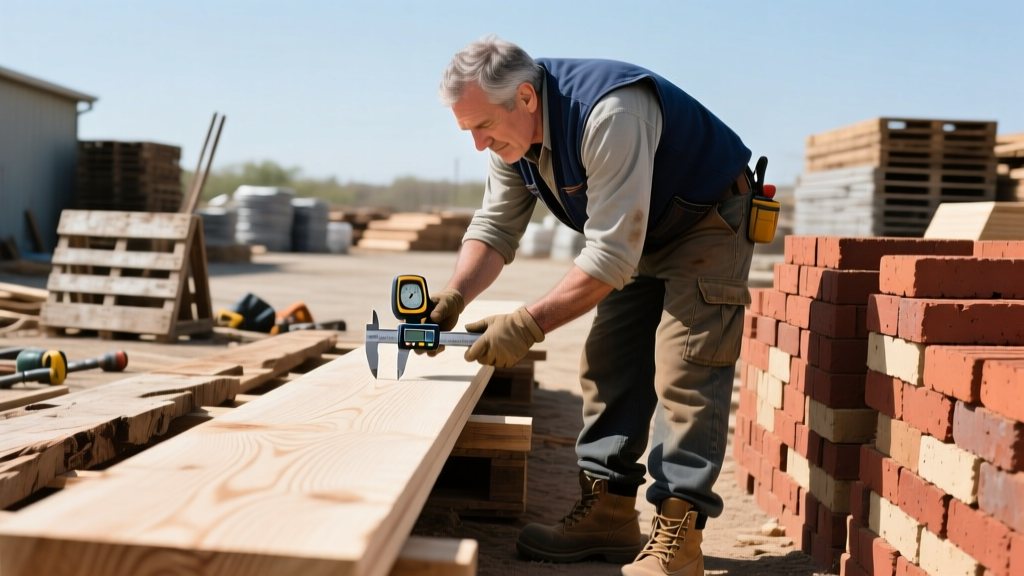
Field Protocol: Use a pinless electromagnetic moisture meter to scan donated 2x4s and 2x6s. Reject any batch averaging above 15% MC for interior applications. For exterior structural applications, verify that the wood is pressure-treated with an AWPA U1 compliant preservative (e.g., Alkaline Copper Quaternary (ACQ) or Copper Azole (CA-C)) and check for end-tag retention levels (minimum 0.25 pcf for above-ground, 0.40 pcf for ground contact).
Engineered Wood Products (LVL, I-Joists, PSL)
Never accept donated I-joists or Laminated Veneer Lumber (LVL) that exhibit any of the following:
- Delamination: Visible separation of the OSB web from the solid sawn flanges.
- Phenol-Formaldehyde Resin Degradation: Chalky or white residue along the glue lines, indicating prolonged UV or moisture exposure.
- Severed Ends: Engineered joists cut to length lose their bearing capacity unless specifically reinforced per the manufacturer's span tables. If the original manufacturer's stamp and span chart are missing, the AHJ will reject the installation.
Masonry and Brick: Verifying ASTM C62 and C216 Standards
Reclaimed brick is highly sought after for its aesthetic patina, but its structural viability is governed by strict ASTM tolerances. The Brick Industry Association Technical Notes explicitly warn against using reclaimed brick in structural load-bearing walls without rigorous compressive strength verification.
Compressive Strength and Weathering Indices
Brick intended for structural use must meet ASTM C62 (Standard Specification for Building Brick). Face brick must meet ASTM C216. The critical metric is the Severe Weathering (SW) index. In climates subject to freeze-thaw cycles, donated brick must possess a minimum compressive strength of 3,000 psi and a maximum cold water absorption rate of 17%.
Field Test for Reclaimed Masonry: Perform an acoustic 'ring test.' Striking a compliant SW brick with a masonry hammer produces a sharp, metallic ping. A dull thud indicates internal micro-fracturing, spalling, or high porosity, rendering the unit unsuitable for exterior or structural use. Furthermore, inspect for efflorescence (white salt deposits). Heavy efflorescence indicates high soluble salt content, which will rapidly corrode modern steel wall ties and lintels when integrated into new cavity wall assemblies.
Material Inspection Matrix: Field Verification Guide
Use the following matrix to rapidly assess donated materials on-site before loading them for transport. This framework aligns with standard AHJ inspection checklists.
| Material Category | Governing Standard | Mandatory Marking / Spec | Critical Failure Mode | Field Verification Tool |
|---|---|---|---|---|
| Dimensional Framing Lumber | IBC 2303.1.1 / ASTM D245 | Grade Stamp (Species, Grade, S-DRY) | Hidden decay, severed stamps, >19% MC | Pinless Moisture Meter, Magnifying Glass |
| Gypsum Wallboard | ASTM C1396 | UL Design Number, Type X stamp (if fire-rated) | Edge crush, moisture swelling, mold (D3273) | Visual Edge Inspection, Bright Flashlight |
| Structural Brick | ASTM C62 / C216 | SW (Severe Weathering) Rating | Micro-fractures, high porosity, efflorescence | Masonry Hammer (Acoustic Test) |
| Joist Hangers / Connectors | ASTM A653 / IBC 2304.9 | G90 or ZMAX Galvanization Stamp | White rust, red rust, pitting, bent flanges | Calipers (Thickness), Visual Rust Check |
Drywall and Insulation: Moisture and R-Value Degradation
Gypsum board and fiberglass batt insulation are frequently donated, but their technical tolerances are easily compromised in warehouse storage environments.
Gypsum Board Edge Integrity
Under ASTM C1396, the tapered edges of drywall are precisely milled to accommodate joint compound and tape, creating a seamless monolithic plane. Donated drywall is often subjected to forklift damage or improper stacking. If the tapered edge is crushed, fractured, or delaminated from the gypsum core, it cannot yield a Level 4 or Level 5 finish. Inspect the binding tape on the pallet edges; if the paper facing is peeling or the edges feel soft, the board has absorbed ambient moisture and lost its structural rigidity.
Fire-Rated Assemblies: If you are sourcing donated Type X (fire-rated) drywall for a garage separation or multi-family party wall, the UL design number printed on the back of the panel must exactly match the architectural plans. An inspector will fail the assembly if the donated boards lack the specific UL or ULC fire-rating stamp, regardless of the board's physical thickness.
Fiberglass and Mineral Wool Insulation
Insulation relies entirely on trapped air pockets to achieve its stated R-value. Donated fiberglass batts that have been tightly compressed in plastic wrapping for over six months may suffer from permanent memory loss in the glass fibers, failing to expand to their required thickness (e.g., a 2x6 cavity requires 5.5 inches of expansion to achieve R-21). Furthermore, any batt showing signs of water staining or biological growth must be rejected, as wet fiberglass conducts heat rapidly, effectively dropping an R-38 ceiling batt to an R-15 equivalent while introducing mold spores into the ceiling cavity.
Fasteners and Structural Connectors: Corrosion and Load Ratings
Reusing donated structural hardware (joist hangers, hold-downs, anchor bolts) presents severe liability and code-compliance risks. Modern structural connectors, such as those manufactured by Simpson Strong-Tie or USP, are engineered with specific galvanization coatings (ASTM A153 or ASTM A653) to resist corrosion when in contact with modern, highly alkaline pressure-treated lumber (like ACQ or MCQ).
Donated connectors sourced from older demolitions were likely designed for use with CCA (chromated copper arsenate) lumber and may only feature a basic G90 zinc coating. When these older connectors are paired with modern ACQ-treated sill plates, the alkaline copper rapidly galvanically corrodes the zinc, leading to catastrophic connector failure within 5 to 10 years. Rule of thumb: Never reuse donated structural connectors unless they are still in their original, sealed manufacturer packaging with the visible ZMAX or hot-dipped galvanized (HDG) specification clearly printed on the box. Loose, unboxed hangers should be relegated to scrap.
Documentation and Chain of Custody for the AHJ
Securing the materials is only half the battle; proving their compliance to the building inspector is the final hurdle. When utilizing donated or salvaged materials in permitted construction, maintain a dedicated 'Surplus Chain of Custody' binder on-site. This binder must include:
- Photographic Evidence: High-resolution photos of the grade stamps, UL markings, and manufacturer labels taken before the materials are installed and concealed.
- Original Specification Sheets: Printed cut sheets or span tables downloaded from the manufacturer's website corresponding to the exact model numbers on the donated hardware or engineered lumber.
- Mill Certificates (if applicable): For large-scale steel or timber salvage, obtain the original mill test reports verifying the yield strength and chemical composition of the material.
By treating the procurement of donated materials with the same technical rigor as commercial supply chain management, contractors and owner-builders can safely integrate surplus stock into high-performance, code-compliant building envelopes. For broader sourcing networks and regional availability, consult the Habitat for Humanity ReStore directory to locate commercial-grade surplus yards in your jurisdiction.
Written by
Priya KapoorPriya Kapoor is a real estate market analyst and construction economics researcher with expertise in housing affordability, development feasibility, and infrastructure investment. She holds a Master of Regional Planning from Cornell University and previously worked as a senior analyst at CBRE's Investment Properties group, where she modeled returns for $4B in mixed-use development pipelines. Priya now runs an independent research practice advising developers, municipalities, and REITs on construction cost forecasting and market timing. She publishes the quarterly "BuildMat Market Pulse" report tracking material price indices across 12 commodity categories. Based in Austin, TX, Priya serves on the board of Habitat for Humanity Austin and is a marathon runner.
More from Priya Kapoor
View all
Construction Cost
Cost to Build a 1600 Sq Ft Home in 2026: Full Breakdown
Accurate 2026 cost to build a 1600 sq ft home—material, labor, and regional pricing breakdowns included. Plan your budget with real-time estimates.
Aug 11, 2026

Wood & Lumber
Name the Types of Wood for Pressure Treatment and Preservation
Learn how to name the types of wood best suited for pressure treatment. Compare species treatability, chemical retention levels, and 2026 preservation costs.
Aug 4, 2026

Stone & Masonry
Stone Veneer Suppliers Lindenhurst: 2026 Cost Analysis
Analyze 2026 stone veneer costs in Lindenhurst, NY. Compare local supplier pricing, delivery fees, and Suffolk County installation labor rates.
Aug 4, 2026