Pond Building Materials Selection Guide: Liners, Edging & Pumps
Expert selection guide for pond building materials. Compare EPDM vs RPE liners, frost-proof edging, and hydraulic plumbing for durable water features.

The Foundation: Selecting Pond Liners and Underlayment
The most critical failure point in any water feature is the containment system. Selecting the correct pond building materials for the basin requires balancing puncture resistance, UV stability, and long-term flexibility. While hardware stores often stock cheap PVC liners, professional aquatic builders rely on advanced polymers that withstand ground settlement and temperature fluctuations without becoming brittle.
Liner Material Comparison Matrix
| Material | Thickness | Puncture Resistance | UV & Ozone Stability | Expected Lifespan | Best Application |
|---|---|---|---|---|---|
| EPDM (Ethylene Propylene Diene Monomer) | 45-mil | Moderate (Requires underlayment) | Excellent | 20-30 Years | Standard residential koi and water gardens |
| EPDM | 60-mil | High | Excellent | 30+ Years | Large ponds, high-traffic edges, rocky soils |
| RPE (Reinforced Polyethylene) | 24-mil to 30-mil | Very High (Woven scrim core) | Excellent | 20-40 Years | Sloped terrain, areas with high root intrusion |
| PVC (Polyvinyl Chloride) | 20-mil to 30-mil | Low | Poor (Degrades in sunlight) | 5-10 Years | Temporary features, preformed shell underlayments |
For 90% of residential applications, 45-mil EPDM is the industry standard. It remains pliable down to -40°F, allowing it to conform to complex shelving and biological filter bays without stressing the seams. However, if your excavation site contains shale, decomposed granite, or aggressive tree roots (like those from willow or poplar species), upgrade to RPE. RPE integrates a woven polyester scrim that provides superior tensile strength, allowing it to bridge minor subgrade voids without tearing.
The Non-Negotiable Underlayment Layer
Never install a flexible liner directly against compacted soil. The hydrostatic pressure of thousands of gallons of water will force the liner into microscopic subgrade imperfections, eventually causing pinhole leaks. You must use a non-woven geotextile underlayment.
Specify an 8 oz/sq yard non-woven geotextile for standard clay or loam soils. If excavating in rocky or gravel-heavy terrain, upgrade to a 16 oz/sq yard needle-punched geotextile. According to guidelines published by the University of Minnesota Extension, proper subgrade preparation and cushioning are the primary determinants of a liner's functional lifespan.
Structural Edging: Preventing Frost Heave and Erosion
The perimeter of the pond is where water, soil mechanics, and hardscaping collide. The most common structural failure in backyard ponds is edge collapse caused by frost heave or capillary erosion. Selecting the right pond building materials for the coping and collar is essential for structural integrity.
The Concrete Collar Method
For natural stone flagging or cantilevered pavers, you must pour a reinforced concrete collar. This collar acts as an anchor, locking the liner in place and distributing the weight of the edging stones.
- Dimensions: The collar should be 8 to 12 inches wide and extend at least 12 inches below the local frost line to prevent winter heaving.
- Reinforcement: Use a continuous loop of #4 (1/2-inch) epoxy-coated rebar tied at 12-inch intervals.
- Liner Integration: The EPDM liner must drape completely over the collar and down into a 4-inch deep 'anchor trench' on the outside edge before backfilling. Never terminate the liner flush with the concrete edge; capillary action will draw water out of the pond over time.
Selecting Coping Stone
When choosing stone for the visible edge, prioritize density and low water absorption. Bluestone, granite, and dense slate are ideal because their low porosity prevents spalling (flaking) during freeze-thaw cycles. Avoid soft sandstones or highly porous limestones for the water's edge, as they will wick pond water, accumulate algae, and degrade rapidly.
Hydraulic Sizing: Plumbing, Pumps, and Filtration
Moving water efficiently requires matching pipe diameter to pump output to minimize friction loss. Undersized plumbing forces the pump to work against excessive Total Dynamic Head (TDH), drastically reducing flow rate and burning out the motor prematurely.
Rigid vs. Flexible PVC Plumbing
For buried runs and long distances, Schedule 40 rigid PVC is mandatory. While Flexible PVC (SpaFlex) is popular among DIYers for its ease of routing around curves, it has a corrugated interior that increases friction loss by up to 30% compared to smooth rigid pipe. Furthermore, flexible PVC is highly susceptible to rodent and termite damage when buried directly in soil.
Filtration Media Selection
Mechanical and biological filtration require distinct materials. For mechanical pre-filtration, use Matala mats (available in grey, green, and blue densities) to trap physical debris. For the biological chamber, where nitrifying bacteria convert toxic ammonia into nitrate, avoid cheap lava rock. Instead, select high-surface-area engineered media like K1 Micro or Hel-X. These moving-bed media provide roughly 900 square meters of protected surface area per cubic foot, vastly outperforming static bio-balls or ceramic rings, as noted in aquatic management resources from Oregon State University Extension.
Hardscape and Substrate: Aquatic-Safe Stone Selection
The stones you place inside the pond directly impact water chemistry. Selecting the wrong hardscape can cause lethal pH swings for fish and promote aggressive algae blooms.
The Vinegar Test for Carbonates
Never place limestone, tufa, Texas holey rock, or crushed coral in a freshwater koi or water garden pond. These materials are calcium carbonate-based and will continuously buffer the water, driving the pH above 8.5 and increasing water hardness to unmanageable levels.
How to test: Place a few drops of standard white household vinegar on the dry stone. If it fizzes or bubbles, it contains carbonates and must be rejected. Safe, inert stones include granite, basalt, river boulders, and slate.
Substrate Gravel Sizing
If you choose to gravel the bottom of the pond (highly recommended for biological stability and aesthetic naturalization), the size of the gravel is critical. Use 3/8-inch to 1/2-inch rounded pea gravel.
- Too small (sand/fine gravel): Compacts easily, creating anaerobic dead zones that produce toxic hydrogen sulfide gas.
- Too large (1-inch+ river rock): Allows large debris and fish waste to fall deep into the crevices where water flow cannot reach it, leading to localized decay.
- The 3/8-inch sweet spot: Large enough to allow water circulation through the bed, but small enough that koi and goldfish cannot accidentally ingest it while foraging, which can cause fatal intestinal blockages.
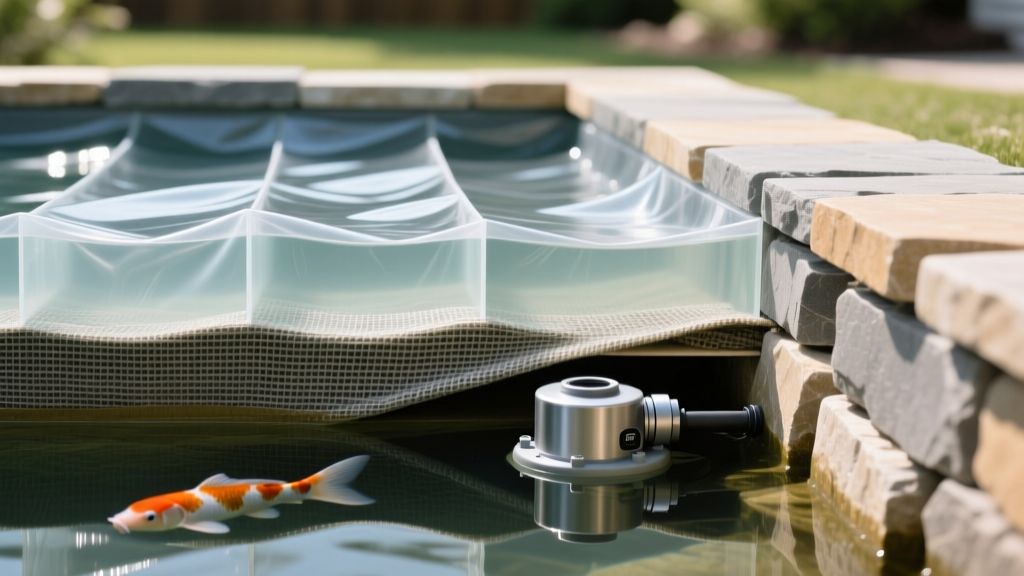
2026 Material Cost Breakdown
Budgeting accurately requires understanding current market rates for premium pond building materials. The table below reflects average 2026 material costs for a mid-sized residential project (excluding heavy machinery rental and labor).
| Material Category | Specific Product / Spec | Estimated Unit Cost (2026) |
|---|---|---|
| Containment | 45-mil EPDM Liner (Firestone/Carlisle) | $1.15 - $1.45 per sq. ft. |
| Containment | 24-mil RPE Liner (Woven Reinforced) | $1.60 - $1.90 per sq. ft. |
| Protection | 8 oz Non-Woven Geotextile Underlayment | $0.45 - $0.60 per sq. ft. |
| Plumbing | Schedule 40 PVC Pipe (1.5-inch, 10ft stick) | $8.50 - $11.00 per stick |
| Filtration | K1 Micro Biological Media (50L bag) | $130.00 - $160.00 per bag |
| Edging | Thermal Bluestone Coping (2-inch thick) | $18.00 - $26.00 per linear ft. |
| Substrate | Washed 3/8-inch Pea Gravel (Bulk) | $45.00 - $65.00 per cubic yard |
By prioritizing material integrity over initial cost savings—specifically regarding liner thickness, non-woven underlayment, and rigid plumbing—you ensure the water feature remains structurally sound and biologically stable for decades. For further reading on aquatic plant integration and ecological balance, consult the Texas A&M Agrilife Extension water gardening archives.
Written by
Marcus ChenMarcus Chen is a licensed structural engineer (PE) and building materials analyst with over 12 years of experience across residential, commercial, and industrial construction. He holds a Master of Science in Civil Engineering from UC Berkeley and spent six years at Thornton Tomasetti before transitioning to independent consulting and technical writing. Marcus specializes in material selection for seismic-prone regions, concrete reinforcement strategies, and lifecycle cost analysis. His work has been cited by the American Concrete Institute (ACI) and the Structural Engineers Association of California (SEAOC). When he is not on a job site or at his desk, you will find him hiking the Sierra Nevada or restoring a 1920s craftsman bungalow in Oakland, CA.
More from Marcus Chen
View all
Construction Cost
How Much Did the Eiffel Tower Cost to Build?
How much did the Eiffel Tower cost to build in 1889? We adjust for inflation and compare its budget to modern skyscraper construction.
Aug 4, 2026

Fire Resistance
What Is a Fire Resistant Material? Testing & Certification Guide
Discover what is a fire resistant material through ASTM and UL testing. Learn how fire ratings, certifications, and assemblies work in construction.
Aug 4, 2026

Construction Cost
How Much Did the Burj Khalifa Cost to Build?
How much did the Burj Khalifa cost to build? We break down the $1.5B project and extract 5 money-saving strategies for your next build.
Jul 30, 2026