How Did the Aztecs Move Building Materials? Logistics of the Templo Mayor
Discover how the Aztecs moved massive building materials like basalt and tezontle without wheels, using human labor, canoes, and ingenious causeways.

The Logistics of Empire: Moving Stone Without the Wheel
When examining the architectural remnants of Tenochtitlan, modern engineers and material scientists are immediately confronted by a profound logistical paradox. The Mexica (Aztecs) constructed monumental pyramids, expansive causeways, and complex aqueducts using multi-ton volcanic stones, yet they possessed no draft animals, no iron tools, and did not utilize the wheel for transport. Understanding how did the Aztecs move building materials requires a deep dive into pre-Columbian material science, biomechanics, and aquatic supply chain management.
The construction of the Templo Mayor and the surrounding ceremonial precinct demanded a continuous, high-volume influx of raw materials. According to the Metropolitan Museum of Art, the Aztec empire relied on a highly organized tribute system and specialized labor guilds to extract, shape, and transport millions of cubic meters of stone, timber, and lime across the rugged terrain and shallow waters of the Valley of Mexico.
Material Inventory: What Exactly Were They Moving?
To understand the transport methods, we must first quantify the physical properties of the materials involved. The Aztecs did not move generic "stone"; they selected specific geological materials based on structural requirements, weight, and workability.
| Material | Geological Type | Avg. Density / Weight | Primary Source Region | Primary Transport Method |
|---|---|---|---|---|
| Tezontle | Vesicular Basalt (Scoria) | 1.2 - 1.5 tons/m³ | Lake Texcoco bed / Chichinautzin | Canoe flotillas (Acalli) |
| Basalt / Andesite | Massive Volcanic Rock | 2.7 - 3.0 tons/m³ | Hualapai / Ajusco Mountains | Wooden sledges & earthen ramps |
| Lime (Calcium Oxide) | Calcined Limestone / Shells | Bulk powder (1.1 tons/m³) | Tula / Xochimilco (80+ km away) | Tlamemes (porters) & Canoes |
| Ahuehuete | Montezuma Cypress (Timber) | ~500 kg per mature log | Mountain riparian forests | River floating & dragging |
Tezontle: The Lightweight Aggregate
Tezontle was the foundational filler and core material for Aztec pyramids. Its high porosity made it significantly lighter than solid basalt. Because it was frequently dredged directly from the shallow beds of Lake Texcoco or quarried from nearby volcanic fields, the Aztecs relied heavily on aquatic transport. A standard Aztec dugout canoe could safely carry 1.5 to 2 metric tons of tezontle, allowing a flotilla of fifty canoes to deliver the equivalent of 100 tons of core material directly to the construction site's docking stairs in a single day.
Basalt and Andesite: The Structural Heavyweights
For load-bearing walls, staircases, and monumental sculpture, the Aztecs required dense, fine-grained basalt and andesite. The famous Coyolxauhqui monolith weighs approximately 8.2 metric tons, while the Sun Stone (Calendar Stone) weighs an estimated 24.5 metric tons. Moving these specific materials from the mountainous periphery of the valley to the lake-bound island of Tenochtitlan represents the pinnacle of Aztec logistical engineering.
The Mechanics of Terrestrial Transport
Without wheels or beasts of burden, terrestrial transport relied entirely on human kinetic energy, friction reduction, and mechanical advantage.
The backbone of Aztec overland logistics was the tlameme (porter). Using a mecapal (a woven agave-fiber tumpline that rested on the forehead), a trained porter could carry 20 to 50 kilograms of material over distances of 20 to 25 kilometers per day. For bulk materials like lime or quarried rubble, thousands of tlamemes operated in relay systems, creating a continuous human conveyor belt from the mainland quarries to the causeway termini.
Sledges, Rollers, and Friction Management
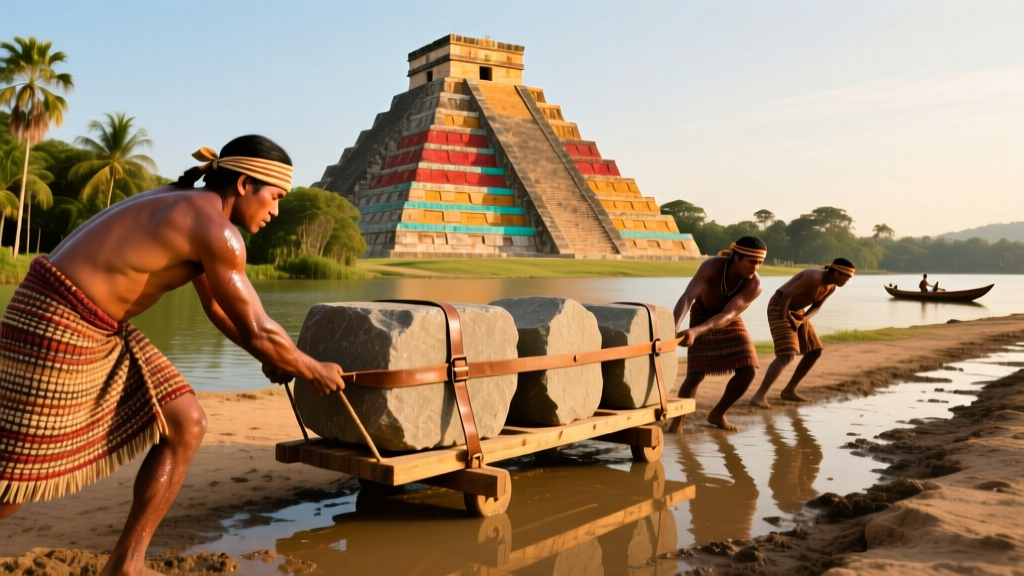
For multi-ton basalt blocks, the Aztecs utilized heavy timber sledges. The mechanics of this process required meticulous preparation of the transport route. Laborers would lay down parallel tracks of smooth, straight Ahuehuete (bald cypress) logs. The sledge was pulled forward using thick ropes braided from maguey (agave) fibers, which possess a tensile strength comparable to modern hemp.
As the sledge moved forward, workers continuously retrieved the logs from the rear and placed them at the front. To reduce the coefficient of friction between the wooden sledge and the rollers, evidence suggests the Aztecs lubricated the tracks with water, mud, or crushed organic matter. Once the stones reached the edge of Lake Texcoco, they were transferred onto massive, reinforced raft-canoes for the final aquatic approach.
Aquatic Highways and Causeway Integration
The UNESCO World Heritage Centre notes that the unique geography of the Valley of Mexico forced the Aztecs to become master hydrologists. Lake Texcoco was not a barrier; it was the empire's primary freight highway.
- The Iztapalapa Causeway: Spanning nearly 10 kilometers, this engineered landmass connected the mainland to Tenochtitlan. While it featured removable wooden bridges for defense and water flow, its solid earthen and stone-paved surface served as a primary drag-route for heavy materials arriving from the south.
- Canal Staging: Tenochtitlan was interlaced with a grid of canals. Building materials were floated directly to the base of specific construction zones, eliminating the need for overland carting once the materials reached the island city.
- Chinampa Integration: The floating agricultural gardens (chinampas) were reinforced with wooden stakes and tezontle. The dredging of canals for transport simultaneously provided the mud and tezontle required for construction, creating a closed-loop material supply chain.
Shaping vs. Moving: The Obsidian Constraint
A critical distinction in Aztec material handling is the relationship between shaping and moving. Because the Aztecs lacked iron and steel, they shaped stone using harder stones (like basalt hammerstones) and obsidian chisels. This process was incredibly labor-intensive and generated high rates of tool degradation.
To optimize logistics, the Aztecs practiced point-of-origin roughing. Stones were quarried and roughly shaped to their approximate final dimensions at the mountain source. This removed up to 30% of the dead weight before the arduous journey began. Final precision dressing, polishing, and intricate carving (such as the relief work on the Templo Mayor) were executed only after the stone was permanently set in its architectural position, minimizing the risk of damaging finished surfaces during transit.
Modern Takeaways for Heavy Material Logistics
While modern construction relies on diesel-powered cranes and flatbed trucks, the Aztec approach offers valid insights into sustainable and site-specific logistics:
- Hydro-Transit Efficiency: Moving bulk materials via water remains exponentially more energy-efficient than overland transport. Modern urban planners are increasingly revisiting canal-based freight systems to reduce carbon emissions in dense cities.
- Modular Staging: The Aztec practice of rough-shaping at the quarry and finish-carving in situ mirrors modern prefabrication and just-in-time delivery methodologies, reducing on-site waste and material handling risks.
- Closed-Loop Excavation: Utilizing dredged canal material (tezontle and mud) as primary structural fill is an early example of circular economy principles in construction.
Frequently Asked Questions
Did the Aztecs use animals to pull heavy stones?
No. Pre-Columbian Mesoamerica lacked large domesticated draft animals such as horses, oxen, or donkeys. The largest domesticated animals were turkeys and dogs, neither of which possesses the biomechanical capacity to pull multi-ton stones. All traction force was generated by human labor.
How long did it take to move a 10-ton stone from the mountains?
Moving a 10-ton monolith from the Ajusco mountains to Tenochtitlan (approximately 30-40 kilometers) required clearing a path, laying rollers, and coordinating hundreds of pullers. Historical estimates suggest a movement rate of 1 to 2 kilometers per day. Therefore, the transit alone would take 15 to 30 days, excluding quarrying and shaping time.
What happened to the transport infrastructure after the conquest?
According to Encyclopedia Britannica, the Spanish conquest in 1521 led to the systematic dismantling of Tenochtitlan. The causeways were repurposed, and the canals were gradually filled in with rubble and tezontle to create the grid streets of modern Mexico City, effectively burying the Aztec aquatic logistics network beneath colonial architecture.
Written by
David NakamuraDavid Nakamura is a licensed architect (AIA) and construction technology writer focused on sustainable building methods, mass timber engineering, and high-performance building envelopes. He holds a Master of Architecture from the University of Washington and is a certified Passive House Consultant (CPHC). David spent eight years at the Seattle firm Mithun, where he led the design of three LEED Platinum projects, before founding his own practice specializing in net-zero residential design. He serves on the editorial advisory board of GreenBuilder Magazine and has authored peer-reviewed papers on cross-laminated timber (CLT) connections for the Journal of Structural Engineering. In his spare time, David teaches woodworking at Pratt Fine Arts Center and kayaks the Puget Sound.
More from David Nakamura
View all
Construction Cost
Labor Cost to Build a Deck Per Sq Ft: 2026 Installation Guide
Discover the exact labor cost to build a deck per sq ft in 2026. This installation guide breaks down contractor rates, complexity factors, and hidden fees.
Aug 4, 2026

Construction Cost
How Much Does It Cost to Build a 3 Bedroom House? Financing Guide
Learn exactly how much it costs to build a 3 bedroom house and explore 2026 financing options, construction loan types, and budget frameworks for your build.
Aug 4, 2026

Construction Cost
Cost to Build a Tennis Court: 2026 Guide
How much does it cost to build a tennis court in 2026? Breakdowns for asphalt, concrete, and synthetic surfaces plus fencing and lighting.
Jul 30, 2026