How to Build a Flute Out of Bamboo Using Structural Principles
Learn how to build a flute out of bamboo by applying structural engineering principles to culm selection, node spacing, and wall thickness.

The Intersection of Structural Bamboo and Acoustic Craft
While most guides treat instrument making as a purely artistic endeavor, learning how to build a flute out of bamboo is fundamentally an exercise in micro-structural engineering. The same fibrovascular bundles that give bamboo culms the tensile strength to serve as scaffolding and trusses in macro-construction (often exceeding 120 MPa) also dictate the material's acoustic impedance and harmonic resonance. By applying the structural grading principles outlined in ISO 22157 for bamboo construction, you can select, cure, and machine a culm that is not only acoustically superior but structurally immune to the splitting and warping that plague amateur builds.
Culm Selection: Structural Grading for Flute Making
In structural applications, bamboo is graded by age, density, and wall thickness. A culm harvested before 3 years lacks sufficient lignification, resulting in high shrinkage and structural failure. For flute making, you must target culms that are exactly 3 to 5 years old, harvested in late autumn when starch content is lowest, minimizing the risk of Dinoderus minutus (bamboo borer) infestation.
| Species (Common / Botanical) | Structural Density (g/cm³) | Avg. Wall Thickness | Acoustic & Structural Suitability |
|---|---|---|---|
| Tonkin (Pseudosasa amabilis) | 0.75 - 0.85 | 3.0 - 5.0 mm | Premium. High density provides bright harmonics; thin walls require minimal bore thinning. |
| Moso (Phyllostachys edulis) | 0.60 - 0.70 | 8.0 - 12.0 mm | Moderate. Standard for structural flooring. Requires aggressive internal boring to achieve correct ID for mid-range flutes. |
| Guadua (Guadua angustifolia) | 0.75 - 0.80 | 15.0 - 25.0 mm | Specialty. The premier structural bamboo of South America. Too massive for standard flutes; reserved for large bass drone instruments. |
Curing and Moisture Content: Preventing Structural Failure
According to the Food and Agriculture Organization (FAO) guidelines on bamboo preservation, structural bamboo must be treated to prevent fungal decay and insect attack. For a flute, the stakes are higher: uneven moisture gradients will cause the culm to ovalize, destroying the circular cross-section required for consistent acoustic wave propagation.
Expert Metric: Use a pinless moisture meter like the Wagner Meters Orion 910 to verify the culm's moisture content (MC). Structural framing lumber is typically approved at 19% MC, but a bamboo flute requires an MC of 8% to 10% before machining. Air-drying in a shaded, cross-ventilated rack takes 6 to 12 months; kiln-drying at 60°C (140°F) reduces this to 48 hours but requires careful monitoring to prevent case-hardening.
After drying, treat the culm using a cold-soak preservation method. Submerge the bamboo in a 5% aqueous solution of borax and boric acid (mixed 1:1.5 by weight) for 14 days. This diffuses into the parenchyma cells, providing long-term structural preservation without altering the acoustic properties of the outer rind. This aligns with the environmental safety standards promoted by the International Bamboo and Rattan Organization (INBAR) for non-toxic bamboo processing.
Step-by-Step: Engineering the Bore and Finger Holes
The internal diameter (ID) of the bore determines the fundamental pitch, while the outer rind (the densest 1/3 of the wall thickness) reflects high-frequency sound waves. Compromising the outer rind during construction destroys both the structural integrity and the tonal brilliance of the instrument.
- Establish the Bore: For a standard pentatonic flute in the key of G, target an internal diameter of 18.0 mm. If using thick-walled Moso, mount the culm in a lathe and use a 16mm high-speed steel (HSS) boring bar to carefully remove the inner pith ring. Stop cutting when you are 2.0 mm away from the dense outer epidermal layer.
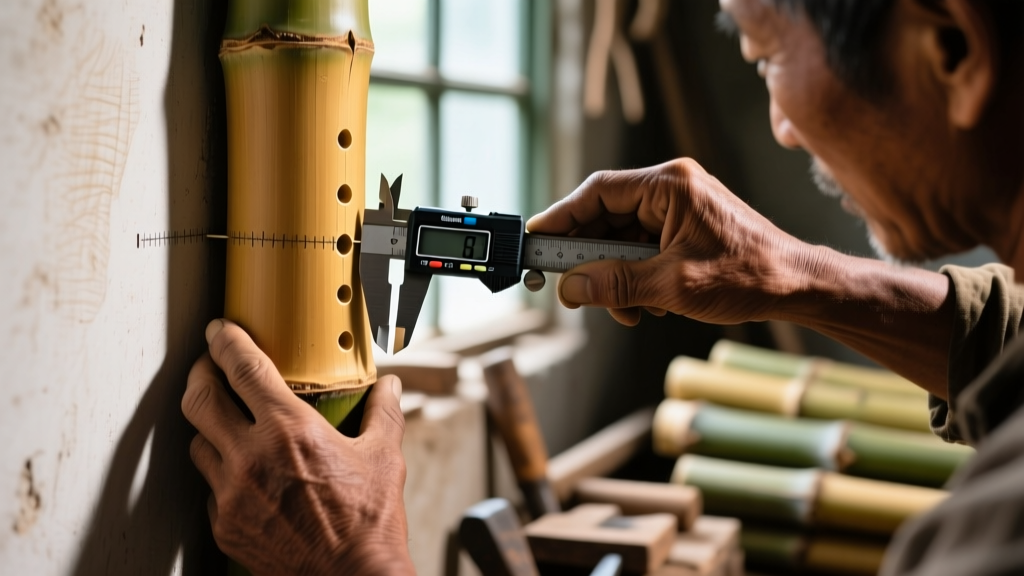
- Mark the Nodes: Identify the structural diaphragms (nodes). Use a flexible ruler to map the internode lengths. The distance between the blow hole and the first finger hole dictates the primary resonant frequency.
- Drill the Finger Holes: Do not use standard twist drills or spade bits; they will tear the transverse vascular bundles and cause catastrophic blowout on the inner wall. Use a DeWalt DW1500 series brad-point bit. The center spur scores the epidermis cleanly before the cutting lips engage.
- Control the RPM: Drill at exactly 2,000 RPM. Apply a backing block of scrap hardwood tightly against the opposite side of the culm to support the inner wall and prevent splintering as the bit exits.
Bamboo's tensile strength runs longitudinally along its fibers. It has virtually zero tensile strength radially. If you force a drill bit or apply lateral pressure while reaming the bore, the culm will split perfectly along the longitudinal axis. Always let the tool do the work, and never use the culm as a lever.
Node Diaphragms: Managing Internal Structural Baffles
The solid nodes that give bamboo its incredible compressive strength in structural columns act as acoustic baffles in a flute. They must be removed to create a continuous air column, but the structural ring where the diaphragm meets the inner wall must be preserved to maintain the culm's hoop strength.
To remove the diaphragms without damaging the structural ring, use a 14mm heat-treated steel rod with a serrated tip, heated to 200°C (392°F) with a propane torch. Slowly push the heated rod through the nodes. The heat carbonizes the pith, allowing it to crumble away, while the thermal shock slightly hardens the surrounding inner wall, creating a smooth, glass-like bore surface that improves airflow dynamics.
Finishing and Structural Sealing
Human breath introduces high humidity into the bore, causing the inner fibers to swell. Because the outer rind is sealed with natural silica and waxes, the differential expansion creates immense radial stress, leading to end-grain checking (splitting).
- Internal Sealing: Flood the bore with a 50/50 mix of pure tung oil and citrus solvent. Let it penetrate for 2 hours, then pour out the excess. This polymerizes inside the parenchyma cells, stabilizing the internal moisture content without adding the acoustic dampening associated with polyurethane.
- External Protection: Lightly scuff the outer epidermis with 400-grit sandpaper and apply a micro-crystalline wax. This preserves the structural silica layer while providing a tactile grip.
- End-Grain Binding: To prevent longitudinal splitting at the embouchure and foot joints, bind the ends with synthetic sinew or Kevlar thread, saturated in cyanoacrylate (CA) glue. This acts as a structural compression ring, counteracting the radial expansion forces.
FAQ: Troubleshooting Structural and Acoustic Flaws
Q: Why is my flute producing a breathy, weak fundamental tone?
A: This usually indicates a bore taper error. If the internal diameter widens by more than 0.5 mm from the blow hole to the foot, the acoustic wave reflects prematurely. Re-measure your boring bar depth and ensure a strict cylindrical or mathematically calculated conical taper.
Q: The bamboo developed a hairline crack near the blow hole after two weeks of playing. How do I fix it?
A: The crack is a structural failure caused by unsealed end-grain moisture absorption. Immediately bind the cracked area with Kevlar thread and wick thin-viscosity CA glue into the split. Once cured, sand flush and ream the bore slightly to remove any glue intrusion that could disrupt the airflow.
Q: Can I use construction-grade bamboo from a local lumberyard?
A: Construction-grade bamboo (often laminated or treated with harsh copper-based preservatives like ACQ) is unsuitable. The chemical treatments alter the density and toxicity, while the laminating adhesives dampen high-frequency harmonics. Always source raw, untreated, whole-culm bamboo from specialized acoustic suppliers.
Written by
Elena RodriguezElena Rodriguez is a civil engineer and technical writer specializing in concrete technology, masonry systems, and ASTM/ACI compliance. She earned her B.S. in Civil Engineering from Texas A&M University and spent a decade at a materials testing laboratory, performing over 2,000 concrete compressive strength tests and masonry prism evaluations. Elena is an ACI-certified Field Testing Technician (Grade I) and a member of ASTM Committee C12 on Natural Building Stone. She currently consults on forensic engineering cases involving concrete failures and moisture intrusion. Based in San Antonio, TX, Elena is a proud member of the Society of Women Engineers (SWE) and coaches her daughter's FIRST Robotics team.
More from Elena Rodriguez
View all
Walls & Panels
Cost Analysis: Light Gauge Steel Framing Advantages and Disadvantages
Evaluate light gauge steel framing advantages and disadvantages through a strict cost analysis lens, comparing material, labor, and lifecycle expenses.
Aug 4, 2026

Walls & Panels
Gypsum Board Types: Exact Specifications, Thickness & Dimensions
Compare standard, Type X, and moisture-resistant gypsum board types. Get exact specifications, thicknesses, dimensions, and ASTM standards for your project.
Aug 4, 2026

Fire Resistance
Best Fire-Resistant Outdoor Decking Materials: 2026 Buyer Guide
Discover the best fire-resistant outdoor decking materials for 2026. Compare Class A PVC, aluminum, and hardwood options for WUI compliance and safety.
Aug 4, 2026