Building a Bamboo Hut: Species, Treatment & Joinery Selection Guide
Master building a bamboo hut with our selection guide. Compare Guadua vs. Moso, choose borax treatments, and select structural joinery for lasting durability.

Core Material Selection: Choosing the Right Bamboo Species
Bamboo is a grass, not a timber, and its anisotropic properties demand specific species selection based on structural loads. When building a bamboo hut, the culm (pole) must possess high tensile strength, thick walls, and resistance to splitting. The three most viable structural species globally are Guadua angustifolia, Phyllostachys edulis (Moso), and Dendrocalamus asper.
| Species | Primary Origin | Avg. Diameter (Base) | Wall Thickness | Modulus of Rupture (MOR) | Best Application |
|---|---|---|---|---|---|
| Guadua angustifolia | South/Central America | 100 - 150 mm | 10 - 20 mm | 110 - 140 MPa | Primary columns, heavy trusses |
| Phyllostachys edulis (Moso) | China / East Asia | 80 - 120 mm | 8 - 12 mm | 90 - 110 MPa | Purlins, rafters, engineered laminates |
| Dendrocalamus asper | Southeast Asia | 150 - 250 mm | 15 - 30 mm | 85 - 105 MPa | Massive load-bearing pillars, aesthetic focal points |
For a standard 400-square-foot hut, Guadua is the superior choice for the primary load-bearing frame due to its exceptional strength-to-weight ratio and natural node diaphragms that provide lateral stability. Sourcing certified, sustainably harvested Guadua from FAO-recognized plantations ensures the material has reached the requisite 3-to-5-year structural maturity.
Harvesting Timing and Culm Selection
Never harvest bamboo during the wet season. High starch content attracts powderpost beetles (Dinoderus minutus), which can hollow out a structural pole in under six months. Harvest strictly during the dry season (typically December through February in the Northern Hemisphere) when starch levels are at their lowest. Select culms that exhibit a faded green-to-yellow hue, indicating full lignification.
Preservation and Treatment Protocols
The Boucherie Method vs. Tank Submersion
For freshly harvested, green bamboo, the Boucherie sap-displacement method is the most effective treatment. This involves attaching a pressure pump to the base of the freshly cut culm and forcing a preservative solution through the vascular bundles, pushing the natural sap out of the top. For dried or partially seasoned poles, tank submersion is required.
- Chemical Mixture: Use a 1:1.5 ratio of Borax (Sodium Borate) to Boric Acid, dissolved in water to achieve a 7% to 10% concentration by weight. This mixture is highly effective against termites and fungi while remaining relatively low-toxicity for human habitation.
- Submersion Time: Poles must remain submerged in the treatment tank for a minimum of 5 to 7 days. Thicker-walled species like D. asper may require up to 14 days for full penetration.
- Curing: After treatment, poles must be stacked horizontally on elevated racks in a shaded, well-ventilated area for 4 to 6 weeks to cure and stabilize moisture content below 15%.
Organizations like the International Bamboo and Rattan Organization (INBAR) heavily advocate for boron-based treatments as the global standard for eco-friendly, long-lasting bamboo preservation.
Foundation Systems for Moisture Mitigation
The golden rule of bamboo architecture is 'good boots and a good hat.' Bamboo's vascular structure acts like a bundle of straws; if the base sits in damp soil, capillary action will draw moisture up into the walls, causing internal rot.
Elevated Concrete Piers with U-Brackets
The most reliable foundation for a bamboo hut is a series of isolated concrete piers. Excavate to below the frost line or to stable subgrade, pour reinforced concrete piers, and embed hot-dipped galvanized steel U-brackets or base plates. The bamboo column must be elevated a minimum of 400mm (16 inches) above the finished grade. Secure the bamboo to the steel bracket using stainless steel through-bolts, ensuring no direct contact between the organic material and the concrete.
Rubble Trench with Stem Walls
For larger huts or areas with poor drainage, dig a continuous trench, fill it with compacted drain rock, and pour a concrete grade beam or stem wall on top. The bamboo frame is then anchored to this stem wall. This method prevents water pooling around the base plates and provides superior resistance to lateral wind loads.
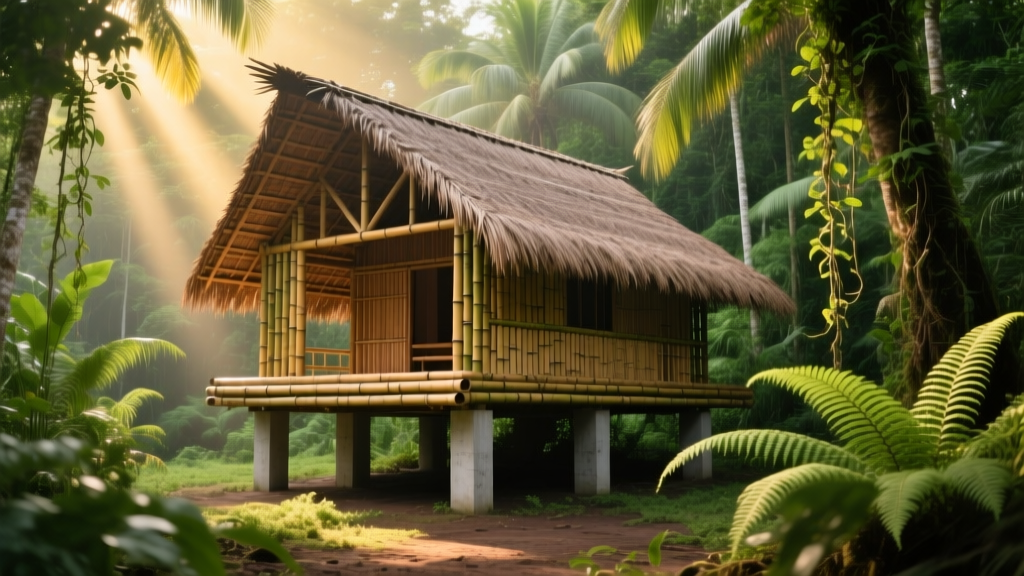
Structural Joinery: Lashings vs. Mechanical Fasteners
Traditional bamboo joinery often relies on mortise-and-tenon cuts or natural fiber lashings. While aesthetically pleasing, these methods have severe structural limitations in modern permanent construction.
- Mortise and Tenon: Carving into the bamboo culm severs the continuous longitudinal fibers, creating massive stress concentrators. A notched bamboo pole can lose up to 40% of its bending capacity.
- Natural Lashings: Hemp, sisal, or rattan lashings stretch when exposed to high humidity and shrink when dry, leading to loose joints that compromise structural rigidity over time.
The Modern Standard: Bolted Connections with Epoxy Injection
For a structurally sound bamboo hut, use mechanical fasteners. Drill completely through the culm and use M10 or M12 hot-dipped galvanized carriage bolts. Crucial Expert Technique: Before tightening the bolt, inject a two-part structural epoxy resin or polyurethane foam into the hollow internode cavity at the joint, or insert a tight-fitting hardwood/bamboo dowel inside the pole. This prevents the culm walls from crushing inward under the clamping force of the bolt head and nut, preserving the structural integrity of the connection.
Roofing Selection and Overhang Requirements
The roof protects the bamboo frame from UV degradation and rain splash-back. UV radiation breaks down the lignin in bamboo, causing the surface to splinter and turn gray within a single season.
| Roofing Material | Minimum Pitch | Required Overhang | Lifespan & Maintenance |
|---|---|---|---|
| Natural Thatch (Palm/Grass) | 35 - 45 degrees | 1.5 meters (5 ft) | 5-8 years; requires periodic re-thatching and fumigation. |
| Corrugated Galvanized Metal | 15 degrees | 1.0 meter (3.3 ft) | 25+ years; noisy during rain, requires condensation barrier. |
| Polycarbonate Multi-wall | 10 degrees | 0.8 meters (2.6 ft) | 15-20 years; excellent light transmission, degrades under intense UV if not coated. |
Regardless of the material chosen, the overhang must extend at least 1 meter (preferably 1.5 meters) beyond the exterior walls. This ensures that wind-driven rain cannot reach the bamboo columns and that the lower walls remain shaded from direct midday sun.
Cost Estimation and Sourcing Framework
Budgeting for a bamboo hut requires accounting for the specialized labor and treatment processes that standard timber framing does not. Below is a baseline cost matrix for a 400 sq. ft. structure in North America (prices reflect 2026 market rates for imported, treated structural bamboo).
| Component | Unit | Estimated Cost (USD) | Notes |
|---|---|---|---|
| Treated Guadua Poles (Primary Frame) | Per linear foot | $14.00 - $22.00 | Includes import, borax treatment, and curing. |
| Moso Bamboo (Purlins/Rafters) | Per linear foot | $8.00 - $12.00 | Smaller diameter, sold in bundles. |
| Galvanized Hardware & Epoxy | Per joint | $6.00 - $10.00 | Custom U-brackets, M12 bolts, structural resin. |
| Concrete Piers & Foundation | Per pier | $150.00 - $250.00 | Depends on soil conditions and depth requirements. |
| Specialized Bamboo Carpentry Labor | Per hour | $65.00 - $110.00 | Standard framers lack the specific notching/bolting skills required. |
When sourcing materials, consult directories provided by groups like Bamboo Central to locate certified importers who can provide phytosanitary certificates and proof of proper boron treatment. Never purchase 'craft grade' or untreated bamboo from general garden centers for structural applications, as these poles are typically harvested prematurely and lack the necessary wall thickness for load-bearing joints.
Written by
Marcus ChenMarcus Chen is a licensed structural engineer (PE) and building materials analyst with over 12 years of experience across residential, commercial, and industrial construction. He holds a Master of Science in Civil Engineering from UC Berkeley and spent six years at Thornton Tomasetti before transitioning to independent consulting and technical writing. Marcus specializes in material selection for seismic-prone regions, concrete reinforcement strategies, and lifecycle cost analysis. His work has been cited by the American Concrete Institute (ACI) and the Structural Engineers Association of California (SEAOC). When he is not on a job site or at his desk, you will find him hiking the Sierra Nevada or restoring a 1920s craftsman bungalow in Oakland, CA.
More from Marcus Chen
View all
Construction Cost
How Much Did the Eiffel Tower Cost to Build?
How much did the Eiffel Tower cost to build in 1889? We adjust for inflation and compare its budget to modern skyscraper construction.
Aug 4, 2026

Fire Resistance
What Is a Fire Resistant Material? Testing & Certification Guide
Discover what is a fire resistant material through ASTM and UL testing. Learn how fire ratings, certifications, and assemblies work in construction.
Aug 4, 2026

Construction Cost
How Much Did the Burj Khalifa Cost to Build?
How much did the Burj Khalifa cost to build? We break down the $1.5B project and extract 5 money-saving strategies for your next build.
Jul 30, 2026