Bamboo Rod Building Cost Comparison: Vs Timber in 2026
Compare bamboo rod building costs against timber and steel in 2026. Explore material pricing, treatment expenses, and labor rates for structural bamboo.

The Economics of Whole-Culm Construction
Bamboo rod building—utilizing whole, un-laminated cylindrical culms rather than engineered bamboo lumber—represents a distinct structural methodology with a unique cost profile. While the raw material cost of bamboo culms is frequently lower than dimensional timber or light-gauge steel, the total installed cost is heavily dictated by species selection, preservation treatments, and specialized node-jointing labor. In 2026, shifting carbon taxes and supply chain constraints on softwood timber have altered the traditional cost hierarchy, making structural bamboo highly competitive for specific architectural typologies, provided the hidden labor variables are properly managed.
This analysis breaks down the exact material, treatment, and labor costs of bamboo rod building compared to conventional Douglas Fir timber and light-gauge steel (LGS) framing, utilizing current 2026 market data and structural grading standards outlined by the International Bamboo and Rattan Organization (INBAR).
Raw Material Costs: Species and Sourcing
Not all bamboo is structural. The cost of bamboo rods varies drastically based on the species, wall thickness, and internode length. For load-bearing frames, builders must source specific timber-grade species. Pricing below reflects 2026 wholesale rates for graded, harvested culms before treatment or transport.
- Guadua angustifolia (South/Central America): The premier structural species in the Americas. A standard 12-meter (40-foot) culm with a 10-12 cm diameter costs between $14.00 and $18.50 ($0.35 - $0.46 per linear foot). It offers high tensile strength and thick walls ideal for bolted connections.
- Dendrocalamus asper (Southeast Asia): A massive, thick-walled species used heavily in Indonesia and the Philippines. Due to its weight and diameter (often exceeding 15 cm), 12-meter culms range from $18.00 to $24.00. It is exceptionally strong in compression but harder to transport.
- Phyllostachys edulis / Moso (China): While widely available and cheaper at $8.00 to $12.00 per 10-meter culm, Moso has thinner walls and is generally relegated to light trusses, purlins, or non-load-bearing architectural elements rather than primary vertical columns.
By comparison, structural Douglas Fir timber (2x6 and 2x8 dimensional lumber) averages $2.80 to $3.60 per board foot in 2026, translating to roughly $1.50 to $2.20 per linear foot for standard framing members. On a pure per-linear-foot basis, Guadua and Asper bamboo rods offer a 60% to 75% material discount over equivalent timber framing members.
Preservation and Treatment Expenses
Raw bamboo contains high levels of starch and moisture, making it highly susceptible to powderpost beetles and fungal decay. Untreated bamboo rod building is a critical failure mode; structural culms must be preserved. The Food and Agriculture Organization (FAO) mandates specific treatment protocols for permanent structures.
1. Vertical Soak Tank (Borax/Boric Acid)
The industry standard for non-toxic, indoor, or protected outdoor bamboo. Culms are submerged in a 1:1.4 ratio of borax to boric acid solution for 5 to 14 days.
Cost: $0.85 to $1.30 per linear foot (including chemical amortization and tank facility fees).
2. Boucherie Method (Sap Displacement)
Utilizes the plant's natural capillary action to push preservative through the vascular bundles immediately after harvesting. This method is faster (24-48 hours) but requires specialized pumping equipment and freshly cut green bamboo.
Cost: $1.80 to $2.50 per culm (highly efficient for large batches, lowering the per-foot cost to roughly $0.15 - $0.20/LF).
3. Heat Treatment / Torching
Surface carbonization to deter insects and reduce moisture. This does not penetrate the inner wall and is generally insufficient for primary structural members in humid climates, though it costs only $0.30 per linear foot in labor and fuel.
The Labor Multiplier: Jointing and Assembly
The most significant cost variable in bamboo rod building is labor. Unlike timber, which features uniform, predictable geometries allowing for rapid nail-plate truss assembly or pneumatic nailing, every bamboo culm is unique. The nodes (diaphragms) vary in spacing, and the diameter tapers from base to tip. This requires custom fitting for every single joint.
| Jointing Technique | Material Cost per Joint | Labor Time per Joint | Best Application |
|---|---|---|---|
| Traditional Lashing (Rope/Rattan) | $1.50 - $3.00 | 1.5 - 2.5 hours | Temporary structures, pavilions |
| Mortise & Tenon (Bamboo Dowels) | $2.00 - $4.00 | 3.0 - 5.0 hours | High-end architectural, seismic zones |
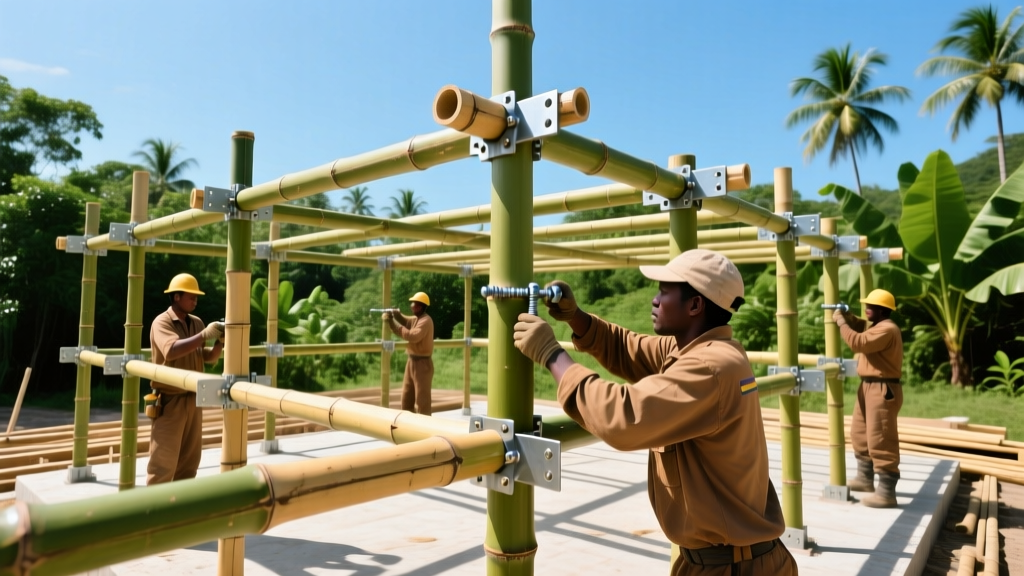
| Steel Gusset Plates & Through-Bolts | $18.00 - $28.00 | 1.0 - 1.5 hours | Commercial, heavy load-bearing frames |
| Resin/Mortar Filled Nodes with Rebar | $6.00 - $10.00 | 2.0 - 3.0 hours | Vertical columns, foundation piers |
When utilizing modern steel gusset plates and through-bolts—the preferred method for code-compliant commercial bamboo rod building in 2026—labor costs drop significantly compared to traditional joinery, but hardware costs spike. A standard timber framing joint using a hurricane tie and nails costs roughly $4.50 in materials and takes 10 minutes. The bamboo equivalent takes 6x longer and costs 4x more in hardware. This labor premium is the primary reason bamboo rod building is often prefabricated in controlled shop environments rather than stick-framed on-site.
Comparative Matrix: Bamboo Rod vs. Timber vs. Steel
To contextualize the total framing package, the following matrix compares the fully installed costs (materials + labor + treatment/hardware) for a standard 2,000 sq. ft. single-story structural frame in a moderate climate zone.
| Metric | Bamboo Rod (Guadua) | Douglas Fir Timber | Light-Gauge Steel (LGS) |
|---|---|---|---|
| Material Cost (per sq ft) | $3.20 - $4.50 | $6.80 - $8.50 | $7.50 - $9.20 |
| Labor Cost (per sq ft) | $11.00 - $14.50 | $5.50 - $7.00 | $6.00 - $8.00 |
| Total Framing Cost | $14.20 - $19.00 | $12.30 - $15.50 | $13.50 - $17.20 |
| Embodied Carbon | -15 kgCO2e (Carbon Negative) | +12 kgCO2e | +45 kgCO2e |
As the data illustrates, bamboo rod building does not inherently yield a cheaper total build cost than timber in regions where softwood lumber is abundant and carpentry labor is highly optimized. The material savings are entirely consumed by the specialized, time-intensive jointing labor. However, when factoring in carbon taxation, LEED certification incentives, and the architectural premium clients are willing to pay for exposed structural bamboo, the ROI shifts heavily in bamboo's favor.
Hidden Costs: Logistics, Grading, and Code Compliance
Builders transitioning from conventional materials to bamboo rod building frequently underestimate three critical edge cases that can blow up a project budget:
1. Freight and Culm Length Limitations
Standard semi-trailers max out at 53 feet, but turning radii and local road restrictions often limit practical transport to 40-foot flatbeds. If your design requires continuous 12-meter (40-foot) columns, freight costs will increase by 30% to 50% due to the need for specialized over-width permits or escort vehicles. Cost mitigation: Design structures around 8-meter to 10-meter maximum continuous spans, splicing culms at structural nodes using internal steel rebar and epoxy resin sleeves.
2. Structural Grading and Stamping
In jurisdictions adopting the ICC-ES AC428 (Acceptance Criteria for Structural Bamboo), raw bamboo cannot simply be pulled from a forest and erected. Every culm must be visually and mechanically graded for wall thickness, internode cracking, and moisture content (must be below 15%). Hiring a certified bamboo grading agency to inspect and stamp your culms typically costs between $1,500 and $3,500 per project, a fixed overhead that disproportionately affects smaller builds. Resources and certified inspector directories can be found via Bamboo Central.
3. Insurance and Financing Premiums
Despite international ISO standards (ISO 22156) governing bamboo structural design, many regional underwriters still classify bamboo rod buildings as "non-standard" or "experimental." This can result in builder's risk insurance premiums that are 15% to 25% higher than equivalent timber frames, and may require the architect to stamp specialized engineering calculations that explicitly model the anisotropic properties of the bamboo nodes.
Strategic Decision Framework
Choose bamboo rod building if your project prioritizes biophilic design, requires carbon-negative material credentials for ESG reporting, and is located in a region with established bamboo treatment facilities and skilled artisan labor (e.g., Colombia, Indonesia, Hawaii, or specialized firms in California). Opt for prefabricated steel-gusset jointing to control on-site labor overruns.
Choose dimensional timber or LGS if the project is heavily constrained by standard municipal building departments lacking bamboo-specific code familiarity, if the budget cannot absorb the 20% labor premium for custom node-fitting, or if the supply chain requires rapid, just-in-time delivery of standardized materials from big-box distributors.
Written by
Elena RodriguezElena Rodriguez is a civil engineer and technical writer specializing in concrete technology, masonry systems, and ASTM/ACI compliance. She earned her B.S. in Civil Engineering from Texas A&M University and spent a decade at a materials testing laboratory, performing over 2,000 concrete compressive strength tests and masonry prism evaluations. Elena is an ACI-certified Field Testing Technician (Grade I) and a member of ASTM Committee C12 on Natural Building Stone. She currently consults on forensic engineering cases involving concrete failures and moisture intrusion. Based in San Antonio, TX, Elena is a proud member of the Society of Women Engineers (SWE) and coaches her daughter's FIRST Robotics team.
More from Elena Rodriguez
View all
Walls & Panels
Cost Analysis: Light Gauge Steel Framing Advantages and Disadvantages
Evaluate light gauge steel framing advantages and disadvantages through a strict cost analysis lens, comparing material, labor, and lifecycle expenses.
Aug 4, 2026

Walls & Panels
Gypsum Board Types: Exact Specifications, Thickness & Dimensions
Compare standard, Type X, and moisture-resistant gypsum board types. Get exact specifications, thicknesses, dimensions, and ASTM standards for your project.
Aug 4, 2026

Fire Resistance
Best Fire-Resistant Outdoor Decking Materials: 2026 Buyer Guide
Discover the best fire-resistant outdoor decking materials for 2026. Compare Class A PVC, aluminum, and hardwood options for WUI compliance and safety.
Aug 4, 2026