Engineered Bamboo for Building Houses: 2026 Structural Guide
Explore how engineered bamboo for building houses compares to timber in 2026. Discover costs, structural grades, LBL panels, and code compliance.

The Shift from Raw Culms to Engineered Composites
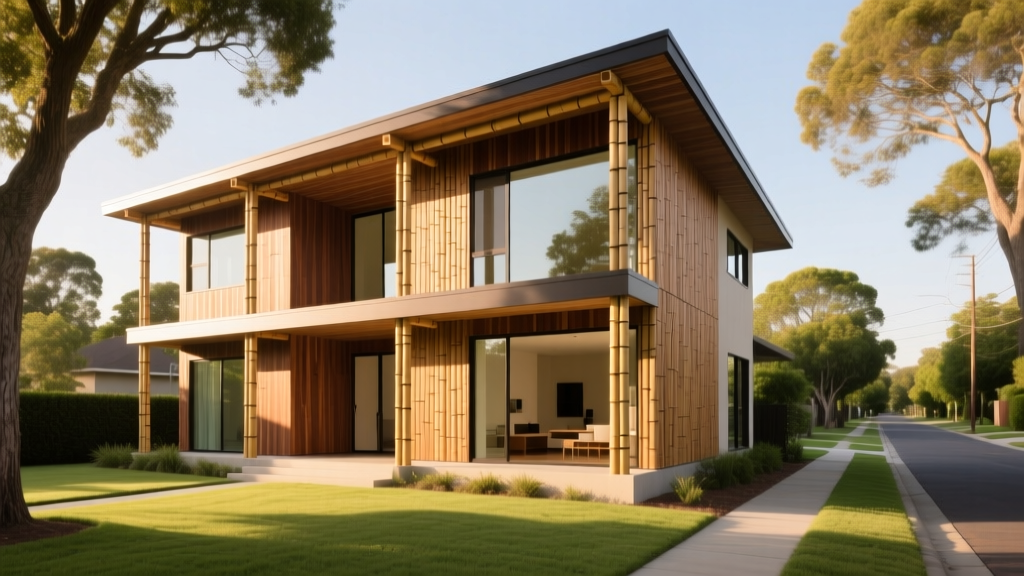
The use of bamboo for building houses has fundamentally evolved over the last decade. While vernacular architecture relied on raw, whole-culm bamboo lashed together with natural fibers or basic mechanical fasteners, modern residential construction demands dimensional stability, predictable load-bearing capacities, and code compliance. In 2026, architects and structural engineers specify engineered bamboo composites—materials that deconstruct the raw grass and reassemble it using industrial adhesives and heat to create structural members that rival or exceed traditional dimensional lumber and engineered wood products (EWP).
Raw bamboo culms suffer from inherent geometric inconsistencies: they taper from base to tip, possess irregular node spacing, and are prone to longitudinal splitting under shear stress. Engineered bamboo products eliminate these variables. By processing species like Phyllostachys edulis (Moso) and Guadua angustifolia into standardized strips, strands, or veneers, manufacturers produce structural components with uniform specific gravity (typically 0.80 to 0.95), predictable moisture content (8-12%), and isotropic mechanical properties.
Primary Engineered Products for Residential Framing
Selecting the correct engineered bamboo product depends on the structural demand and the specific assembly. The market has consolidated around three primary composite categories for residential framing:
| Product Type | Manufacturing Process | Best Residential Application | Approx. 2026 Material Cost |
|---|---|---|---|
| Laminated Bamboo Lumber (LBL) | Rectangular bamboo strips laminated parallel to the grain using PF or PUR resins. | Load-bearing beams, columns, headers, and rim boards. | $14.00 - $22.00 / linear ft |
| Cross-Laminated Bamboo (CLB) | Orthogonal layers of bamboo strips or veneers pressed into thick, solid panels. | Shear walls, floor cassettes, and roof diaphragms. | $18.00 - $28.00 / sq ft |
| Strand Woven Bamboo (SWB) | Crushed bamboo fibers shredded into strands, impregnated with resin, and hot-pressed. | Subflooring, heavy-duty shear panels, and sill plates. | $9.00 - $14.00 / sq ft |
For a standard 2,000-square-foot residential build, a hybrid approach is most common: LBL for the primary post-and-beam skeleton, CLB for the lateral force-resisting system (shear walls), and SWB for high-impact subflooring.
Structural Performance and Fire Resistance
When evaluating bamboo for building houses, structural engineers look primarily at tensile and compressive strength. LBL exhibits a tensile strength parallel to the grain ranging from 140 MPa to 180 MPa. By comparison, standard Douglas Fir-Larch dimensional lumber typically yields between 35 MPa and 50 MPa. This immense tensile capacity allows LBL beams to span longer distances at shallower depths than equivalent timber glulams, reducing the overall depth of floor assemblies and increasing ceiling heights.
Compressive strength perpendicular to the grain is another critical metric, particularly at bearing points where beams rest on columns or sill plates. Engineered bamboo's high density (averaging 850 kg/m³) provides exceptional bearing capacity, often eliminating the need for steel bearing plates or stiffeners that are mandatory with softer timber species.
Navigating Building Codes and Certifications
The primary barrier to specifying engineered bamboo in North America and Europe has historically been a lack of prescriptive building codes. However, the regulatory landscape in 2026 is far more mature. The International Bamboo and Rattan Organization (INBAR) has been instrumental in developing ISO 22156, which provides a comprehensive framework for bamboo structural design. Furthermore, structural composite lumber (SCL) standards, such as ASTM D5457, are increasingly being adapted by testing agencies to certify LBL and CLB products.
To secure building permits, specify products that carry an Evaluation Report from the ICC Evaluation Service (ICC-ES) or equivalent regional bodies. These reports validate the manufacturer's specific adhesive formulations, layup schedules, and allowable design values, providing the structural engineer with the exact reference design values needed for structural modeling software.
2026 Cost Breakdown for a 2,000 sq ft Home
While raw bamboo is inexpensive, the industrial processing required to create structural composites places engineered bamboo in a premium pricing tier, comparable to high-grade engineered wood or steel framing. Below is a realistic material cost breakdown for the structural shell of a 2,000 sq ft custom home in 2026:
| Assembly Component | Material Specification | Estimated Material Cost |
|---|---|---|
| Primary Columns & Beams | 6x10 and 8x12 LBL (approx. 1,800 LF) | $28,000 - $36,000 |
| Shear Walls & Diaphragms | 5-ply CLB Panels (approx. 4,500 SF) | $85,000 - $110,000 |
| Subflooring | 3/4' SWB Tongue-and-Groove (2,000 SF) | $12,000 - $16,000 |
| Hardware & Fasteners | Structural screws, concealed hangers, hold-downs | $4,500 - $6,500 |
| Total Structural Shell | Materials Only (Excl. Labor & Foundation) | $129,500 - $168,500 |
Labor costs for engineered bamboo are generally 10% to 15% higher than standard light-frame wood construction due to the weight of the materials (requiring crane assistance for CLB panels) and the specialized fastening protocols.
Critical Failure Modes and Mitigation Strategies
Despite its immense strength, engineered bamboo behaves differently than timber. Ignoring its unique material properties leads to catastrophic failures. Structural designers and builders must account for the following edge cases:
- End-Grain Moisture Ingress: Bamboo vascular bundles act as microscopic straws. If LBL beams are left exposed to the elements with untreated end-grains, moisture will wick deep into the member, causing internal delamination. Mitigation: All cut ends must be sealed immediately on-site with a high-solids epoxy or polyurethane end-grain sealer.
- Fastener Withdrawal and Splitting: The high shear strength and density of SWB and LBL mean that standard pneumatic nails will bend upon impact, and driving lag screws without pre-drilling will cause the bamboo to split explosively along the glue lines. Mitigation: Use self-drilling structural screws (e.g., Simpson Strong-Tie Strong-Drive SDWS) specifically designed for high-density composites. For larger connections, pre-drill pilot holes using carbide-tipped bits at 80% of the fastener's shank diameter.
- Adhesive Degradation in High Humidity: Not all engineered bamboo is suitable for exterior or high-moisture environments. Products bonded with Urea-Formaldehyde (UF) resins will delaminate if exposed to sustained moisture. Mitigation: Strictly specify Phenol-Formaldehyde (PF), Phenol-Resorcinol-Formaldehyde (PRF), or Polyurethane (PUR/MDI) adhesives for any structural member located in unconditioned spaces, exterior envelopes, or high-humidity zones like bathrooms.
- Differential Shrinkage: While lamination drastically reduces the asymmetric shrinkage seen in raw culms, LBL can still experience up to 1.5% to 2% dimensional movement across the grain if ambient humidity fluctuates wildly. Mitigation: Design slip-joints at non-structural partition walls and allow for a 1/4-inch gap at floor-to-wall transitions to accommodate seasonal swelling.
Sourcing and Supply Chain Realities
The global supply chain for structural bamboo is heavily concentrated. Over 85% of commercial Moso bamboo LBL and SWB is manufactured in China's Zhejiang and Fujian provinces, while structural Guadua products are primarily sourced from Colombia and Ecuador. When procuring materials, it is vital to work with distributors who maintain climate-controlled warehousing in your destination country. Bamboo composites stored in unventilated shipping containers or damp local lumberyards can absorb moisture, compromising the moisture-content thresholds required for structural adhesive performance.
For architects and builders exploring sustainable alternatives, the World Bamboo Organization maintains directories of certified manufacturers and testing facilities. By treating engineered bamboo not as a novelty material, but as a high-performance structural composite with specific handling and fastening requirements, the construction industry can reliably leverage its exceptional strength-to-weight ratio and rapid renewability for modern residential housing.
Written by
David NakamuraDavid Nakamura is a licensed architect (AIA) and construction technology writer focused on sustainable building methods, mass timber engineering, and high-performance building envelopes. He holds a Master of Architecture from the University of Washington and is a certified Passive House Consultant (CPHC). David spent eight years at the Seattle firm Mithun, where he led the design of three LEED Platinum projects, before founding his own practice specializing in net-zero residential design. He serves on the editorial advisory board of GreenBuilder Magazine and has authored peer-reviewed papers on cross-laminated timber (CLT) connections for the Journal of Structural Engineering. In his spare time, David teaches woodworking at Pratt Fine Arts Center and kayaks the Puget Sound.
More from David Nakamura
View all
Construction Cost
Labor Cost to Build a Deck Per Sq Ft: 2026 Installation Guide
Discover the exact labor cost to build a deck per sq ft in 2026. This installation guide breaks down contractor rates, complexity factors, and hidden fees.
Aug 4, 2026

Construction Cost
How Much Does It Cost to Build a 3 Bedroom House? Financing Guide
Learn exactly how much it costs to build a 3 bedroom house and explore 2026 financing options, construction loan types, and budget frameworks for your build.
Aug 4, 2026

Construction Cost
Cost to Build a Tennis Court: 2026 Guide
How much does it cost to build a tennis court in 2026? Breakdowns for asphalt, concrete, and synthetic surfaces plus fencing and lighting.
Jul 30, 2026