Building Bamboo Structures: Species and Joinery Selection Guide
A technical selection guide for building bamboo structures, covering species matrices, joinery systems, treatment protocols, and 2026 cost data.

Transitioning from conventional timber or steel to bamboo requires a fundamental shift in how structural engineers and architects approach material selection. Unlike homogeneous timber, bamboo is a highly anisotropic, functionally graded composite material. The vascular bundles (fibers) are densest at the outer wall and taper toward the hollow core, giving it exceptional tensile strength but making it highly susceptible to crushing and splitting at connection points. When building bamboo structures, success hinges on selecting the correct species, enforcing rigorous preservation protocols, and specifying joinery that respects the culm's unique biological geometry.
Culm Age and Harvesting: The Foundation of Structural Integrity
Before selecting a species, you must dictate the harvest age. A bamboo culm reaches its maximum mechanical strength at physiological maturity, after which the lignin begins to degrade and starch content fluctuates, attracting pests.
- Guadua angustifolia: Harvest strictly between 36 and 48 months. Culms younger than 3 years lack sufficient lignification and will shrink excessively, compromising joint tightness.
- Phyllostachys edulis (Moso): Optimal harvest is between 48 and 60 months. Harvesting in late autumn or winter is mandatory to minimize starch content, reducing the risk of lyctus beetle infestation.
- Dendrocalamus asper: Requires 4 to 5 years of growth. Because of its massive wall thickness, improper drying of younger culms leads to severe radial checking.
Structural Bamboo Species Selection Matrix
Not all bamboo is structural. Out of over 1,600 species, only a handful possess the geometric and mechanical properties required for primary load-bearing applications. According to the Wood Database, the following three species dominate global structural engineering:
| Species | Primary Origin | Avg. Compressive Strength (MPa) | Avg. Tensile Strength (MPa) | Best Structural Application |
|---|---|---|---|---|
| Guadua angustifolia | South/Central America | 40 - 55 | 150 - 220 | Long-span trusses, seismic-resistant frames |
| Phyllostachys edulis (Moso) | China / East Asia | 45 - 60 | 120 - 180 | Engineered bamboo lumber, columns, purlins |
| Dendrocalamus asper | Southeast Asia | 50 - 75 | 100 - 150 | Heavy vertical columns, short-span beams |
Preservation and Treatment: The Non-Negotiable Step
Untreated bamboo has a functional lifespan of 2 to 4 years when exposed to weather and ground contact. The high starch content in the parenchyma cells makes it a primary target for powderpost beetles and fungal decay. For building bamboo structures meant to last decades, chemical modification is mandatory.
Moisture content (MC) management is equally critical. Culms must be air-dried in a covered, well-ventilated yard until the MC drops below 18% before any sealants or structural connections are applied. Sealing bamboo with high internal moisture traps water, leading to internal rot and catastrophic structural failure.
Joinery Systems: Matching Connections to Load Paths
The most common point of failure in bamboo architecture is the joint. Because the culm is hollow and thin-walled, traditional timber joinery (like mortise and tenon) severely weakens the bamboo by cutting through the dense outer fibers. Modern structural engineering relies on three primary connection typologies.
1. Steel Flitch Plates and Through-Bolts
This is the most common method for contemporary commercial projects. Steel plates are sandwiched between split culms or inserted into the hollow core. Edge Case/Failure Mode: If bolts are placed too close to the end of the culm or outside the internal node (diaphragm), the bamboo will split under shear load. Rule of thumb: Always place bolts within 20mm of the internal node, where the solid diaphragm provides lateral reinforcement against crushing.
2. Resin-Injected and Mortar-Filled Nodes
To prevent the thin walls from crushing under bolt tension, the hollow cavity at the joint is injected with a low-viscosity epoxy resin or high-strength non-shrink grout. A steel rebar or threaded rod is then inserted through the culm. This transforms the hollow tube into a solid composite column at the connection point, allowing for multi-directional load transfers that pure bamboo cannot handle.
3. Traditional Lashing (Modernized)
While historically common, organic lashings (rattan, coir) degrade quickly. Modern interpretations use synthetic aramid fibers (Kevlar) or stainless steel tension cables wrapped around the nodes. This method is excellent for seismic zones because it allows for slight rotational flexibility, dissipating kinetic energy during an earthquake without snapping the culm.
Engineered Bamboo vs. Round Pole: Decision Framework
When building bamboo structures, architects must choose between raw round poles and engineered bamboo products (like Laminated Bamboo Lumber or Bamboo Scrimber). The International Bamboo and Rattan Organization (INBAR) has published extensive guidelines on both applications.
Round Pole Bamboo
- Pros: Retains natural structural efficiency; highest strength-to-weight ratio; lower embodied energy; visually striking organic aesthetic.
- Cons: Highly variable dimensions; requires custom, complex joinery; difficult to integrate with standard glass/brick envelopes; susceptible to splitting.
Engineered Bamboo (LBL/Scrimber)
- Pros: Uniform, predictable dimensions; can be cut and joined using standard timber tools; highly resistant to moisture and checking; easy to integrate with conventional building materials.
- Cons: High embodied energy due to adhesives and heat pressing; loses the natural 'bamboo' aesthetic; significantly higher material cost per linear foot.
2026 Cost Estimation for Structural Bamboo
Pricing for structural bamboo varies wildly based on treatment, certification, and logistics. The following table reflects average North American and European market rates for 2026, assuming FSC-certified, fully treated, and graded structural culms.
| Material Type | Specification | Base Material Cost | Treatment & Grading Surcharge |
|---|---|---|---|
| Round Pole (Guadua) | 100-120mm OD, 6m lengths | $6.50 - $9.00 / linear ft | + 18% (Boron treatment) |
| Round Pole (Moso) | 80-100mm OD, 4m lengths | $4.00 - $6.00 / linear ft | + 15% (Heat/Boron treatment) |
| Engineered LBL Beams | 100x200mm cross-section | $14.00 - $22.00 / linear ft | Included in manufacturing |
| Bamboo Scrimber Columns | 150x150mm solid core | $18.00 - $26.00 / linear ft | Included in manufacturing |
Note: Freight and import duties for containerized round pole bamboo from South America or Asia can add 25% to 40% to the base material cost. Sourcing regionally appropriate species is critical for budget control.
Code Compliance and Structural Testing
Historically, the lack of building codes hindered the adoption of bamboo in commercial construction. This has changed significantly with the publication of ISO 22156:2021 (Bamboo — Structural design) and ISO 22157:2019 (Bamboo — Determination of physical and mechanical properties). These standards provide the exact testing methodologies for determining shear, compression, and bending capacities, allowing structural engineers to stamp bamboo designs in jurisdictions that adopt ISO or IBC (International Building Code) frameworks.
'When designing for seismic loads, the inherent damping ratio of bamboo (typically 3% to 5%, compared to 2% for steel) provides a massive advantage. However, this flexibility means drift calculations must be meticulously managed to prevent non-structural cladding from shattering during a sway event.'
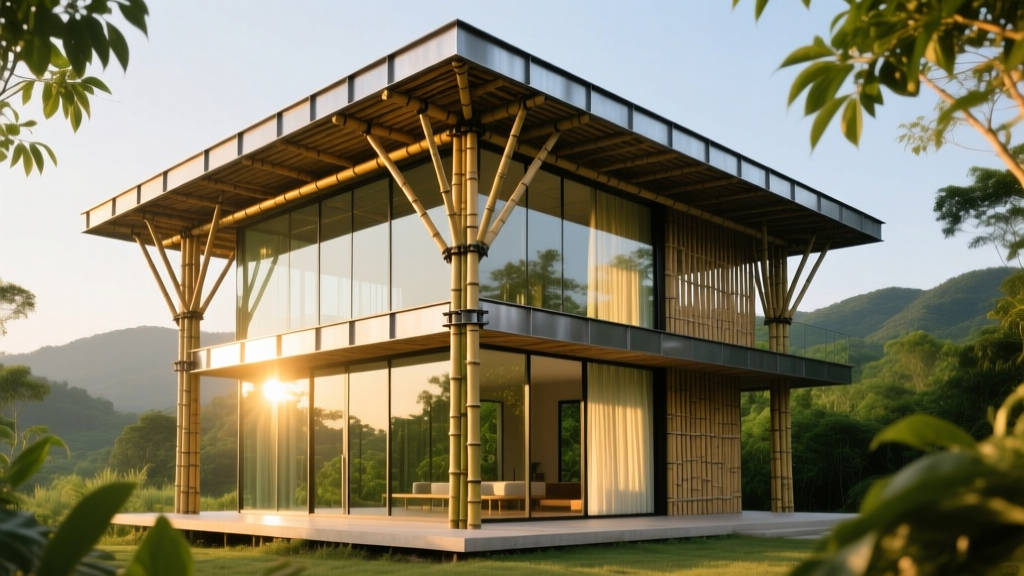
For architects and engineers, the path to successful bamboo construction lies in respecting the material's biological limits. By specifying mature culms, mandating boron-based preservation, and utilizing node-reinforced joinery, building bamboo structures transitions from an experimental novelty to a highly durable, carbon-sequestering structural reality.
Written by
James ThorntonJames Thornton is a construction industry veteran with 25 years of hands-on experience in wood framing, lumber grading, and residential building codes. He started as a framing carpenter in rural Oregon, earned his ICC Residential Building Inspector certification, and eventually became a senior plan reviewer for the City of Portland Bureau of Development Services. James holds a B.S. in Wood Science & Technology from Oregon State University and is a certified lumber grader through the West Coast Lumber Inspection Bureau (WCLIB). He has inspected over 3,000 residential construction sites and authored the city's internal guide on advanced framing techniques (2x6 at 24" O.C.). James lives in Bend, OR, where he builds custom timber-frame cabins and competes in lumberjack sports.
More from James Thornton
View all
Insulation
Best Home Insulation Materials: Complete 2026 Guide
Compare top home insulation materials for 2026. Find R-values, installed costs per square foot, and best uses for fiberglass, spray foam, and mineral wool.
Aug 4, 2026

Sustainable Building
Certify Your Green Building Material for LEED and WELL
Step-by-step guide to certifying a green building material for LEED v5 and WELL v2. Master EPDs, HPDs, and VOC limits for 2026 project specifications.
Aug 4, 2026

Stone & Masonry
Veneer Stacked Stone Panels: Interior Design & Style Showcase
Discover how veneer stacked stone panels transform interiors. Explore modern design profiles, material pairings, and technical installation specs.
Aug 4, 2026