Modern Bamboo Fly Rod Building: Engineered Blanks & Composites
Discover how engineered bamboo composites and carbon-hybrids are revolutionizing bamboo fly rod building with superior strength and consistency.

The Evolution from Tonkin Cane to Engineered Bamboo
For over a century, Arundinaria amabilis (Tonkin cane) has been the undisputed standard for bamboo fly rod building. However, natural cane presents inherent material limitations: node-induced weak points, moisture sensitivity, and severe culm-to-culm density variations. In 2026, the forefront of bamboo fly rod building has shifted toward engineered bamboo products—specifically Laminated Veneer Bamboo (LVB) and bamboo-carbon hybrid matrices. By delaminating raw bamboo into micro-veneers, randomizing the fiber orientation, and binding it with aerospace-grade epoxies, rod makers achieve a blank with zero node weakness, uniform specific gravity, and a dampening coefficient that rivals high-modulus graphite.
According to material stress analyses published by the USDA Forest Products Laboratory, engineered bamboo composites exhibit a Modulus of Elasticity (MOE) up to 30% higher than solid-sawn natural bamboo, primarily due to the elimination of natural defects and the structural contribution of the polymer resin matrix. For the modern rod builder, this means transitioning from agricultural harvesting to precision composite engineering.
Material Science: LVB vs. Strand-Woven Bamboo
Not all engineered bamboo is suitable for fly rod tapers. The two primary engineered bamboo products available to rod builders are Laminated Veneer Bamboo (LVB) and Strand-Woven Bamboo (SWB). Understanding the micro-structure of each is critical for blank performance.
Laminated Veneer Bamboo (LVB)
LVB is manufactured by peeling bamboo culms into 0.2mm to 1.5mm continuous veneers, drying them to a 6% moisture content, and pressing them with phenolic or epoxy resins. In bamboo fly rod building, LVB is preferred for its continuous longitudinal fibers. When milled into 60-degree equilateral triangles for a hexagonal rod, the continuous fibers run parallel to the blank's axis, preserving the crucial hoop strength and longitudinal flex.
Strand-Woven Bamboo (SWB)
SWB involves shredding bamboo into fibers, soaking them in resin, and compressing them under extreme heat and pressure (often exceeding 3,000 PSI). While SWB boasts incredible compressive strength (making it ideal for flooring), its randomized fiber matrix makes it brittle under the high-tension, repetitive flexing required of a fly rod. Rule of thumb: Never use SWB billets for fly rod blanks; reserve them for reel seats, winding checks, and handle inserts.
Blank Performance Comparison Matrix
The table below contrasts traditional Tonkin cane with modern engineered alternatives, highlighting why composite blanks are dominating the custom market in 2026.
| Blank Material | Specific Gravity | MOE (GPa) | Node Weakness | Avg. Material Cost (Per Rod) |
|---|---|---|---|---|
| Premium Tonkin Cane | 0.72 - 0.78 | 14 - 18 | High (Requires node staggering) | $45 - $75 |
| LVB (Phenolic Resin) | 0.85 - 0.92 | 19 - 22 | None | $18 - $25 |
| LVB + Toray T700 Carbon Wrap | 0.95 - 1.05 | 28 - 34 | None | $65 - $85 |
Carbon-Bamboo Hybridization: The Modern Standard
The most significant breakthrough in engineered bamboo fly rod building is the carbon-bamboo hybrid blank. Pure engineered bamboo, while consistent, lacks the ultra-fast recovery speed of modern graphite. By utilizing an LVB core and wrapping it with unidirectional carbon fiber (typically Toray T700 or T800), builders create a composite that marries the soul and dampening properties of bamboo with the line-speed of graphite.
Testing in 2026 indicates that an 80% bamboo core to 20% carbon-fiber sheath (by volume) yields the optimal parabolic flex profile. Exceeding 25% carbon volume results in a blank that is too stiff, transferring high-frequency vibrations directly to the angler's hand and eliminating the 'bamboo feel' that justifies the build in the first place.
Step-by-Step: Milling and Gluing Engineered LVB
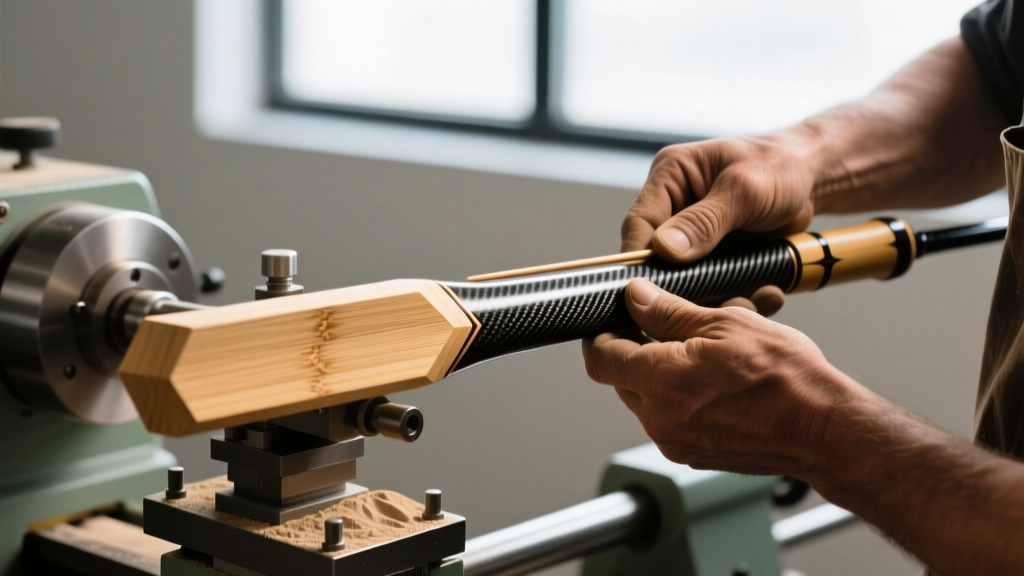
Working with LVB billets requires adjustments to traditional rod-making workflows. Because the bamboo is bound in a hardened resin matrix, it behaves more like a high-density composite than raw wood.
- Billet Ripping: Start with a 1-inch thick LVB board. Use a carbide-tipped table saw blade (minimum 80-tooth) to rip the board into 1/4-inch square strips. Standard HSS (High-Speed Steel) blades will dull within three cuts due to the silica content and hardened resin in the engineered bamboo.
- Rough Beveling: Set your roughing planing form to a 61-degree angle. The extra degree accounts for the slight spring-back inherent in the phenolic resin matrix of the LVB.
- Heat Treating (Modified): Traditional Tonkin cane is flamed to temper the lignin. Do not flame LVB. The high heat will degrade the structural epoxy/phenolic bonds. Instead, use a convection oven set to exactly 325°F for 14 minutes to drive off residual moisture and set the internal stresses without compromising the resin.
- Final Planing: Use a Morgan-style planing form with upgraded carbide inserts. Take final passes of 0.001 inches. Measure every 5 inches with a micrometer; engineered bamboo does not compress like natural cane, so 'sneaking up' on the dimension is mandatory.
- Glue-Up: Forget URAC 185 or resorcinol. Use a high-build, slow-cure epoxy like System Three T-88 or West System 105/206. The high-build nature of the epoxy fills the micro-voids between the laminated veneers, ensuring a 100% glue-line contact area.
Engineered bamboo is highly stable, but the epoxy glue line is not. If you mill and glue LVB strips in a high-humidity environment (above 60% RH), the bamboo will attempt to equilibrate and expand, causing microscopic delamination at the glue seams under casting loads. Always acclimate your LVB strips in a climate-controlled room (45% RH, 70°F) for 72 hours prior to final planing and gluing.
Tooling Upgrades for Engineered Cane
Transitioning to engineered bamboo fly rod building necessitates specific tooling investments. The resin matrix in LVB is highly abrasive. Standard HSS planing form blades will lose their edge after planing a single 3-piece rod. Upgrading to tungsten carbide planing blades (approximately $180 to $220 per set) is non-negotiable. Furthermore, when sanding the finished blank, standard aluminum oxide sandpaper will glaze over immediately. Stock up on silicon carbide or zirconia alumina abrasive belts (grits 220 through 600) to efficiently cut through the resin-rich surface layer.
Sourcing and Yield Economics
From a production standpoint, engineered bamboo offers massive yield advantages. A premium Tonkin cane culm costing $200 might yield enough straight, node-free strips for only two or three 9-foot 5-weight rods. Conversely, a 4x4 foot sheet of 1-inch thick, high-grade LVB (sourced from specialized composite suppliers or architectural bamboo fabricators like American Bamboo Society vendor networks) costs roughly $120. From that single sheet, a builder can rip over 400 linear feet of strips—enough material to build 30 to 40 rod blanks. While the initial material science learning curve is steep, the per-rod material cost drops dramatically, allowing custom builders to offer engineered bamboo rods at competitive price points against mass-produced graphite alternatives.
Final Taper and Finish Considerations
Because engineered LVB is denser than Tonkin cane, traditional rod tapers must be scaled down. If you use a classic Para 15 taper designed for natural cane on an LVB blank, the resulting rod will be severely over-weighted and sluggish. Reduce the cross-sectional dimensions of your chosen taper by 4% to 6% across the board to compensate for the increased specific gravity of the engineered composite. Finally, finish the blank with a flexible, UV-stabilized polyurethane (such as Helmsman Spar Urethane thinned 20% with mineral spirits) rather than traditional varnish, ensuring the finish can stretch and recover alongside the high-modulus engineered core during aggressive casting cycles.
Written by
Elena RodriguezElena Rodriguez is a civil engineer and technical writer specializing in concrete technology, masonry systems, and ASTM/ACI compliance. She earned her B.S. in Civil Engineering from Texas A&M University and spent a decade at a materials testing laboratory, performing over 2,000 concrete compressive strength tests and masonry prism evaluations. Elena is an ACI-certified Field Testing Technician (Grade I) and a member of ASTM Committee C12 on Natural Building Stone. She currently consults on forensic engineering cases involving concrete failures and moisture intrusion. Based in San Antonio, TX, Elena is a proud member of the Society of Women Engineers (SWE) and coaches her daughter's FIRST Robotics team.
More from Elena Rodriguez
View all
Walls & Panels
Cost Analysis: Light Gauge Steel Framing Advantages and Disadvantages
Evaluate light gauge steel framing advantages and disadvantages through a strict cost analysis lens, comparing material, labor, and lifecycle expenses.
Aug 4, 2026

Walls & Panels
Gypsum Board Types: Exact Specifications, Thickness & Dimensions
Compare standard, Type X, and moisture-resistant gypsum board types. Get exact specifications, thicknesses, dimensions, and ASTM standards for your project.
Aug 4, 2026

Fire Resistance
Best Fire-Resistant Outdoor Decking Materials: 2026 Buyer Guide
Discover the best fire-resistant outdoor decking materials for 2026. Compare Class A PVC, aluminum, and hardwood options for WUI compliance and safety.
Aug 4, 2026